Calyptridium arizonicum
Arizona pussypaws
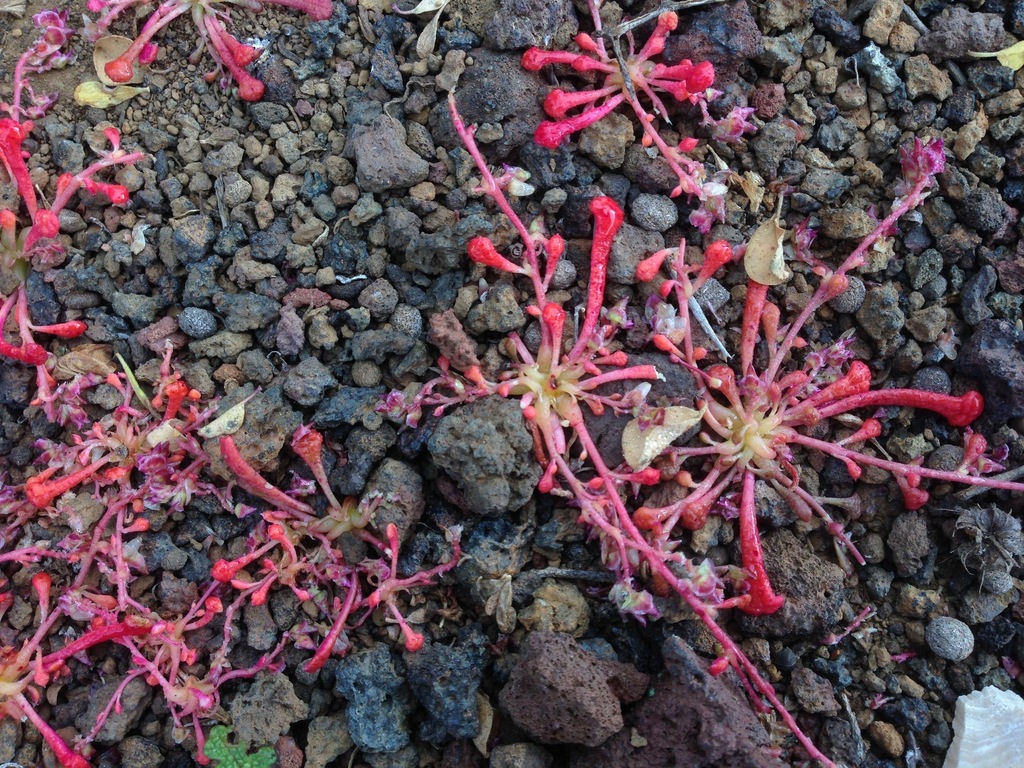
(c) Adam J. Searcy, some rights reserved (CC BY) · licence
Family: Montiaceae · Type: Annual · Native
Conservation status: CNPS 2B.1
Calyptridium arizonicum (Arizona pussypaws) is a native California annual in the Montiaceae family.
Arizona pussypaws is a rare (CNPS 2B.1) California native annual found in western Desert Southwest region in the northern Pinyon Mountain area of Anza-Borrego Desert State Park in coarse, well-drained desert scrub at elevations of 600 to 800 meters. Flowering from March to April, this delicate plant produces small white to pink flowers in compact axillary clusters. Growing with a slender taproot and reaching just 2 to 11 centimeters tall, it forms a diminutive and unassuming desert herb. Its leaves are both basal and along the stem, typically 1 to 3 centimeters long, with basal leaves often withering by fruiting time. The fruit is 6 to 7 millimeters long and notably exserted from the widely reniform sepals with scarious margins.
Identification and appearance
Key characters: 1 sympatric species. Key differentiator is fruit size and sepal shape.
Habitat and range
Habitat: Coarse, well-drained soils in desert scrub, wash
Elevation: 600-800 m
Outside California: southern Arizona, northwestern Mexico
Bloom period
Calyptridium arizonicum blooms Mar-Apr.
Conservation status
CNPS 2B.1
How to tell it apart
vs Eriogonum: Calyptridium has separate petals; Eriogonum flowers are in papery involucres with 6 petal-like tepals.; vs Cistanthe: Calyptridium has 2-4 petals and 1-3 stamens; Cistanthe consistently has 5 petals and 5-10 stamens.; vs Chorizanthe: Calyptridium has distinct petals; Chorizanthe has tubular flowers with papery bracts and no true petals.; vs Camissoniopsis: Calyptridium has 2-4 petals with few stamens; Camissoniopsis has 4 petals with 8 stamens.; vs Claytonia: Calyptridium has only 2-4 petals and dense ground-hugging clusters; Claytonia has 5 petals on upright stems.
Frequently asked questions
Is Calyptridium arizonicum native to California?
Yes. Calyptridium arizonicum is native to California (recorded as native).
When does Calyptridium arizonicum bloom?
Calyptridium arizonicum blooms Mar-Apr.
What plant family does Calyptridium arizonicum belong to?
Calyptridium arizonicum is in the Montiaceae family, genus Calyptridium.
Is Calyptridium arizonicum rare or endangered?
Calyptridium arizonicum carries California Rare Plant Rank 2B.1, state rank S1.
What habitat does Calyptridium arizonicum grow in?
Calyptridium arizonicum grows in Coarse, well-drained soils in desert scrub, wash.
Related species
Other California species in the same genus, family, or bioregion.
Sources: Jepson eFlora · CalPhotos · CDFW CNDDB
Last updated 2026-09-30
Data from The California Species Project — 14,000+ California species with verified data from CNPS, CDFW, USFWS, Cal-IPC, and more.