Calyptridium parryi var. hesseae
Santa cruz mountains pussypaws, Santa Cruz Mountains Pussypaws
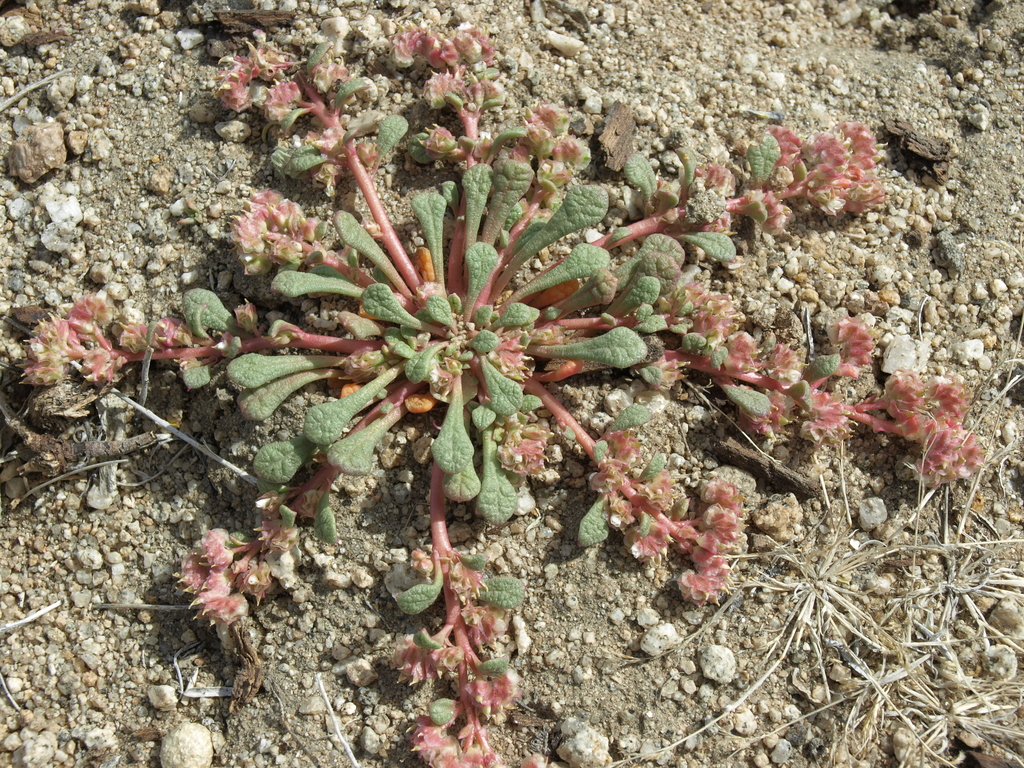
(c) Jim Morefield, some rights reserved (CC BY) · licence
Family: Montiaceae · Type: Herb · Native
Conservation status: CNPS 1B.1
Calyptridium parryi var. hesseae (Santa cruz mountains pussypaws) is a native California herb in the Montiaceae family, recognized by . Variety-level differences in fruit persistence and seed texture.
Santa cruz mountains pussypaws is a rare (CNPS 1B.1) California native annual found in southwestern San Francisco Bay and northern South Coast Ranges in sandy soils of chaparral, oak woodland, and conifer forest at elevations of 600 to 1,050 meters. Flowering from April to July, this delicate plant produces small white to pink flowers with ovate sepals that have narrow scarious margins. Growing with slender, low-spreading stems to approximately 15 centimeters tall, it forms compact clusters close to the ground. Its leaves are small, spatulate to oblanceolate, forming a basal rosette with soft, pale green coloration. The tiny seeds, less than one millimeter long, are decorated with marginal papillae and readily detach from the plant.
Identification and appearance
Key characters: 3 sympatric species. Variety-level differences in fruit persistence and seed texture.
Habitat and range
Habitat: Sandy soils in chaparral, oak woodland, conifer forest
Elevation: 600-1050 m
California counties: Santa Cruz, Monterey, Fresno, Santa Clara, San Benito, San Luis Obispo
Bloom period
Calyptridium parryi var. hesseae blooms Apr-Jul.
Conservation status
CNPS 1B.1
How to tell it apart
vs Eriogonum: Calyptridium has separate petals; Eriogonum flowers are in papery involucres with 6 petal-like tepals.; vs Cistanthe: Calyptridium has 2-4 petals and 1-3 stamens; Cistanthe consistently has 5 petals and 5-10 stamens.; vs Chorizanthe: Calyptridium has distinct petals; Chorizanthe has tubular flowers with papery bracts and no true petals.; vs Camissoniopsis: Calyptridium has 2-4 petals with few stamens; Camissoniopsis has 4 petals with 8 stamens.; vs Claytonia: Calyptridium has only 2-4 petals and dense ground-hugging clusters; Claytonia has 5 petals on upright stems.
Frequently asked questions
Is Calyptridium parryi var. hesseae native to California?
Yes. Calyptridium parryi var. hesseae is native to California (recorded as native).
When does Calyptridium parryi var. hesseae bloom?
Calyptridium parryi var. hesseae blooms Apr-Jul.
Where in California does Calyptridium parryi var. hesseae grow?
Calyptridium parryi var. hesseae occurs in Santa Cruz, Monterey, Fresno, Santa Clara, San Benito, San Luis Obispo, at elevations of 600-1050 m.
What plant family does Calyptridium parryi var. hesseae belong to?
Calyptridium parryi var. hesseae is in the Montiaceae family, genus Calyptridium.
Is Calyptridium parryi var. hesseae rare or endangered?
Calyptridium parryi var. hesseae carries California Rare Plant Rank 1B.1, state rank S2.
Related species
Other California species in the same genus, family, or bioregion.
Sources: Jepson eFlora · CNPS Rare Plant Inventory · Index of California Plant Names · CalPhotos · CDFW CNDDB
Last updated 2026-10-07
Data from The California Species Project — 14,000+ California species with verified data from CNPS, CDFW, USFWS, Cal-IPC, and more.