Calyptridium parryi var. parryi
Parry's pussypaws
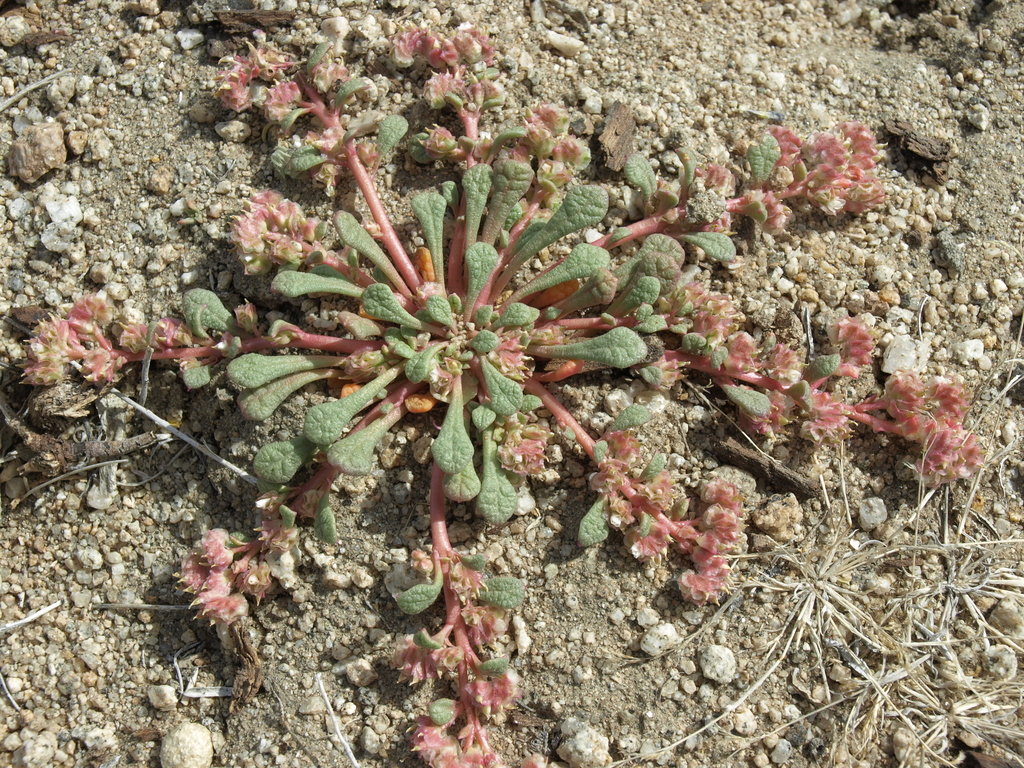
(c) Jim Morefield, some rights reserved (CC BY) · licence
Family: Montiaceae · Type: Herb · Native
Calyptridium parryi var. parryi (Parry's pussypaws) is a native California herb in the Montiaceae family, recognized by . Variety distinguished by fruit persistence and seed papillation pattern.
Parry's pussypaws is a California native annual found in southern Santa Lucia Mountains, Transverse Ranges, and San Jacinto Mountains in open, sandy areas of chaparral and conifer forest at elevations of 1,400 to 3,500 meters. Flowering from May to July, this delicate plant produces small white to pink flowers with distinctive ovate to kidney-shaped sepals that often have translucent margins. Growing with low-spreading stems typically less than 20 centimeters tall, it forms loose clusters of tiny blooms close to the ground. Its leaves are typically spatulate, forming dense basal rosettes that hug the sandy soil. Tiny seeds, less than one millimeter long, are covered in fine papillate texture that helps them cling to the surrounding environment.
Identification and appearance
Key characters: 5 sympatric species. Variety distinguished by fruit persistence and seed papillation pattern.
Habitat and range
Habitat: Open, sandy areas in chaparral, conifer forest
Elevation: 1400-3500 m
California counties: San Bernardino, Riverside, Los Angeles, San Benito, Santa Barbara, San Luis Obispo, Ventura, Kern, Fresno
Bloom period
Calyptridium parryi var. parryi blooms May-Jul.
How to tell it apart
vs Eriogonum: Calyptridium has separate petals; Eriogonum flowers are in papery involucres with 6 petal-like tepals.; vs Cistanthe: Calyptridium has 2-4 petals and 1-3 stamens; Cistanthe consistently has 5 petals and 5-10 stamens.; vs Chorizanthe: Calyptridium has distinct petals; Chorizanthe has tubular flowers with papery bracts and no true petals.; vs Camissoniopsis: Calyptridium has 2-4 petals with few stamens; Camissoniopsis has 4 petals with 8 stamens.; vs Claytonia: Calyptridium has only 2-4 petals and dense ground-hugging clusters; Claytonia has 5 petals on upright stems.
Frequently asked questions
Is Calyptridium parryi var. parryi native to California?
Yes. Calyptridium parryi var. parryi is native to California (recorded as native).
When does Calyptridium parryi var. parryi bloom?
Calyptridium parryi var. parryi blooms May-Jul.
Where in California does Calyptridium parryi var. parryi grow?
Calyptridium parryi var. parryi occurs in San Bernardino, Riverside, Los Angeles, San Benito, Santa Barbara, San Luis Obispo, Ventura, Kern and other counties, at elevations of 1400-3500 m.
What plant family does Calyptridium parryi var. parryi belong to?
Calyptridium parryi var. parryi is in the Montiaceae family, genus Calyptridium.
What habitat does Calyptridium parryi var. parryi grow in?
Calyptridium parryi var. parryi grows in Open, sandy areas in chaparral, conifer forest.
Related species
Other California species in the same genus, family, or bioregion.
Sources: Jepson eFlora · Index of California Plant Names · CalPhotos
Last updated 2026-10-07
Data from The California Species Project — 14,000+ California species with verified data from CNPS, CDFW, USFWS, Cal-IPC, and more.