Calystegia atriplicifolia subsp. buttensis
Butte county morning-glory, Butte County Morning-Glory
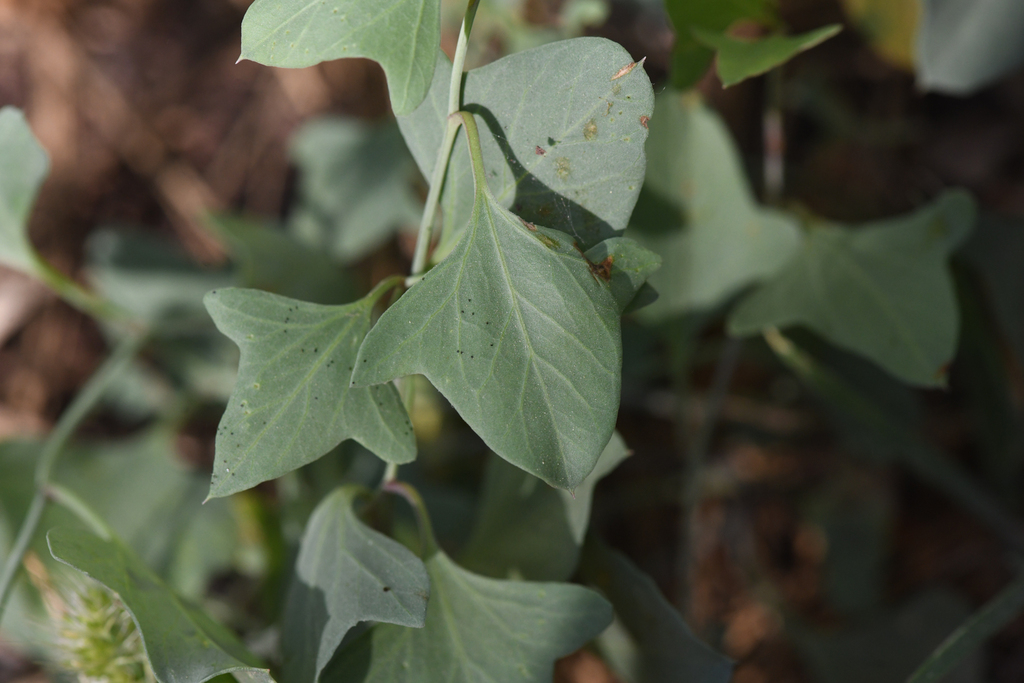
(c) Trevor Van Loon, some rights reserved (CC BY) · licence
Family: Convolvulaceae · Type: Herb · Native
Conservation status: CNPS 4.2
Calystegia atriplicifolia subsp. buttensis (Butte county morning-glory) is a native California herb in the Convolvulaceae family, recognized by non-climbing habit, small leaves, and partially concealing bracts.
Butte county morning-glory is a native perennial herb ranked 4.2 by CNPS, found in the Klamath Ranges, California Ranges, and San Francisco Bay Area in dry, rocky places within open forest and chaparral at elevations of 600 to 1,200 meters. Flowering from May to July, this plant produces white (occasionally pink-tinged) flowers 30 to 45 millimeters long with distinctive trumpet-like form. Growing with decumbent to nearly erect stems 10 to 50 centimeters tall, it emerges from an underground rhizome and spreads with a generally glabrous appearance. Its leaves have triangular to kidney-shaped blades 2 to 4 centimeters long, with soft lobes that are broadly rounded and often without clear boundaries. The plant's peduncles are typically shorter than 5 centimeters and emerge beneath the leaves, with small cordate-elliptic bracts that partially expose the flower's green sepals.
Identification and appearance
Key characters: 16 sympatric species; key features are non-climbing habit, small leaves, and partially concealing bracts
Habitat and range
Habitat: Dry, rocky places in open forest, chaparral
Elevation: 600-1200 m
Bloom period
Calystegia atriplicifolia subsp. buttensis blooms May-Jul.
Conservation status
CNPS 4.2
How to tell it apart
vs Convolvulus: Convolvulus has smaller flowers with sharply pointed stigma lobes; Calystegia stigma lobes are blunt.; vs Ipomoea: Ipomoea stigma is a single rounded knob; Calystegia stigma has two distinct flattened lobes.; vs Datura: Datura flowers are upright with pleated edges; Calystegia flowers are smooth funnels.; vs Abronia: Abronia has clusters of small tubular flowers; Calystegia has single large funnel flowers.; vs Oenothera: Oenothera has four separate petals; Calystegia petals are fused into continuous funnel.
Frequently asked questions
Is Calystegia atriplicifolia subsp. buttensis native to California?
Yes. Calystegia atriplicifolia subsp. buttensis is native to California (recorded as native).
When does Calystegia atriplicifolia subsp. buttensis bloom?
Calystegia atriplicifolia subsp. buttensis blooms May-Jul.
What plant family does Calystegia atriplicifolia subsp. buttensis belong to?
Calystegia atriplicifolia subsp. buttensis is in the Convolvulaceae family, genus Calystegia.
Is Calystegia atriplicifolia subsp. buttensis rare or endangered?
Calystegia atriplicifolia subsp. buttensis carries California Rare Plant Rank 4.2, state rank S3.
What habitat does Calystegia atriplicifolia subsp. buttensis grow in?
Calystegia atriplicifolia subsp. buttensis grows in Dry, rocky places in open forest, chaparral.
Related species
Other California species in the same genus, family, or bioregion.
- Calystegia collina — Coast range false bindweed
- Calystegia collina subsp. collina
- Calystegia collina subsp. oxyphylla — Mount saint helena morning-glory
- Calystegia collina subsp. tridactylosa — Three-fingered morning-glory
- Calystegia collina subsp. venusta — South coast range morning-glory
- Calystegia felix — lucky morning- glory
Sources: Jepson eFlora · CalPhotos · CDFW CNDDB
Last updated 2026-10-07
Data from The California Species Project — 14,000+ California species with verified data from CNPS, CDFW, USFWS, Cal-IPC, and more.