Calystegia occidentalis subsp. occidentalis
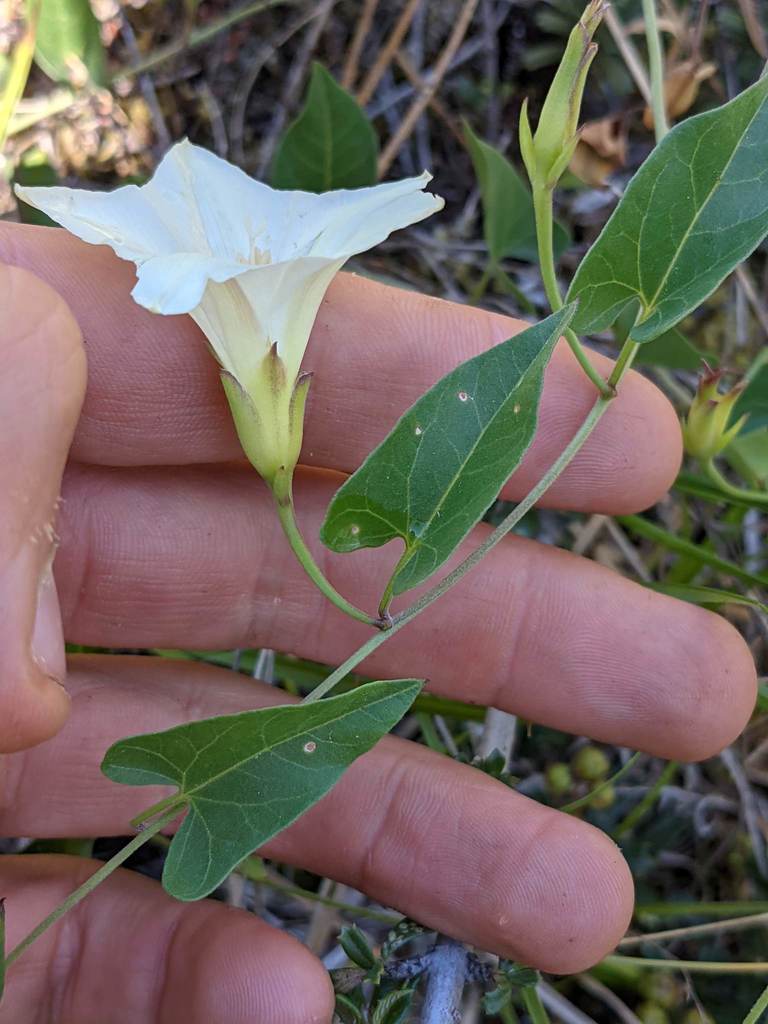
Photo: parent species Calystegia occidentalis · (c) Trevor Van Loon, some rights reserved (CC BY) · licence
Family: Convolvulaceae · Type: Vine · Native
Calystegia occidentalis subsp. occidentalis is a native California vine in the Convolvulaceae family, recognized by climbing habit and multi-flowered inflorescences distinguish it.
Western morning-glory is a California native perennial found in the Klamath Ranges, northern Coast Ranges, high Cascade Range, Sierra Nevada, San Francisco Bay Area, and North Coast Ranges in dry slopes, chaparral, and pine woodland at elevations below 1,200 meters. Flowering from May to July, this plant produces white to pale pink flowers with distinctive showy trumpet-like shapes. Growing with stems that can reach over 1 meter long, it develops decumbent to strongly climbing stems that wind through surrounding vegetation. Its leaves have somewhat indistinct lobes with generally two-tipped edges, creating a soft, irregular leaf structure. The plant's delicate bracts near the flower are narrow and linear-oblong, measuring 4 to 18 millimeters long.
Identification and appearance
Key characters: 11 sympatric species; climbing habit and multi-flowered inflorescences distinguish it
Habitat and range
Habitat: dry slopes, chaparral, pine woodland
Elevation: < 1200 m
California counties: Trinity, Amador, Humboldt, Butte, Nevada, Siskiyou, Del Norte, Orange, Lake, Modoc, Kern, Plumas, Lassen, Shasta, Sierra, Tehama, San Diego, Fresno, El Dorado, Placer, Calaveras, Sonoma, Yolo, Alameda, Marin, Mendocino, Solano, Sacramento, Yuba, Tulare, Glenn, Sutter, Tuolumne, San Mateo, Colusa, Mariposa, Napa
Outside California: Oregon
Bloom period
Calystegia occidentalis subsp. occidentalis blooms May-Jul.
How to tell it apart
vs Convolvulus: Convolvulus has smaller flowers with sharply pointed stigma lobes; Calystegia stigma lobes are blunt.; vs Ipomoea: Ipomoea stigma is a single rounded knob; Calystegia stigma has two distinct flattened lobes.; vs Datura: Datura flowers are upright with pleated edges; Calystegia flowers are smooth funnels.; vs Abronia: Abronia has clusters of small tubular flowers; Calystegia has single large funnel flowers.; vs Oenothera: Oenothera has four separate petals; Calystegia petals are fused into continuous funnel.
Frequently asked questions
Is Calystegia occidentalis subsp. occidentalis native to California?
Yes. Calystegia occidentalis subsp. occidentalis is native to California (recorded as native).
When does Calystegia occidentalis subsp. occidentalis bloom?
Calystegia occidentalis subsp. occidentalis blooms May-Jul.
Where in California does Calystegia occidentalis subsp. occidentalis grow?
Calystegia occidentalis subsp. occidentalis occurs in Trinity, Amador, Humboldt, Butte, Nevada, Siskiyou, Del Norte, Orange and other counties, at elevations of < 1200 m.
What plant family does Calystegia occidentalis subsp. occidentalis belong to?
Calystegia occidentalis subsp. occidentalis is in the Convolvulaceae family, genus Calystegia.
What habitat does Calystegia occidentalis subsp. occidentalis grow in?
Calystegia occidentalis subsp. occidentalis grows in dry slopes, chaparral, pine woodland.
Related species
Other California species in the same genus, family, or bioregion.
Sources: Jepson eFlora · Index of California Plant Names · CalPhotos
Last updated 2026-10-07
Data from The California Species Project — 14,000+ California species with verified data from CNPS, CDFW, USFWS, Cal-IPC, and more.