Camissonia contorta
Contorted sun cup
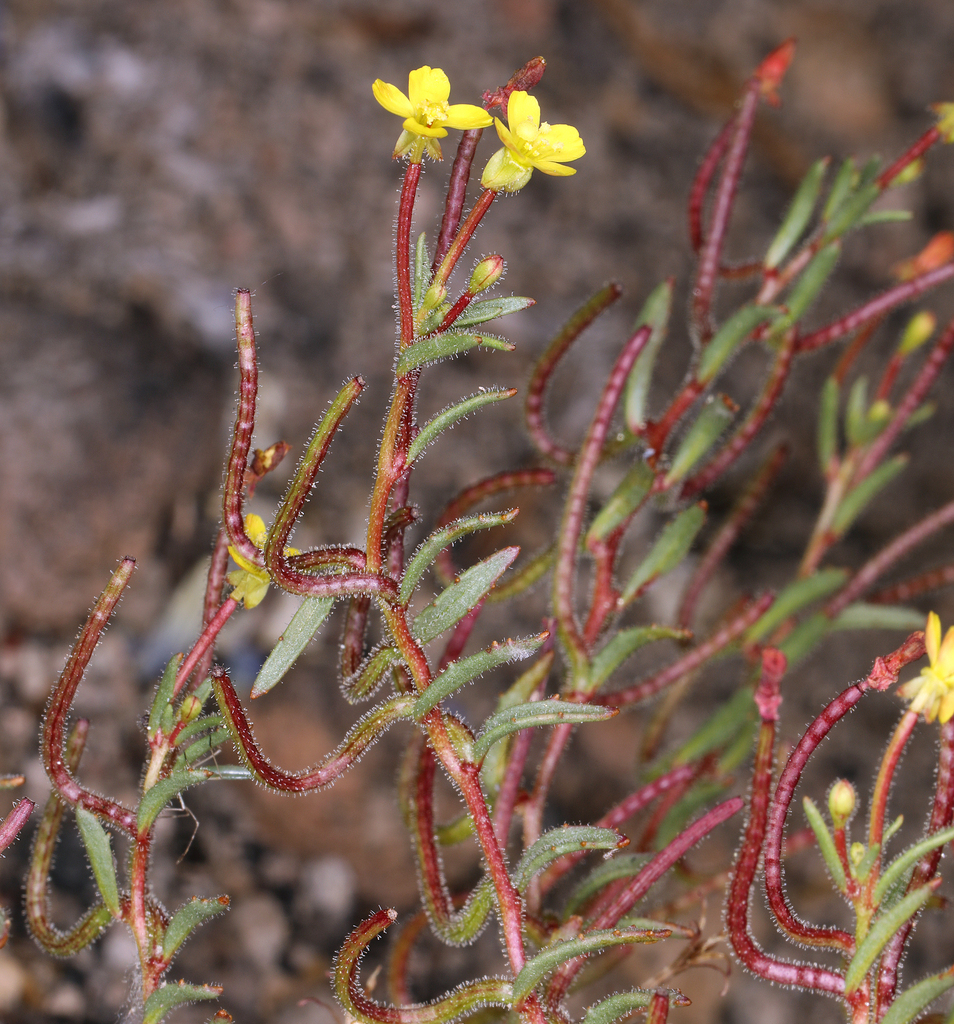
(c) Steve Matson, some rights reserved (CC BY), uploaded by Steve Matson · licence
Family: Onagraceae · Type: Herb · Native
Camissonia contorta (Contorted sun cup) is a native California herb in the Onagraceae family, recognized by blue-green leaves and often spotless flowers.
Contorted sun cup is a California native annual found in the northwestern California, Cascade Range, Sierra Nevada Foothills, Central Valley, central western California, and Modoc Plateau regions in sandy soils, grasslands, chaparral, and pinyon/juniper woodlands at elevations below 2,300 meters. Flowering from May to June, this plant produces yellow flowers that fade to reddish, with delicate petals 3 to 5 millimeters long and subtle basal spots. Growing with slender, wiry stems 3 to 30 centimeters tall that tend to peel and spread with transparent rod-shaped hairs, it has a delicate and flexible structure. Its leaves are blue-green, linear to narrowly elliptic, 10 to 35 millimeters long with minute serrations along the edges. The fruit is a distinctive elongated capsule 25 to 35 millimeters long, sometimes straight and sometimes wavy, subtly swollen with seeds.
Identification and appearance
Key characters: 12 sympatric species; blue-green leaves and often spotless flowers
Habitat and range
Habitat: Sandy soil, slopes, flats, often disturbed, grassland, chaparral, pinyon/juniper woodland
Elevation: < 2300 m
California counties: San Francisco, Tuolumne, Merced, Mariposa, Lake, Kern, Contra Costa, Fresno, Siskiyou, Santa Cruz, San Joaquin, Butte, Modoc, San Benito, Monterey, Lassen, Humboldt, Stanislaus, Santa Clara, Madera, Ventura, San Luis Obispo, Tulare, Plumas, Shasta, Tehama, Mono, El Dorado, Santa Barbara, Sutter, Colusa, Inyo, Riverside, Napa, Alameda, Mendocino, Calaveras, Trinity, Sacramento, Los Angeles, San Diego, Glenn, Sierra, Yolo
Outside California: to Washington, Idaho, western Nevada
Bloom period
Camissonia contorta blooms May-Jun.
How to tell it apart
vs Camissoniopsis: Camissonia flowers from top with round fruits; Camissoniopsis flowers from base with four-angled fruits.; vs Eulobus: Camissonia has plain yellow petals; Eulobus has elegant wands with red flecks at petal bases.; vs Chylismia: Camissonia has narrow leaves up the stem; Chylismia has dandelion-like basal leaves.; vs Taraxia: Camissonia flowers from upper stem; Taraxia flowers open from ground level at night.; vs Eschscholzia: Camissonia has four petals and cylindrical fruits; Eschscholzia has dissected leaves and poppy-like flowers.
Frequently asked questions
Is Camissonia contorta native to California?
Yes. Camissonia contorta is native to California (recorded as native).
When does Camissonia contorta bloom?
Camissonia contorta blooms May-Jun.
Where in California does Camissonia contorta grow?
Camissonia contorta occurs in San Francisco, Tuolumne, Merced, Mariposa, Lake, Kern, Contra Costa, Fresno and other counties, at elevations of < 2300 m.
What plant family does Camissonia contorta belong to?
Camissonia contorta is in the Onagraceae family, genus Camissonia.
What habitat does Camissonia contorta grow in?
Camissonia contorta grows in Sandy soil, slopes, flats, often disturbed, grassland, chaparral, pinyon/juniper woodland.
Related species
Other California species in the same genus, family, or bioregion.
Sources: Jepson eFlora · Index of California Plant Names · CalPhotos
Last updated 2026-10-08
Data from The California Species Project — 14,000+ California species with verified data from CNPS, CDFW, USFWS, Cal-IPC, and more.