Camissoniopsis cheiranthifolia subsp. cheiranthifolia
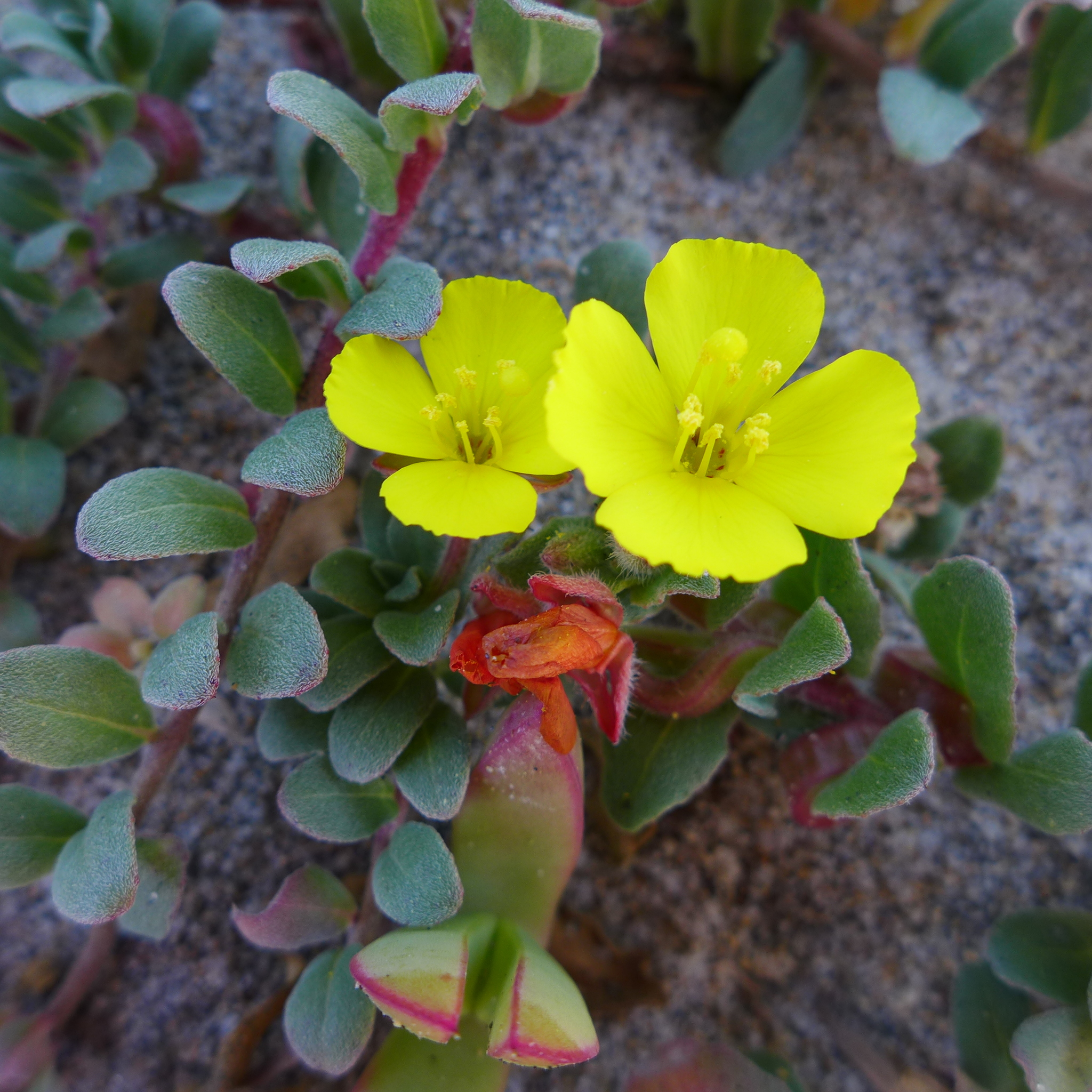
iNaturalist user: icosahedron (via Wikimedia Commons) · CC BY
Family: Onagraceae · Type: Perennial · Native
Camissoniopsis cheiranthifolia subsp. cheiranthifolia is a native California perennial in the Onagraceae family, recognized by subsp. suffruticosa by herbaceous habit and smaller flowers.
beach evening primrose is a California native perennial found in northern coastal, central coastal, and Channel Islands bioregions on sandy slopes, flats, and coastal dunes at elevations below 100 meters. Flowering from April to August, this plant produces yellow flowers with petals 6 to 11 millimeters long. Growing with sparse to rarely dense silvery hairs, the plant forms low-spreading stems with a delicate structure. Its leaves are somewhat narrow and lance-shaped, arranged alternately along the stems. The flower's hypanthium measures 2.1 to 4.2 millimeters long, with small anthers approximately 1 to 1.5 millimeters in length.
Identification and appearance
Key characters: 9 sympatric species; distinguished from subsp. suffruticosa by herbaceous habit and smaller flowers
Habitat and range
Habitat: Sandy slopes, flats, coastal dunes
Elevation: < 100 m
California counties: San Luis Obispo, Alameda, Del Norte, Sacramento, Humboldt, Los Angeles, Marin, Monterey, Mendocino, San Mateo, Santa Barbara, Santa Cruz, Sonoma, Ventura, San Francisco, Orange, San Diego, Solano
Outside California: southwestern Oregon
Bloom period
Camissoniopsis cheiranthifolia subsp. cheiranthifolia blooms Apr-Aug.
How to tell it apart
vs Camissonia: Camissoniopsis flowers from base with four-angled fruits; Camissonia flowers from top with round fruits.; vs Oenothera: Camissoniopsis has four-angled fruits; Oenothera has round fruits and a distinctive 4-lobed cross-shaped stigma.; vs Taraxia: Camissoniopsis has four-angled fruits and flowers from base; Taraxia has round fruits.; vs Tetrapteron: Camissoniopsis has four-angled fruits; Tetrapteron has four-winged fruits.; vs Eulobus: Camissoniopsis has four-angled fruits; Eulobus has wand-like stems with red-flecked petals.
Frequently asked questions
Is Camissoniopsis cheiranthifolia subsp. cheiranthifolia native to California?
Yes. Camissoniopsis cheiranthifolia subsp. cheiranthifolia is native to California (recorded as native).
When does Camissoniopsis cheiranthifolia subsp. cheiranthifolia bloom?
Camissoniopsis cheiranthifolia subsp. cheiranthifolia blooms Apr-Aug.
Where in California does Camissoniopsis cheiranthifolia subsp. cheiranthifolia grow?
Camissoniopsis cheiranthifolia subsp. cheiranthifolia occurs in San Luis Obispo, Alameda, Del Norte, Sacramento, Humboldt, Los Angeles, Marin, Monterey and other counties, at elevations of < 100 m.
What plant family does Camissoniopsis cheiranthifolia subsp. cheiranthifolia belong to?
Camissoniopsis cheiranthifolia subsp. cheiranthifolia is in the Onagraceae family, genus Camissoniopsis.
What habitat does Camissoniopsis cheiranthifolia subsp. cheiranthifolia grow in?
Camissoniopsis cheiranthifolia subsp. cheiranthifolia grows in Sandy slopes, flats, coastal dunes.
Related species
Other California species in the same genus, family, or bioregion.
- Camissoniopsis cheiranthifolia subsp. suffruticosa
- Camissoniopsis confusa — San bernardino sun cup
- Camissoniopsis guadalupensis subsp. clementina — San clemente island evening-primrose
- Camissoniopsis hardhamiae — Hardham's evening-primrose
- Camissoniopsis hirtella — Hairy sun cup
- Camissoniopsis ignota — Jurupa hills sun cup
Sources: Jepson eFlora · Index of California Plant Names · CalPhotos
Last updated 2026-10-07
Data from The California Species Project — 14,000+ California species with verified data from CNPS, CDFW, USFWS, Cal-IPC, and more.