Campsis radicans
Trumpet creeper
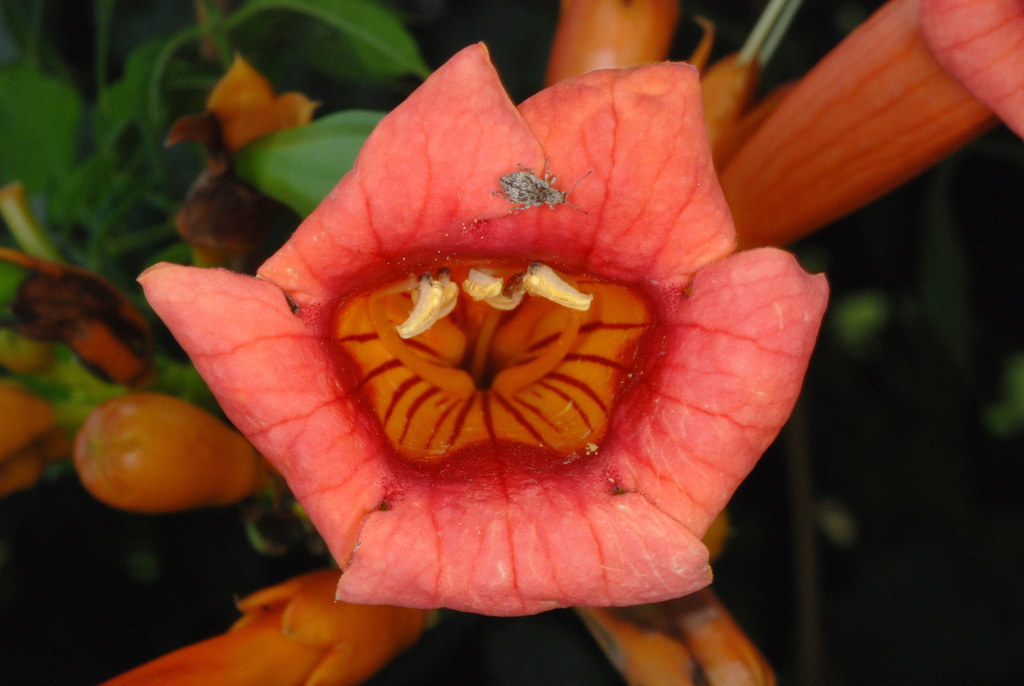
(c) Douglas Goldman, some rights reserved (CC BY-SA), uploaded by Douglas Goldman · licence
Family: Bignoniaceae · Type: Vine · Not Native
Campsis radicans (Trumpet creeper) is a non-native California vine in the Bignoniaceae family, recognized by Eastern North American genus occasionally naturalizing in California.
Trumpet creeper is a naturalized shrub escaping throughout the California Floristic Province, commonly found along roadsides, fencerows, and in abandoned fields and floodplain forests at elevations below 1,000 meters. Flowering from May to August, this plant produces fragrant, trumpet-shaped red-orange flowers 5 to 8 centimeters long in flat-topped clusters. Growing up to 10 meters tall with climbing and spreading habit, it develops woody stems that can attach and sprawl across surfaces. Its compound leaves have elliptic or ovate blades 4 to 7 centimeters long, divided into multiple leaflets. The plant produces elongated oblanceolate seed pods 10 to 20 centimeters in length, containing linear seeds 20 to 30 millimeters long.
Identification and appearance
Key characters: Eastern North American genus occasionally naturalizing in California
Habitat and range
Habitat: Roadsides, fencerows, abandoned fields, floodplain forests
Elevation: < 1000 m
California counties: Sacramento, Glenn, Butte, Alameda, Contra Costa, Monterey, Sonoma, San Luis Obispo
Outside California: western, central, southeastern United States
Bloom period
Campsis radicans blooms May-Aug.
How to tell it apart
vs Catalpa: Campsis is a climbing vine with pinnately compound, toothed leaves; Catalpa is an upright tree with large, simple, heart-shaped leaves.; vs Chilopsis: Campsis leaves are once-pinnate with several leaflets; Chilopsis (desert willow) has simple, narrow, willow-like leaves.; vs Jacaranda: Campsis leaves are once-pinnate and flowers are red-orange; Jacaranda leaves are twice-pinnate and fern-like, with blue-purple flowers.; vs Tecoma: Campsis climbs by clinging aerial rootlets and has red-orange trumpets; Tecoma (yellow bells) is a free-standing shrub with yellow flowers.; vs Lonicera: Campsis has pinnately compound leaves and a long dry capsule; Lonicera (honeysuckle) has simple opposite leaves and fleshy berries.
Frequently asked questions
Is Campsis radicans native to California?
No. Campsis radicans is not native to California (recorded as not native).
When does Campsis radicans bloom?
Campsis radicans blooms May-Aug.
Where in California does Campsis radicans grow?
Campsis radicans occurs in Sacramento, Glenn, Butte, Alameda, Contra Costa, Monterey, Sonoma, San Luis Obispo, at elevations of < 1000 m.
What plant family does Campsis radicans belong to?
Campsis radicans is in the Bignoniaceae family, genus Campsis.
What habitat does Campsis radicans grow in?
Campsis radicans grows in Roadsides, fencerows, abandoned fields, floodplain forests.
Related species
Other California species in the same genus, family, or bioregion.
Sources: Jepson eFlora · Index of California Plant Names · CalPhotos
Last updated 2026-10-07
Data from The California Species Project — 14,000+ California species with verified data from CNPS, CDFW, USFWS, Cal-IPC, and more.