Capsella bursa-pastoris
Shepherd's purse
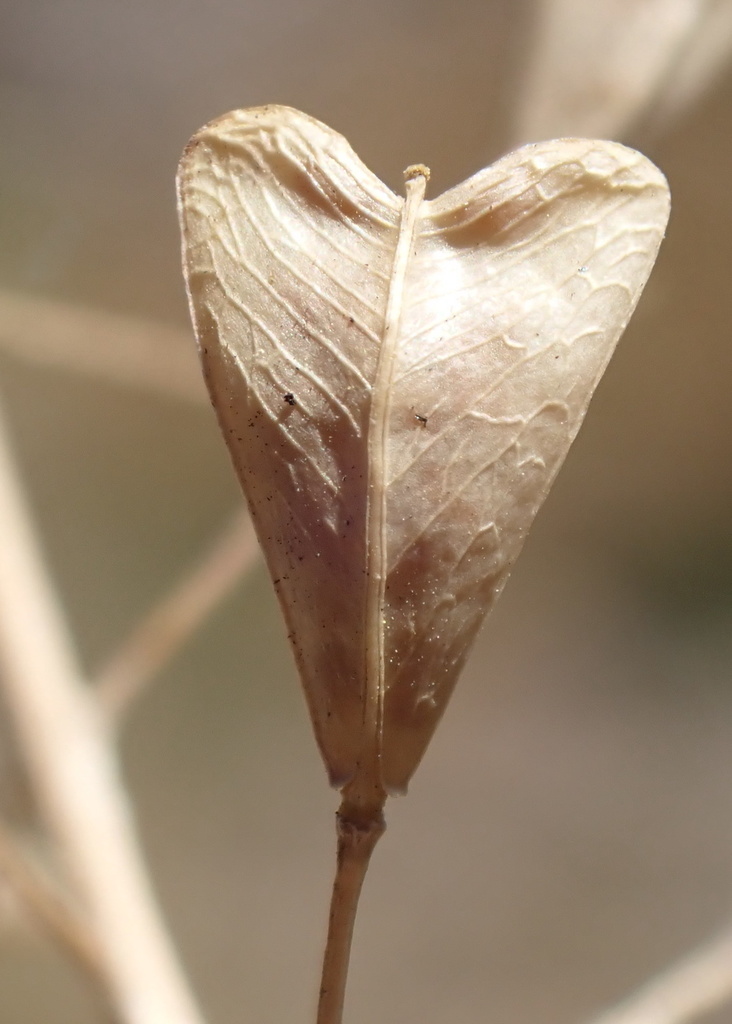
no rights reserved, uploaded by Mike Palmer · CC0
Family: Brassicaceae · Type: Herb · Not Native
Capsella bursa-pastoris (Shepherd's purse) is a non-native California herb in the Brassicaceae family, recognized by Cosmopolitan weedy genus with single widespread species in California.
Shepherd's purse is a naturalized annual found throughout California in disturbed areas at elevations below 2,800 meters. Flowering from January to October, this plant produces small white (occasionally pink) flowers with delicate obovate petals 2 to 4 millimeters long. Growing with erect stems 20 to 50 centimeters tall, it can be simple or branched toward the top and features distinctive stellate hairs with three to five rays. Its leaves are notably variable, with basal leaves 3 to 6 centimeters long that are oblanceolate and may be entire or pinnately lobed, while stem leaves are oblong to linear in shape. The plant produces small triangular fruits 4 to 9 millimeters long with a wedge-shaped base and slender spreading pedicels.
Identification and appearance
Key characters: Cosmopolitan weedy genus with single widespread species in California
Habitat and range
Habitat: Disturbed areas
Elevation: < 2800 m
California counties: Trinity, Calaveras, Kern, Los Angeles, Yolo, Orange, Contra Costa, El Dorado, Fresno, Glenn, Madera, Riverside, San Bernardino, San Diego, San Francisco, San Joaquin, San Luis Obispo, Santa Cruz, Sonoma, Tulare, Ventura, Amador, Butte, Lake, Merced, Santa Clara, Nevada, Lassen, Santa Barbara, Shasta, Stanislaus, Inyo, San Mateo, Mariposa, Alameda, Placer, Colusa, Kings, Sacramento, Solano, Mono, Sutter, Mendocino, Tuolumne, Modoc, Monterey, Sierra, Napa, Imperial, Plumas, Del Norte, Siskiyou, San Benito, Marin, Alpine, Humboldt, Tehama, Yuba
Outside California: North America, native to Eurasia
Bloom period
Capsella bursa-pastoris blooms Jan-Oct.
How to tell it apart
vs Lepidium: Capsella pods are triangular pointing down; Lepidium pods are round to oval.; vs Cardamine: Capsella has triangular heart-shaped pods; Cardamine has narrow cylindrical pods.; vs Lobularia: Capsella has triangular pods on stalks; Lobularia has tiny round pods pressed to stem.; vs Thysanocarpus: Capsella pods are triangular and flat; Thysanocarpus pods are round with radiating veins like a wheel.; vs Taraxacum: Capsella has small white flowers and heart-shaped pods; Taraxacum has yellow ray flowers and fluffy seed heads.
Frequently asked questions
Is Capsella bursa-pastoris native to California?
No. Capsella bursa-pastoris is not native to California (recorded as not native).
When does Capsella bursa-pastoris bloom?
Capsella bursa-pastoris blooms Jan-Oct.
Where in California does Capsella bursa-pastoris grow?
Capsella bursa-pastoris occurs in Trinity, Calaveras, Kern, Los Angeles, Yolo, Orange, Contra Costa, El Dorado and other counties, at elevations of < 2800 m.
What plant family does Capsella bursa-pastoris belong to?
Capsella bursa-pastoris is in the Brassicaceae family, genus Capsella.
What habitat does Capsella bursa-pastoris grow in?
Capsella bursa-pastoris grows in Disturbed areas.
Related species
Other California species in the same genus, family, or bioregion.
Sources: Jepson eFlora · Index of California Plant Names · CalPhotos
Last updated 2026-10-07
Data from The California Species Project — 14,000+ California species with verified data from CNPS, CDFW, USFWS, Cal-IPC, and more.