Cardamine bellidifolia
Alpine bittercress
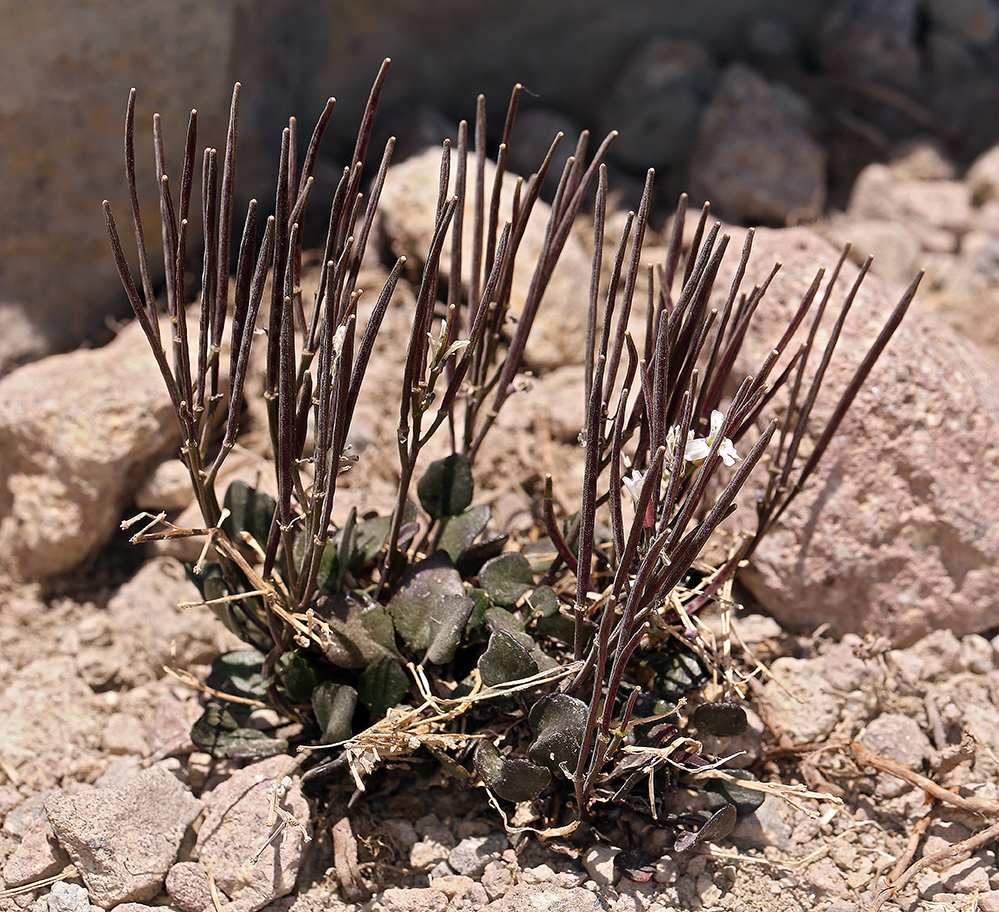
(c) Steve Matson, some rights reserved (CC BY), uploaded by Steve Matson · licence
Family: Brassicaceae · Type: Herb · Native
Conservation status: CNPS 4.3
Cardamine bellidifolia (Alpine bittercress) is a native California herb in the Brassicaceae family, recognized by alpine habitat and simple leaves diagnostic.
Alpine bittercress is a California native perennial found in the High Cascade Range in rocky, moist alpine slopes, volcanic peaks, and streambank habitats at elevations of 1,800 to 2,850 meters. Flowering from June to September, this plant produces delicate white flowers 4 to 5.5 millimeters long in small, clustered umbel-like arrangements. Growing with multiple erect or ascending stems 1 to 8 centimeters tall, it forms dense tufted clumps with a compact growth habit. Its basal leaves form a distinctive rosette with ovate to oblong blades 1 to 5 centimeters long, typically with entire margins and a simple structure. The plant produces slender erect fruits 1.3 to 2.8 centimeters long, containing 8 to 18 small oblong seeds.
Identification and appearance
Key characters: 5 sympatric species; alpine habitat and simple leaves diagnostic
Habitat and range
Habitat: Ledges, rocky, moist soil, alpine slopes, volcanic peaks, mossy places, streambanks
Elevation: 1800-2850 m
California counties: Siskiyou, Shasta, Plumas
Outside California: to Alaska, northeastern United States, Greenland, northern Eurasia
Bloom period
Cardamine bellidifolia blooms Jun-Sep.
Conservation status
CNPS 4.3
How to tell it apart
vs Raphanus: Cardamine has narrow pencil-like pods with many seeds; Raphanus has thick beaked pods that break into segments.; vs Nasturtium: Cardamine grows on moist land in shade; Nasturtium grows in or at the edge of water in sun.; vs Viola: Cardamine has four petals and thin seed pods; Viola has five petals and a capsule that splits into three parts.; vs Vancouveria: Cardamine has four-petaled flowers and seed pods; Vancouveria has six-petaled flowers and follicles.; vs Lepidium: Cardamine has narrow pods with many seeds; Lepidium has flattened round pods with only 2 seeds.
Frequently asked questions
Is Cardamine bellidifolia native to California?
Yes. Cardamine bellidifolia is native to California (recorded as native).
When does Cardamine bellidifolia bloom?
Cardamine bellidifolia blooms Jun-Sep.
Where in California does Cardamine bellidifolia grow?
Cardamine bellidifolia occurs in Siskiyou, Shasta, Plumas, at elevations of 1800-2850 m.
What plant family does Cardamine bellidifolia belong to?
Cardamine bellidifolia is in the Brassicaceae family, genus Cardamine.
Is Cardamine bellidifolia rare or endangered?
Cardamine bellidifolia carries California Rare Plant Rank 4.3, state rank S3.
Related species
Other California species in the same genus, family, or bioregion.
Sources: Jepson eFlora · CNPS Rare Plant Inventory · Index of California Plant Names · CalPhotos · CDFW CNDDB
Last updated 2026-10-07
Data from The California Species Project — 14,000+ California species with verified data from CNPS, CDFW, USFWS, Cal-IPC, and more.