Cardamine nuttallii
Nuttall's toothwort
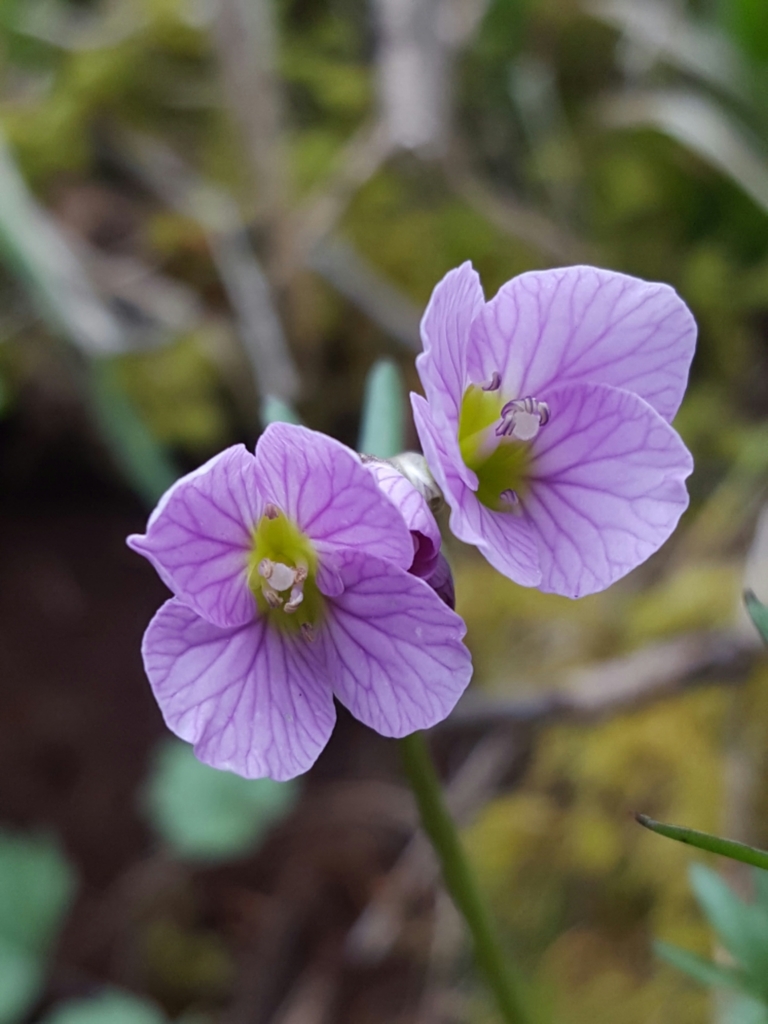
(c) Alex Abair, some rights reserved (CC BY), uploaded by Alex Abair · licence
Family: Brassicaceae · Type: Herb · Native
Conservation status: CNPS 3.3
Cardamine nuttallii (Nuttall's toothwort) is a native California herb in the Brassicaceae family, recognized by pink/purple flowers and segmented rhizome diagnostic.
Nuttall's toothwort is a California native perennial found in northwestern California and northern and central Sierra Nevada Mountains in moist sites, canyons, and forest habitats at elevations of 150 to 2,200 meters. Flowering from March to May, this plant produces pale pink to purple (occasionally white) flowers 1 to 1.5 centimeters long with petals 4 to 7.5 millimeters wide. Growing with simple stems 5 to 20 centimeters tall, it has a slender rhizome with fleshy segments 2 to 5 millimeters wide. Its leaves are simple or compound with 3 to 5 leaflets, featuring a terminal leaflet 1.3 to 4 centimeters long, reniform to round in shape, with crenate or dentate margins and a cordate base. The fruit is 2.6 to 5.6 centimeters long with 8 to 16 seeds, each about 2 to 2.5 millimeters long.
Identification and appearance
Key characters: 8 sympatric species; pink/purple flowers and segmented rhizome diagnostic
Habitat and range
Habitat: Generally moist sites, canyons, forest
Elevation: 150-2200 m
California counties: Plumas, Glenn, El Dorado, Del Norte, Humboldt, Mendocino, Yuba, Siskiyou, Placer, Trinity, Butte, Tuolumne, Santa Cruz, Nevada, Lake, Lassen, Shasta, Mariposa
Outside California: to British Columbia
Bloom period
Cardamine nuttallii blooms Mar-May.
Conservation status
CNPS 3.3
How to tell it apart
vs Raphanus: Cardamine has narrow pencil-like pods with many seeds; Raphanus has thick beaked pods that break into segments.; vs Nasturtium: Cardamine grows on moist land in shade; Nasturtium grows in or at the edge of water in sun.; vs Viola: Cardamine has four petals and thin seed pods; Viola has five petals and a capsule that splits into three parts.; vs Vancouveria: Cardamine has four-petaled flowers and seed pods; Vancouveria has six-petaled flowers and follicles.; vs Lepidium: Cardamine has narrow pods with many seeds; Lepidium has flattened round pods with only 2 seeds.
Frequently asked questions
Is Cardamine nuttallii native to California?
Yes. Cardamine nuttallii is native to California (recorded as native).
When does Cardamine nuttallii bloom?
Cardamine nuttallii blooms Mar-May.
Where in California does Cardamine nuttallii grow?
Cardamine nuttallii occurs in Plumas, Glenn, El Dorado, Del Norte, Humboldt, Mendocino, Yuba, Siskiyou and other counties, at elevations of 150-2200 m.
What plant family does Cardamine nuttallii belong to?
Cardamine nuttallii is in the Brassicaceae family, genus Cardamine.
Is Cardamine nuttallii rare or endangered?
Cardamine nuttallii carries California Rare Plant Rank 3.3, state rank S2.
Related species
Other California species in the same genus, family, or bioregion.
Sources: Jepson eFlora · Index of California Plant Names · CalPhotos · CDFW CNDDB
Last updated 2026-10-07
Data from The California Species Project — 14,000+ California species with verified data from CNPS, CDFW, USFWS, Cal-IPC, and more.