Carduus acanthoides subsp. acanthoides
Plumeless thistle, Plumeless Thistle
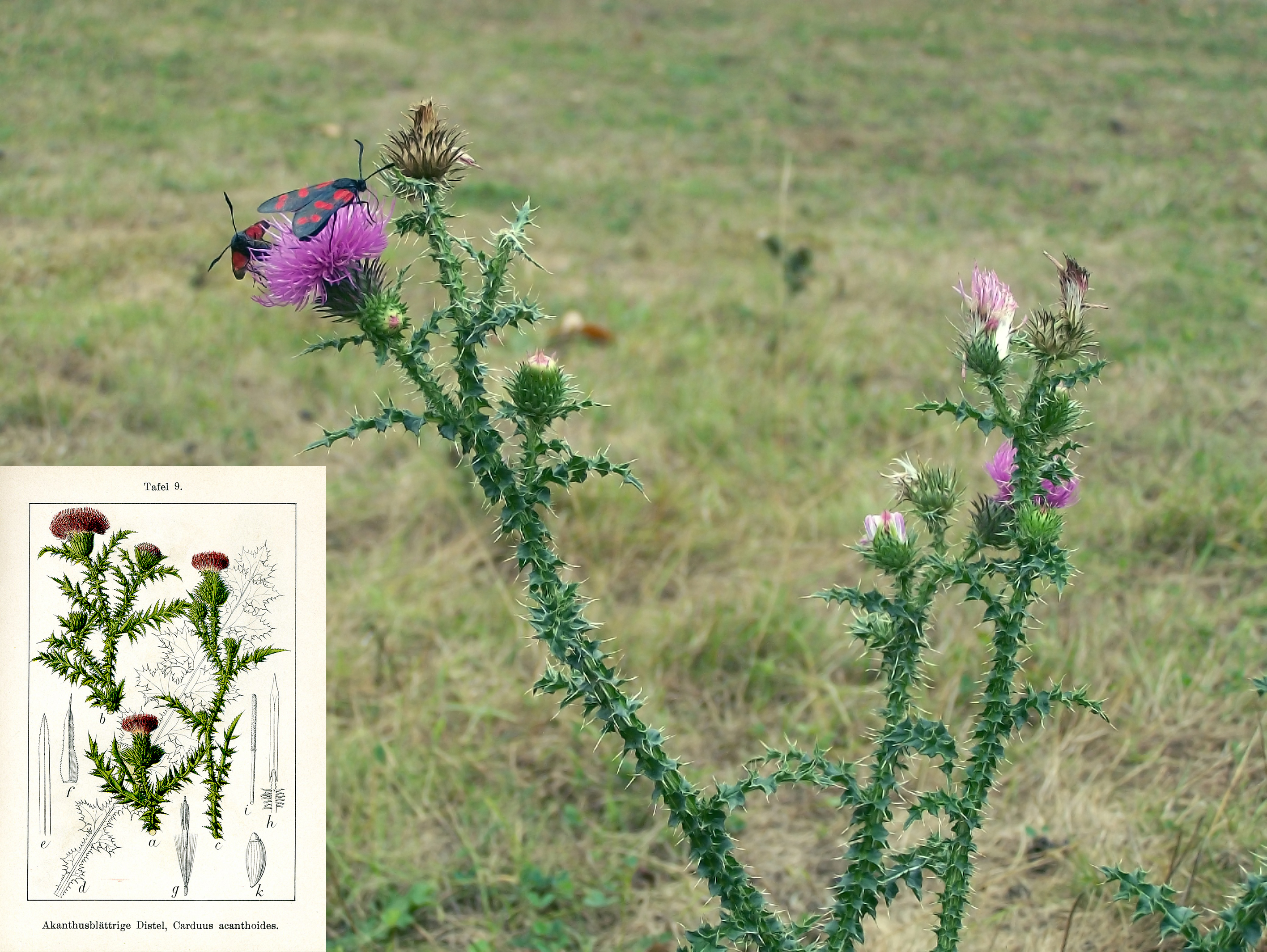
T.Voekler (via Wikimedia Commons) · CC BY-SA
Family: Asteraceae · Type: Biennial · Not Native
Conservation status: Cal-IPC Yes
Carduus acanthoides subsp. acanthoides (Plumeless thistle) is a non-native California biennial in the Asteraceae family, recognized by involucre shape, flower head size, and seed dimensions.
Plumeless thistle is a naturalized biennial found in northern California coastal ranges, northern Sierra Nevada, northern central Coast Ranges, and the Modoc Plateau in roadsides, pastures, and disturbed areas at elevations below 1,300 meters. Flowering from July to November, this aggressive plant produces distinctive purple flowers in spheric or hemispheric heads 1 to 2.5 centimeters in diameter. Growing 3 to 5 meters tall with strongly spiny-winged stems that are nearly glabrous to loosely woolly, it forms dense clusters of flowering heads. Its basal leaves are 10 to 30 centimeters long, deeply lobed with spiny teeth and sparse hairs, creating a formidable and prickly appearance. The fruit is golden to brown, with a pappus 11 to 13 millimeters long, allowing efficient wind dispersal across disturbed landscapes.
Identification and appearance
Key characters: 3 sympatric species; distinguished by involucre shape, flower head size, and seed dimensions
Habitat and range
Habitat: Roadsides, pastures, disturbed areas
Elevation: < 1300 m
Outside California: North America, native to Europe
Bloom period
Carduus acanthoides subsp. acanthoides blooms Jul-Nov.
Conservation status
Cal-IPC Yes
How to tell it apart
vs Silybum: Carduus has spiny-winged stems and plain leaves; Silybum has smooth stems and white-marbled leaves.; vs Cirsium: Carduus has continuous spiny wings down stems and rough seed bristles; Cirsium lacks stem wings and has feathery seed plumes.; vs Centaurea: Carduus has spiny-winged stems; Centaurea stems lack spiny wings and have bracts with fringed appendages.; vs Sonchus: Carduus has spiny-winged stems and thistle flowers; Sonchus has hollow stems with milky sap and dandelion-like flowers.; vs Blitum: Carduus is a spiny thistle with purple flower heads; Blitum is in the goosefoot family with tiny clustered flowers.
Frequently asked questions
Is Carduus acanthoides subsp. acanthoides native to California?
No. Carduus acanthoides subsp. acanthoides is not native to California (recorded as not native).
When does Carduus acanthoides subsp. acanthoides bloom?
Carduus acanthoides subsp. acanthoides blooms Jul-Nov.
What plant family does Carduus acanthoides subsp. acanthoides belong to?
Carduus acanthoides subsp. acanthoides is in the Asteraceae family, genus Carduus.
Is Carduus acanthoides subsp. acanthoides invasive in California?
Carduus acanthoides subsp. acanthoides is listed by Cal-IPC with an invasiveness rating of Yes.
What habitat does Carduus acanthoides subsp. acanthoides grow in?
Carduus acanthoides subsp. acanthoides grows in Roadsides, pastures, disturbed areas.
Related species
Other California species in the same genus, family, or bioregion.
Sources: Jepson eFlora · CalPhotos
Last updated 2026-09-30
Data from The California Species Project — 14,000+ California species with verified data from CNPS, CDFW, USFWS, Cal-IPC, and more.