Carduus pycnocephalus subsp. pycnocephalus
Italian thistle, Italian Thistle
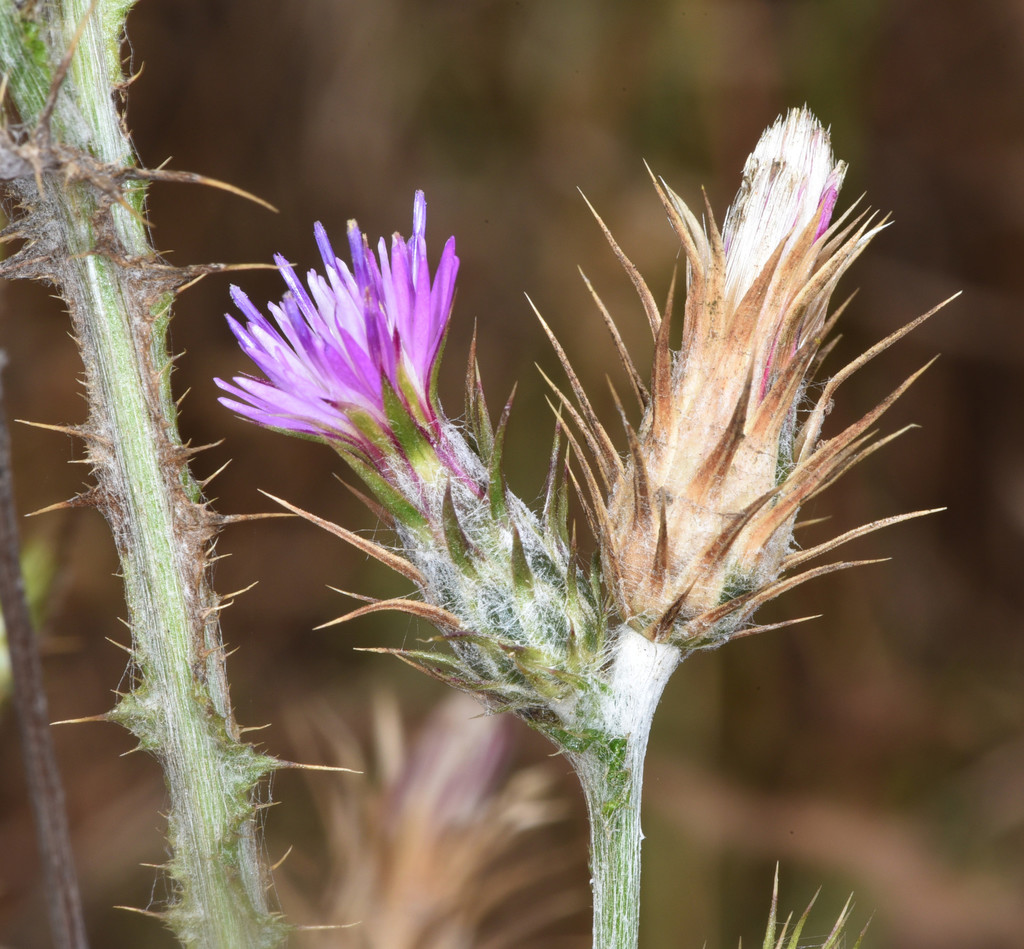
(c) Don Loarie, some rights reserved (CC BY), uploaded by Don Loarie · licence
Family: Asteraceae · Type: Annual · Not Native
Conservation status: Cal-IPC Yes
Carduus pycnocephalus subsp. pycnocephalus (Italian thistle) is a non-native California annual in the Asteraceae family, recognized by C. tenuiflorus by phyllary indumentum and seed vein count.
Italian thistle is a naturalized annual found in the Klamath Ranges, northern California Coast Ranges, Cascade Range foothills, Sierra Nevada foothills, Sacramento Valley, central western California, southern California coast, Transverse Ranges, and Peninsular Ranges in roadsides, pastures, and disturbed areas at elevations below 1,200 meters. Flowering from March to July, this plant produces pink to purple flowers in dense clustered heads 1 to 2 centimeters in diameter with lance-linear spiny tips. Growing 20 to 200 centimeters tall with narrowly spiny-winged stems that are glabrous or slightly woolly, it forms prominent clusters of thistle-like growth. Its basal leaves are 10 to 15 centimeters long with 4 to 10 distinctive lobes, while cauline leaves are somewhat woolly. The fruit is 4 to 6 millimeters long, golden to brown, with prominent veins and a pappus 10 to 15 millimeters in length.
Identification and appearance
Key characters: 3 sympatric species; distinguished from C. tenuiflorus by phyllary indumentum and seed vein count
Habitat and range
Habitat: Roadsides, pastures, disturbed areas
Elevation: < 1200 m
California counties: Kern, San Diego, Calaveras, Marin, Los Angeles, Butte, Yuba, Colusa, Contra Costa, Amador, Santa Clara, Alameda, Sonoma, San Francisco, Santa Barbara, Solano, Shasta, Tehama, Humboldt, San Luis Obispo, Mendocino, Trinity, San Mateo, Napa, Ventura, Riverside, Monterey, Placer, Siskiyou, Lake, Yolo, Sutter, El Dorado, Santa Cruz
Outside California: North America, native to Mediterranean
Bloom period
Carduus pycnocephalus subsp. pycnocephalus blooms Mar-Jul.
Conservation status
Cal-IPC Yes
How to tell it apart
vs Silybum: Carduus has spiny-winged stems and plain leaves; Silybum has smooth stems and white-marbled leaves.; vs Cirsium: Carduus has continuous spiny wings down stems and rough seed bristles; Cirsium lacks stem wings and has feathery seed plumes.; vs Centaurea: Carduus has spiny-winged stems; Centaurea stems lack spiny wings and have bracts with fringed appendages.; vs Sonchus: Carduus has spiny-winged stems and thistle flowers; Sonchus has hollow stems with milky sap and dandelion-like flowers.; vs Blitum: Carduus is a spiny thistle with purple flower heads; Blitum is in the goosefoot family with tiny clustered flowers.
Frequently asked questions
Is Carduus pycnocephalus subsp. pycnocephalus native to California?
No. Carduus pycnocephalus subsp. pycnocephalus is not native to California (recorded as not native).
When does Carduus pycnocephalus subsp. pycnocephalus bloom?
Carduus pycnocephalus subsp. pycnocephalus blooms Mar-Jul.
Where in California does Carduus pycnocephalus subsp. pycnocephalus grow?
Carduus pycnocephalus subsp. pycnocephalus occurs in Kern, San Diego, Calaveras, Marin, Los Angeles, Butte, Yuba, Colusa and other counties, at elevations of < 1200 m.
What plant family does Carduus pycnocephalus subsp. pycnocephalus belong to?
Carduus pycnocephalus subsp. pycnocephalus is in the Asteraceae family, genus Carduus.
Is Carduus pycnocephalus subsp. pycnocephalus invasive in California?
Carduus pycnocephalus subsp. pycnocephalus is listed by Cal-IPC with an invasiveness rating of Yes.
Related species
Other California species in the same genus, family, or bioregion.
Sources: Jepson eFlora · Index of California Plant Names · CalPhotos
Last updated 2026-09-30
Data from The California Species Project — 14,000+ California species with verified data from CNPS, CDFW, USFWS, Cal-IPC, and more.