Carex klamathensis
Klamath sedge, Klamath Sedge
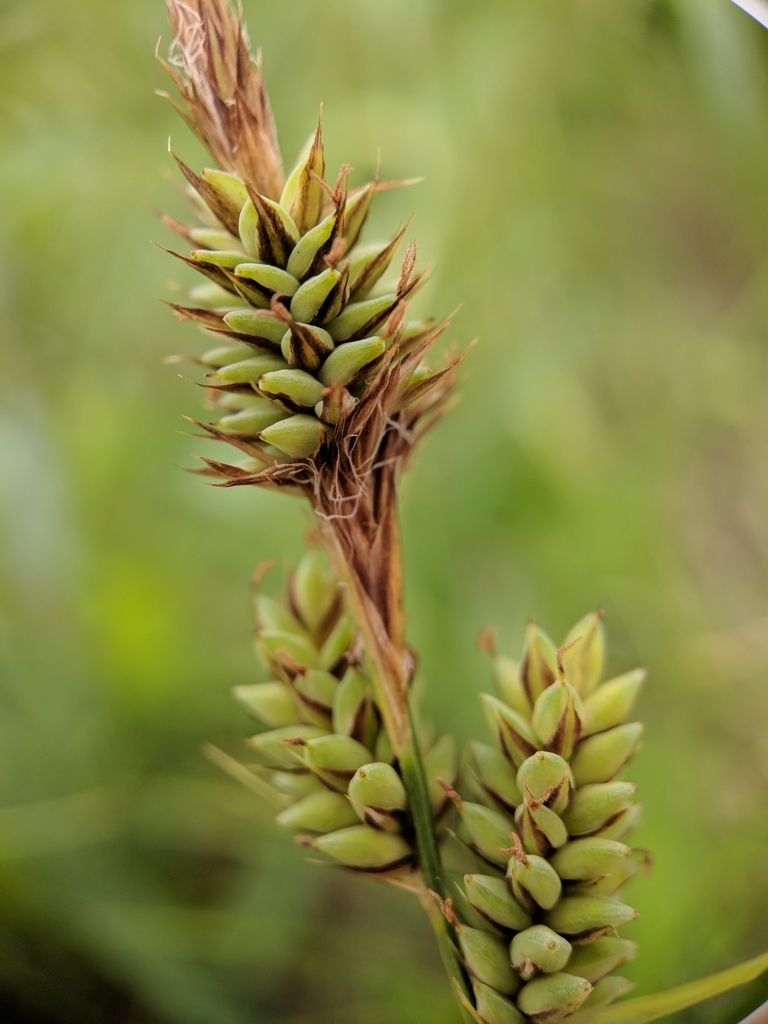
(c) Trevor Edmonson, some rights reserved (CC BY), uploaded by Trevor Edmonson · licence
Family: Cyperaceae · Type: Grass · Native
Conservation status: CNPS 1B.2
Carex klamathensis (Klamath sedge) is a native California grass in the Cyperaceae family, recognized by . Distinguished by serpentine habitat, strongly glaucous leaves, and papillate obovoid perigynia.
Klamath sedge is a rare (CNPS 1B.2) California native perennial found in the Klamath Ranges and northern Coast Ranges at elevations of 900 to 1,600 meters in moist to wet serpentine soils. Flowering time not specified in source data, this sedge has distinctive pale, glaucous foliage with leaves 2 to 6 millimeters wide, flat or folded. Growing in dense clumps with long rhizomes, it forms compact clusters of greenish-tan vegetation. Its leaves are strongly glaucous with papillate undersides, and the pistillate flower bracts range from dark to red-brown or golden. The fruit is small, obovoid, and green-glaucous with strong veins and a barely noticeable bent beak.
Identification and appearance
Key characters: 81 sympatric species. Distinguished by serpentine habitat, strongly glaucous leaves, and papillate obovoid perigynia.
Habitat and range
Habitat: Moist to wet serpentine soils
Elevation: 900-1600 m
Outside California: southwestern Oregon
Conservation status
CNPS 1B.2
How to tell it apart
vs Juncus: Carex stems are triangular when rolled; Juncus stems are round and often hollow with partitions inside.; vs Cyperus: Carex has seeds in individual flasks; Cyperus has umbrella-like flower clusters with flattened ribbon-like spikes.; vs Plantago: Carex has triangular stems and brown/green spikelets; Plantago has round flower stalks and white/brown spike flowers.; vs Eleocharis: Carex has leaves along the stem; Eleocharis is nearly leafless with just one spikelet per stem.; vs Schoenoplectus: Carex has leafy stems and flask-enclosed seeds; Schoenoplectus has leafless round stems with exposed seeds.
Frequently asked questions
Is Carex klamathensis native to California?
Yes. Carex klamathensis is native to California (recorded as native).
What plant family does Carex klamathensis belong to?
Carex klamathensis is in the Cyperaceae family, genus Carex.
Is Carex klamathensis rare or endangered?
Carex klamathensis carries California Rare Plant Rank 1B.2, state rank S1.
What habitat does Carex klamathensis grow in?
Carex klamathensis grows in Moist to wet serpentine soils.
Related species
Other California species in the same genus, family, or bioregion.
Sources: Jepson eFlora · CalPhotos · CDFW CNDDB
Last updated 2026-10-07
Data from The California Species Project — 14,000+ California species with verified data from CNPS, CDFW, USFWS, Cal-IPC, and more.