Carex scopulorum var. bracteosa
Mountain sedge, Mountain Sedge
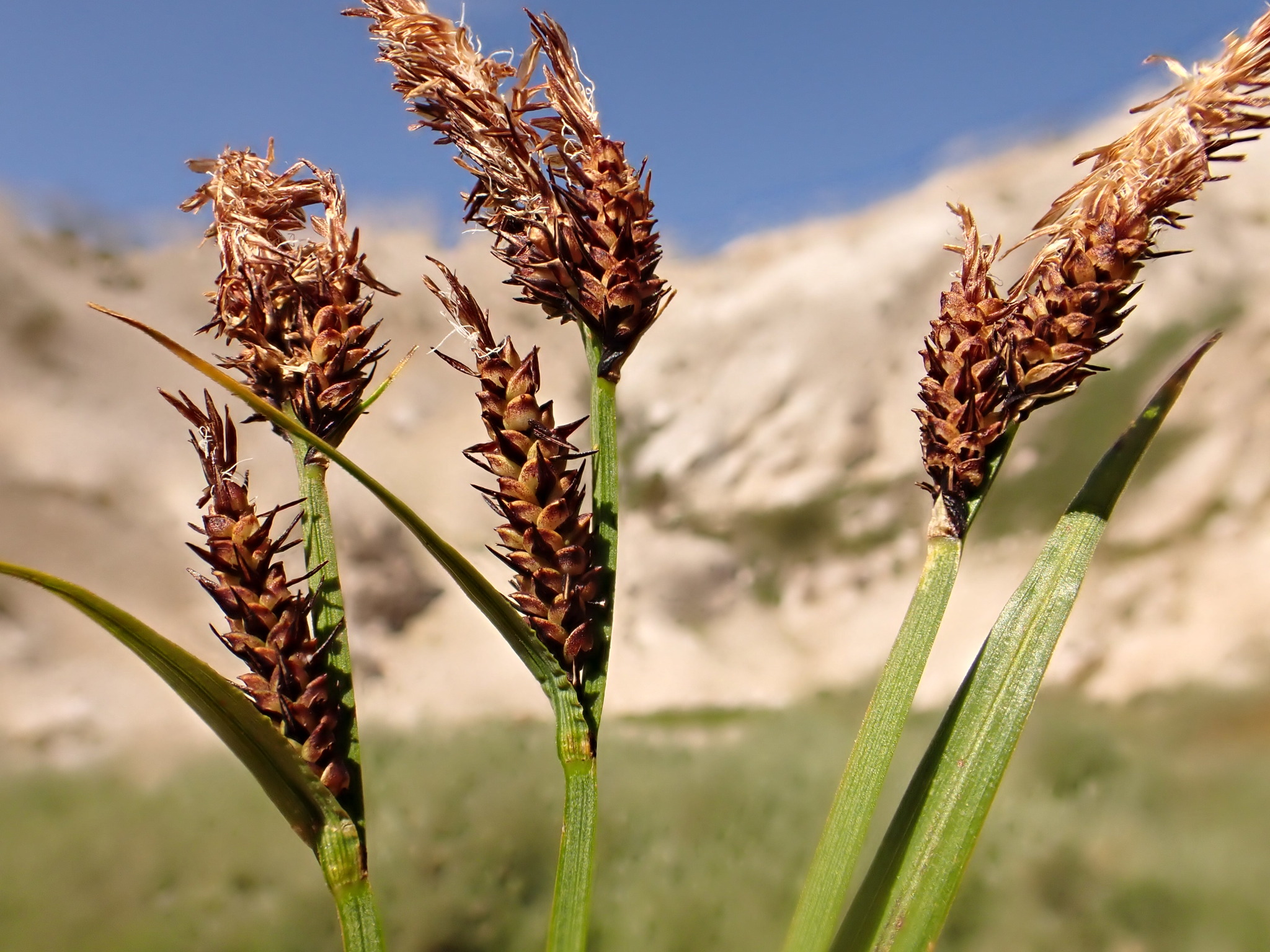
Matt Lavin (via Wikimedia Commons) · CC BY-SA
Family: Cyperaceae · Type: Grass · Native
Carex scopulorum var. bracteosa (Mountain sedge) is a native California grass in the Cyperaceae family, recognized by dark purple inflorescence and papillate unveined perigynia.
Mountain sedge is a California native perennial sedge found in the Klamath Ranges, northern Coast Ranges, high Cascade Range, Sierra Nevada, Warner Mountains, and eastern Sierra Nevada in wet places at elevations of 1,200 to 3,400 meters. Producing dense, generally dark purple inflorescences, this sedge has thin flowering stems with distinctive brown or purple-dotted leaf sheaths. Growing with rhizomatous roots and thin stems 20 to 40 centimeters tall, it forms clustered clumps in moist alpine and montane habitats. Its leaf blades are 3 to 6 millimeters wide, with lateral spikes 8 to 30 millimeters long and generally erect. The fruit is small and dull, with ascending perianth segments typically purple above and measuring 2 to 4 millimeters long.
Identification and appearance
Key characters: 120 sympatric species; key features are dark purple inflorescence and papillate unveined perigynia
Habitat and range
Habitat: Wet places
Elevation: 1200-3400 m
California counties: Tulare, Mono, Shasta, Alpine, Fresno, Mariposa, Nevada, Plumas, Tehama, Trinity, Tuolumne, Inyo, Siskiyou, Humboldt, Glenn, El Dorado, Lassen, Madera, Sierra, Modoc, Placer, Lake, Los Angeles, Butte
Outside California: to British Columbia, Rocky Mountains
How to tell it apart
vs Juncus: Carex stems are triangular when rolled; Juncus stems are round and often hollow with partitions inside.; vs Cyperus: Carex has seeds in individual flasks; Cyperus has umbrella-like flower clusters with flattened ribbon-like spikes.; vs Plantago: Carex has triangular stems and brown/green spikelets; Plantago has round flower stalks and white/brown spike flowers.; vs Eleocharis: Carex has leaves along the stem; Eleocharis is nearly leafless with just one spikelet per stem.; vs Schoenoplectus: Carex has leafy stems and flask-enclosed seeds; Schoenoplectus has leafless round stems with exposed seeds.
Frequently asked questions
Is Carex scopulorum var. bracteosa native to California?
Yes. Carex scopulorum var. bracteosa is native to California (recorded as native).
Where in California does Carex scopulorum var. bracteosa grow?
Carex scopulorum var. bracteosa occurs in Tulare, Mono, Shasta, Alpine, Fresno, Mariposa, Nevada, Plumas and other counties, at elevations of 1200-3400 m.
What plant family does Carex scopulorum var. bracteosa belong to?
Carex scopulorum var. bracteosa is in the Cyperaceae family, genus Carex.
What habitat does Carex scopulorum var. bracteosa grow in?
Carex scopulorum var. bracteosa grows in Wet places.
Related species
Other California species in the same genus, family, or bioregion.
Sources: Jepson eFlora · Index of California Plant Names · CalPhotos
Last updated 2026-10-07
Data from The California Species Project — 14,000+ California species with verified data from CNPS, CDFW, USFWS, Cal-IPC, and more.