Carnegiea gigantea
Saguaro
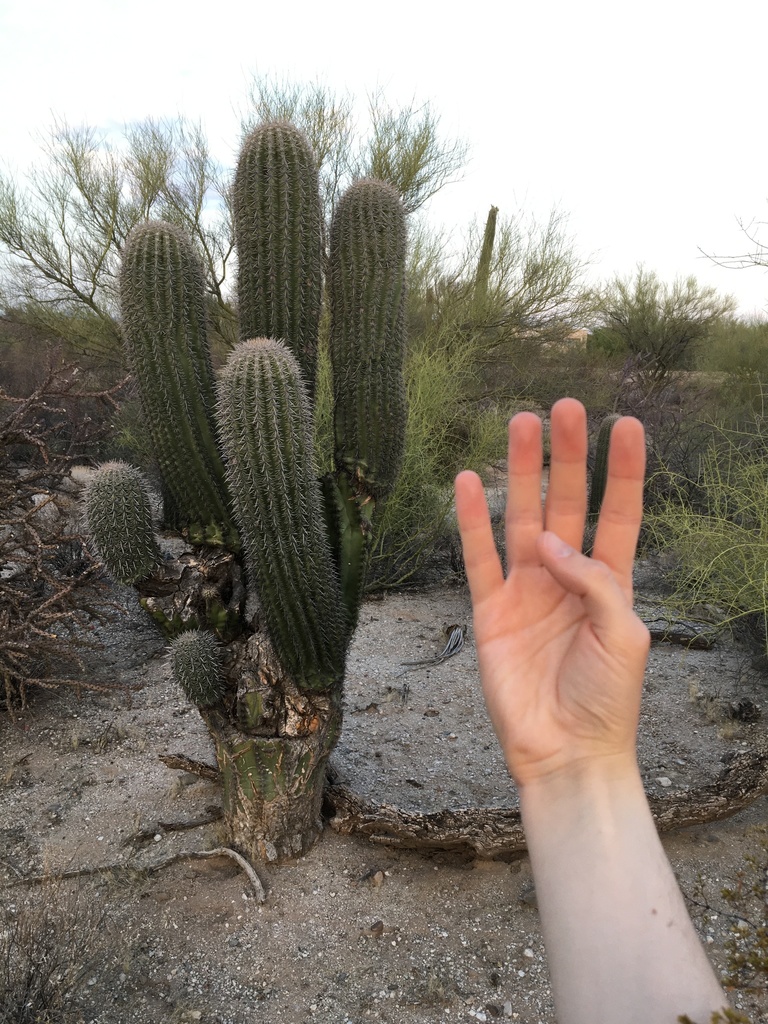
(c) Harrison J Elkins, some rights reserved (CC BY) · licence
Family: Cactaceae · Type: Tree · Native
Conservation status: CNPS 2B.2
Carnegiea gigantea (Saguaro) is a native California tree in the Cactaceae family, recognized by Monotypic genus representing the largest cactus in North America, at its western range limit in California.
Saguaro is a native tree found in the eastern Sonoran Desert on rocky hills and plains at elevations below 1,500 meters. Flowering from May to June, this iconic cactus produces large white flowers 8.5 to 12.5 centimeters long with white inner petals and green outer perianth parts. Growing to an impressive 3 to 16 meters tall with a trunk 30 to 75 centimeters in diameter, the saguaro develops 12 to 30 prominent vertical ribs and branches that emerge from the sides of its massive columnar trunk. Its areoles feature 15 to 28 stout, needle-like spines that are straight to slightly curved, creating a formidable protective surface. The fruit is a distinctive red, obovoid structure 45 to 75 millimeters long that splits open vertically to reveal black, shiny seeds.
Identification and appearance
Key characters: Monotypic genus representing the largest cactus in North America, at its western range limit in California
Habitat and range
Habitat: Rocky hills, plains
Elevation: < 1500 m
California counties: San Bernardino, Imperial
Outside California: southern Arizona, northwestern Mexico
Bloom period
Carnegiea gigantea blooms May-Jun.
Conservation status
CNPS 2B.2
How to tell it apart
vs Trichocereus: Carnegiea has thick unbranched base for 5+ feet; Trichocereus branches from ground level.; vs Pachycereus: Carnegiea has white flowers and smooth spines; Pachycereus has colored flowers and rougher spines.; vs Ferocactus: Carnegiea is tall columnar over 6 feet; Ferocactus is barrel-shaped under 4 feet.; vs Cereus: Carnegiea stays unbranched in lower 5+ feet; Cereus branches lower to ground.; vs Cleistocactus: Carnegiea has stems over 12 inches wide; Cleistocactus has pencil-thin stems under 3 inches.
Frequently asked questions
Is Carnegiea gigantea native to California?
Yes. Carnegiea gigantea is native to California (recorded as native).
When does Carnegiea gigantea bloom?
Carnegiea gigantea blooms May-Jun.
Where in California does Carnegiea gigantea grow?
Carnegiea gigantea occurs in San Bernardino, Imperial, at elevations of < 1500 m.
What plant family does Carnegiea gigantea belong to?
Carnegiea gigantea is in the Cactaceae family, genus Carnegiea.
Is Carnegiea gigantea rare or endangered?
Carnegiea gigantea carries California Rare Plant Rank 2B.2, state rank S1.
Related species
Other California species in the same genus, family, or bioregion.
Sources: Jepson eFlora · CNPS Rare Plant Inventory · Index of California Plant Names · CalPhotos · CDFW CNDDB
Last updated 2026-10-07
Data from The California Species Project — 14,000+ California species with verified data from CNPS, CDFW, USFWS, Cal-IPC, and more.