Carpobrotus edulis
Freeway iceplant, Freeway Iceplant
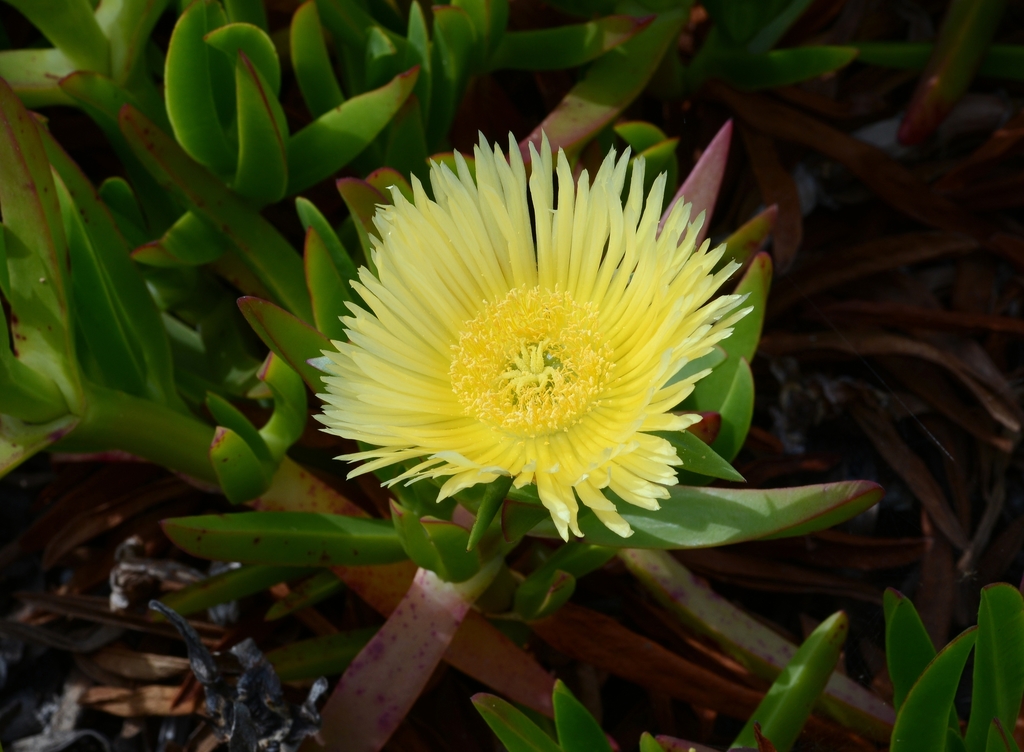
(c) Alvesgaspar, some rights reserved (CC BY-SA) · licence
Family: Aizoaceae · Type: Shrub · Not Native
Conservation status: Cal-IPC Yes
Carpobrotus edulis (Freeway iceplant) is a non-native California shrub in the Aizoaceae family, recognized by (C. chilensis). Clear morphological differences in leaf shape, glaucous coating, flower stalks and size, sepal shape, and fruit morphology.
Freeway iceplant is a naturalized shrub found in coastal regions including Northern California Coast, Central Coast, Southern California Coast, and Channel Islands in sandy coastal habitats at elevations below 100 meters. Flowering essentially year-round, this plant produces pink to magenta flowers that are large and showy, reaching 3 to 4 centimeters across. Growing up to 3 meters long with sprawling, succulent stems that spread horizontally across the ground, it forms dense mats that can quickly cover large areas. Its thick, triangular succulent leaves are widest below the middle, with a fleshy green appearance that helps the plant retain water in coastal environments. The fruit is triangular and flattened near the stem, contributing to the plant's distinctive ground-covering growth habit.
Identification and appearance
Key characters: 1 sympatric species (C. chilensis). Clear morphological differences in leaf shape, glaucous coating, flower stalks and size, sepal shape, and fruit morphology.
Habitat and range
Habitat: Common. Many coastal habitats, especially sand
Elevation: < 100 m
California counties: San Diego, Orange, Los Angeles, Ventura, Santa Barbara, San Francisco, Alameda, Kern, Sacramento, San Luis Obispo, Santa Cruz, Sonoma, Marin, Mendocino, Monterey, San Mateo, Solano, Humboldt
Outside California: to Mexico, native to southern Africa
Bloom period
Carpobrotus edulis blooms +- all year.
Conservation status
Cal-IPC Yes
How to tell it apart
vs Disphyma: Carpobrotus has huge flowers (3+ inches) and chunky triangular leaves; Disphyma has smaller flowers and rounded leaves.; vs Mesembryanthemum: Carpobrotus is robust perennial with fleshy fruits; Mesembryanthemum is delicate annual with crystalline leaves.; vs Delosperma: Carpobrotus has fleshy fig-fruits and huge flowers; Delosperma has dry capsules and smaller flowers.; vs Dudleya: Carpobrotus has opposite triangular leaves and ice-plant flowers; Dudleya has leaf rosettes and tubular flowers on stalks.; vs Hylotelephium: Carpobrotus has triangular succulent leaves and daisy-like flowers; Hylotelephium has flattened leaves and clustered star flowers.
Frequently asked questions
Is Carpobrotus edulis native to California?
No. Carpobrotus edulis is not native to California (recorded as not native).
When does Carpobrotus edulis bloom?
Carpobrotus edulis blooms +- all year.
Where in California does Carpobrotus edulis grow?
Carpobrotus edulis occurs in San Diego, Orange, Los Angeles, Ventura, Santa Barbara, San Francisco, Alameda, Kern and other counties, at elevations of < 100 m.
What plant family does Carpobrotus edulis belong to?
Carpobrotus edulis is in the Aizoaceae family, genus Carpobrotus.
Is Carpobrotus edulis invasive in California?
Carpobrotus edulis is listed by Cal-IPC with an invasiveness rating of Yes.
Related species
Other California species in the same genus, family, or bioregion.
Sources: Jepson eFlora · Index of California Plant Names · CalPhotos
Last updated 2026-10-07
Data from The California Species Project — 14,000+ California species with verified data from CNPS, CDFW, USFWS, Cal-IPC, and more.