Carthamus lanatus
Woolly distaff thistle
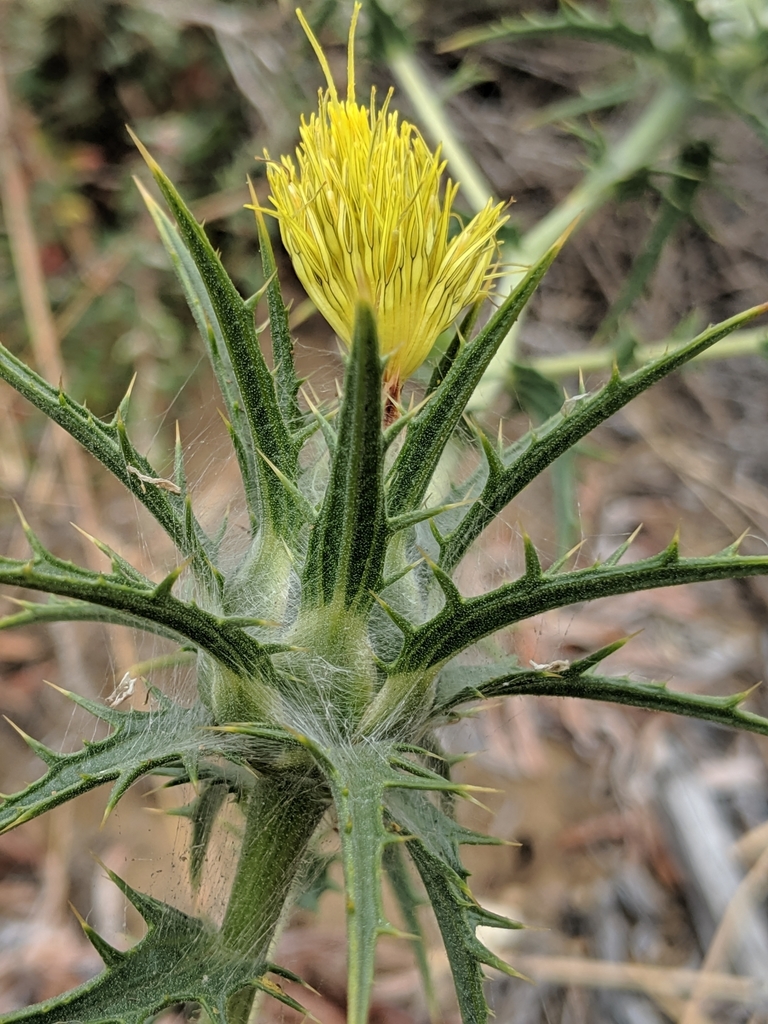
no rights reserved, uploaded by Alex Heyman · CC0
Family: Asteraceae · Type: Herb · Not Native
Conservation status: Cal-IPC Yes
Carthamus lanatus (Woolly distaff thistle) is a non-native California herb in the Asteraceae family, recognized by persistent woolly-tomentose coating, straw-colored stems, ascending outer phyllaries.
Woolly distaff thistle is a naturalized annual found in northern coastal California, central Sierra Nevada foothills, northern San Joaquin Valley, and central western California in disturbed ground, grasslands, and oak woodlands at elevations below 1,100 meters. Flowering from May to September, this plant produces bright yellow flowers in spiny, woolly heads 25 to 35 millimeters wide. Growing 40 to 100 centimeters tall with straw-colored stems that are densely glandular and loosely cobwebby, it has a robust and distinctive appearance. Its cauline leaves are deeply lobed and very spiny, creating a formidable botanical profile with sharp, defensive structures. The fruit is small, brown, and approximately 4 to 6 millimeters long with a pappus 10 to 13 millimeters in length.
Identification and appearance
Key characters: 3 sympatric species; key features are persistent woolly-tomentose coating, straw-colored stems, ascending outer phyllaries
Habitat and range
Habitat: Disturbed ground, grassland, oak woodland
Elevation: < 1100 m
Outside California: native to Mediterranean
Bloom period
Carthamus lanatus blooms May-Sep.
Conservation status
Cal-IPC Yes
How to tell it apart
vs Centaurea: Carthamus has spine-tipped leaf lobes and yellow to orange flowers; Centaurea has spine-tipped bracts but purple to pink flowers.; vs Cirsium: Carthamus has four-angled seeds with scale-like pappus; Cirsium has rounded seeds with feathery bristle pappus.; vs Carduus: Carthamus has yellow to orange flowers; Carduus has purple to pink flowers with feathery pappus bristles.; vs Scolymus: Carthamus has many-flowered heads with outer spiny bracts; Scolymus has large yellow ray flowers with spiny-winged stems.; vs Silybum: Carthamus has spine-tipped leaf lobes; Silybum has spine-edged leaves with distinctive white marbling or veining.
Frequently asked questions
Is Carthamus lanatus native to California?
No. Carthamus lanatus is not native to California (recorded as not native).
When does Carthamus lanatus bloom?
Carthamus lanatus blooms May-Sep.
What plant family does Carthamus lanatus belong to?
Carthamus lanatus is in the Asteraceae family, genus Carthamus.
Is Carthamus lanatus invasive in California?
Carthamus lanatus is listed by Cal-IPC with an invasiveness rating of Yes.
What habitat does Carthamus lanatus grow in?
Carthamus lanatus grows in Disturbed ground, grassland, oak woodland.
Related species
Other California species in the same genus, family, or bioregion.
Sources: Jepson eFlora · CalPhotos
Last updated 2026-10-07
Data from The California Species Project — 14,000+ California species with verified data from CNPS, CDFW, USFWS, Cal-IPC, and more.