Carthamus tinctorius
Safflower
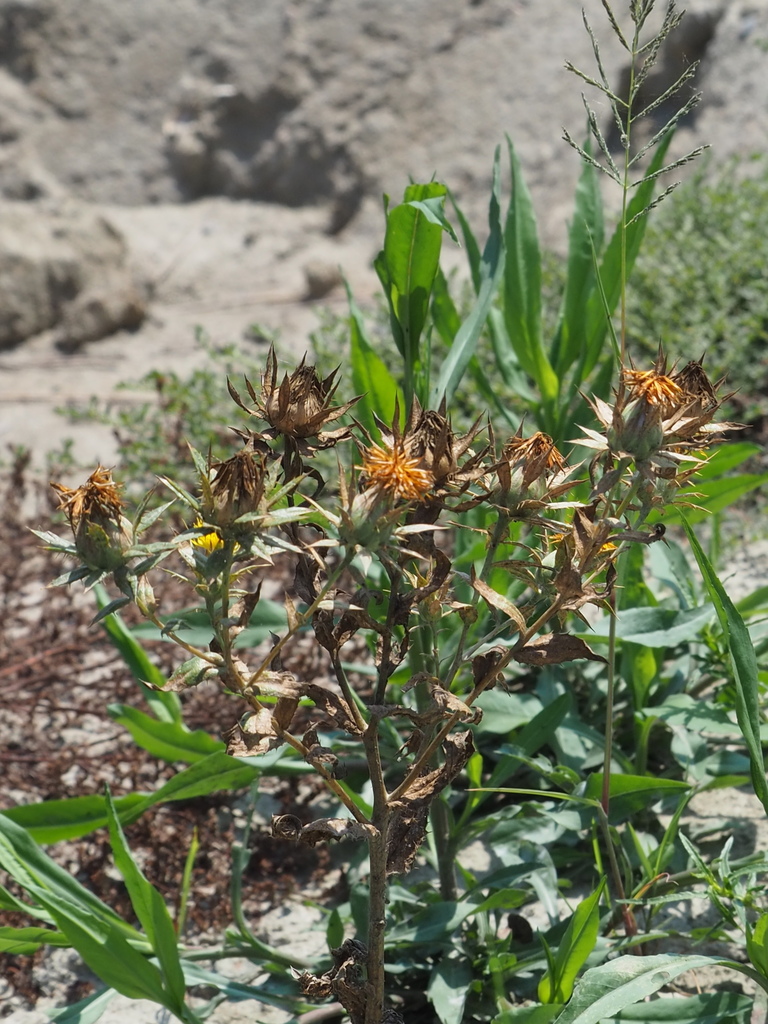
no rights reserved, uploaded by 葉子 · CC0
Family: Asteraceae · Type: Herb · Not Native
Carthamus tinctorius (Safflower) is a non-native California herb in the Asteraceae family, recognized by dentate (not deeply lobed) leaves, flat-topped inflorescence, white fruits.
Safflower is a naturalized annual found in southern North Coast Ranges, San Francisco Bay Area, Central Valley and its margins, Central Coast, Southern Coast, San Jacinto Mountains, and Colorado Desert at elevations below 1,000 meters in disturbed places and roadsides. Flowering from April to July, this plant produces yellow to red flowers in large flat-topped clusters with involucres 2 to 4 centimeters wide. Growing 3 to 10 decimeters tall with straw-colored stems that are nearly hairless, it develops an upright, branching habit. Its cauline leaves are shiny green with dentate edges featuring minutely spine-tipped teeth, creating a distinctive textured appearance. The fruits are white, 7 to 9 millimeters long, and may have a small pappus of 1 to 4 millimeters.
Identification and appearance
Key characters: 3 sympatric species; key features are dentate (not deeply lobed) leaves, flat-topped inflorescence, white fruits
Habitat and range
Habitat: Disturbed places, roadsides
Elevation: < 1000 m
Outside California: native to Mediterranean
Bloom period
Carthamus tinctorius blooms Apr-Jul(Sep).
How to tell it apart
vs Centaurea: Carthamus has spine-tipped leaf lobes and yellow to orange flowers; Centaurea has spine-tipped bracts but purple to pink flowers.; vs Cirsium: Carthamus has four-angled seeds with scale-like pappus; Cirsium has rounded seeds with feathery bristle pappus.; vs Carduus: Carthamus has yellow to orange flowers; Carduus has purple to pink flowers with feathery pappus bristles.; vs Scolymus: Carthamus has many-flowered heads with outer spiny bracts; Scolymus has large yellow ray flowers with spiny-winged stems.; vs Silybum: Carthamus has spine-tipped leaf lobes; Silybum has spine-edged leaves with distinctive white marbling or veining.
Frequently asked questions
Is Carthamus tinctorius native to California?
No. Carthamus tinctorius is not native to California (recorded as not native).
When does Carthamus tinctorius bloom?
Carthamus tinctorius blooms Apr-Jul(Sep).
What plant family does Carthamus tinctorius belong to?
Carthamus tinctorius is in the Asteraceae family, genus Carthamus.
What habitat does Carthamus tinctorius grow in?
Carthamus tinctorius grows in Disturbed places, roadsides.
Related species
Other California species in the same genus, family, or bioregion.
- Carthamus creticus — Smooth distaff thistle
- Carthamus lanatus — Woolly distaff thistle
- Carthamus leucocaulos — Whitestem distaff thistle
- Carthamus sp. — Distaff thistle
- Centaurea benedicta — Blessed thistle
- Centaurea calcitrapa — Purple star-thistle
- Centaurea cineraria — Dusty miller
- Centaurea cyanus — Bachelor's button
Sources: Jepson eFlora · Index of California Plant Names · CalPhotos
Last updated 2026-10-07
Data from The California Species Project — 14,000+ California species with verified data from CNPS, CDFW, USFWS, Cal-IPC, and more.