Castela emoryi
Emory's crucifixion-thorn, Emory's Crucifixion-Thorn
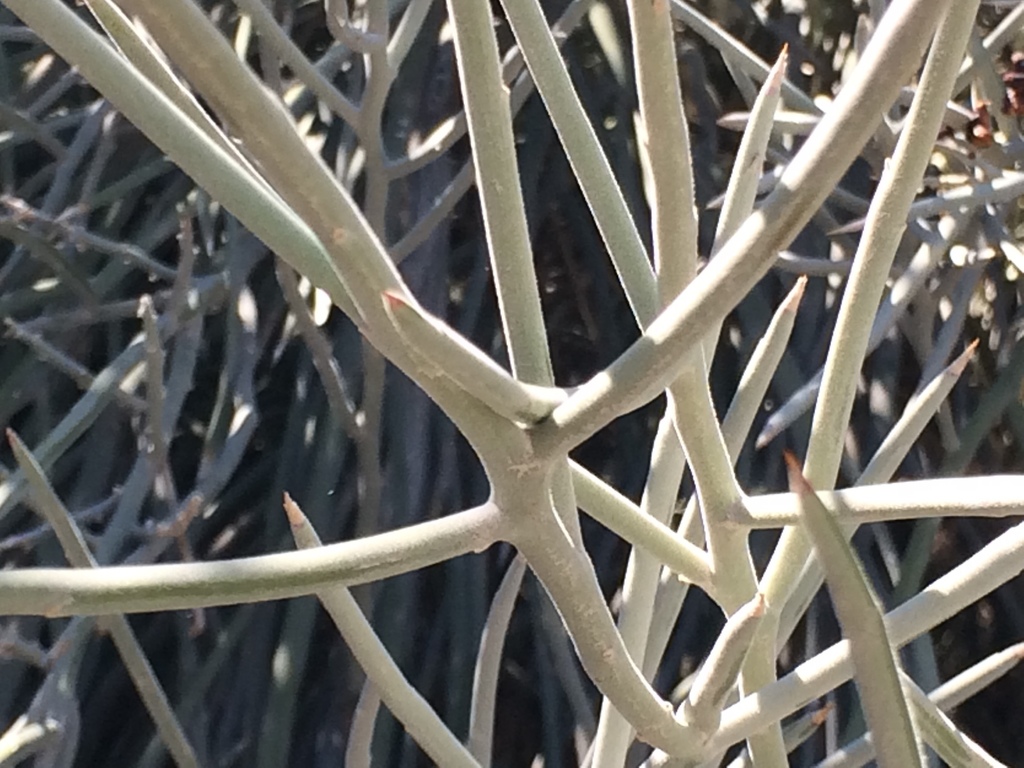
no rights reserved · CC0
Family: Simaroubaceae · Type: Shrub / Tree · Native
Conservation status: CNPS 2B.2
Castela emoryi (Emory's crucifixion-thorn) is a native California shrub / tree in the Simaroubaceae family, recognized by Desert representative of primarily tropical family Simaroubaceae, adapted to extreme arid conditions.
Emory's crucifixion-thorn is a rare (CNPS 2B.2) California native shrub found in the southern Mojave Desert and Sonoran Desert in dry, gravelly washes, slopes, and plains at elevations around 650 meters. Flowering from June to July, this plant produces small flowers approximately 6 to 8 millimeters in diameter, nestled in stiff, much-branched panicles. Growing as an intricately branched shrub often less than 1 meter tall but occasionally reaching up to 4 meters, it features dense puberulent young branches that create a complex, intricate form. Its leaves are ephemeral and rarely seen, making the plant's structural architecture its most distinctive feature. The fruit is approximately 6 millimeters wide with a flat top and rounded base, sometimes persisting for several years.
Identification and appearance
Key characters: Desert representative of primarily tropical family Simaroubaceae, adapted to extreme arid conditions
Habitat and range
Habitat: Dry, gravelly washes, slopes, plains
Elevation: +- 650 m.
California counties: San Bernardino, Riverside, Imperial, Santa Barbara, Los Angeles, Inyo
Outside California: Arizona, northwestern Mexico
Bloom period
Castela emoryi blooms Jun-Jul.
Conservation status
CNPS 2B.2
How to tell it apart
vs Condaliopsis: Castela has prominent long thorns and tiny scale leaves; Condaliopsis has spine-tipped twigs and larger oval leaves.; vs Ailanthus: Castela is a low thorny desert shrub; Ailanthus is a tall unarmed tree with huge compound leaves.; vs Thamnosma: Castela has fierce thorns and simple leaves; Thamnosma lacks thorns and has tiny trifoliate leaves.; vs Glossopetalon: Castela has separate male/female flowers and deeply lobed fruits; Glossopetalon has bisexual flowers and simple capsules.; vs Tamarix: Castela has thorny stems and simple leaves; Tamarix lacks thorns and has scale-like feathery foliage.
Frequently asked questions
Is Castela emoryi native to California?
Yes. Castela emoryi is native to California (recorded as native).
When does Castela emoryi bloom?
Castela emoryi blooms Jun-Jul.
Where in California does Castela emoryi grow?
Castela emoryi occurs in San Bernardino, Riverside, Imperial, Santa Barbara, Los Angeles, Inyo, at elevations of +- 650 m..
What plant family does Castela emoryi belong to?
Castela emoryi is in the Simaroubaceae family, genus Castela.
Is Castela emoryi rare or endangered?
Castela emoryi carries California Rare Plant Rank 2B.2, state rank S2S3.
Related species
Other California species in the same genus, family, or bioregion.
Sources: Jepson eFlora · CNPS Rare Plant Inventory · Index of California Plant Names · CalPhotos · CDFW CNDDB
Last updated 2026-10-07
Data from The California Species Project — 14,000+ California species with verified data from CNPS, CDFW, USFWS, Cal-IPC, and more.