Castilleja exserta
Purple owl's-clover
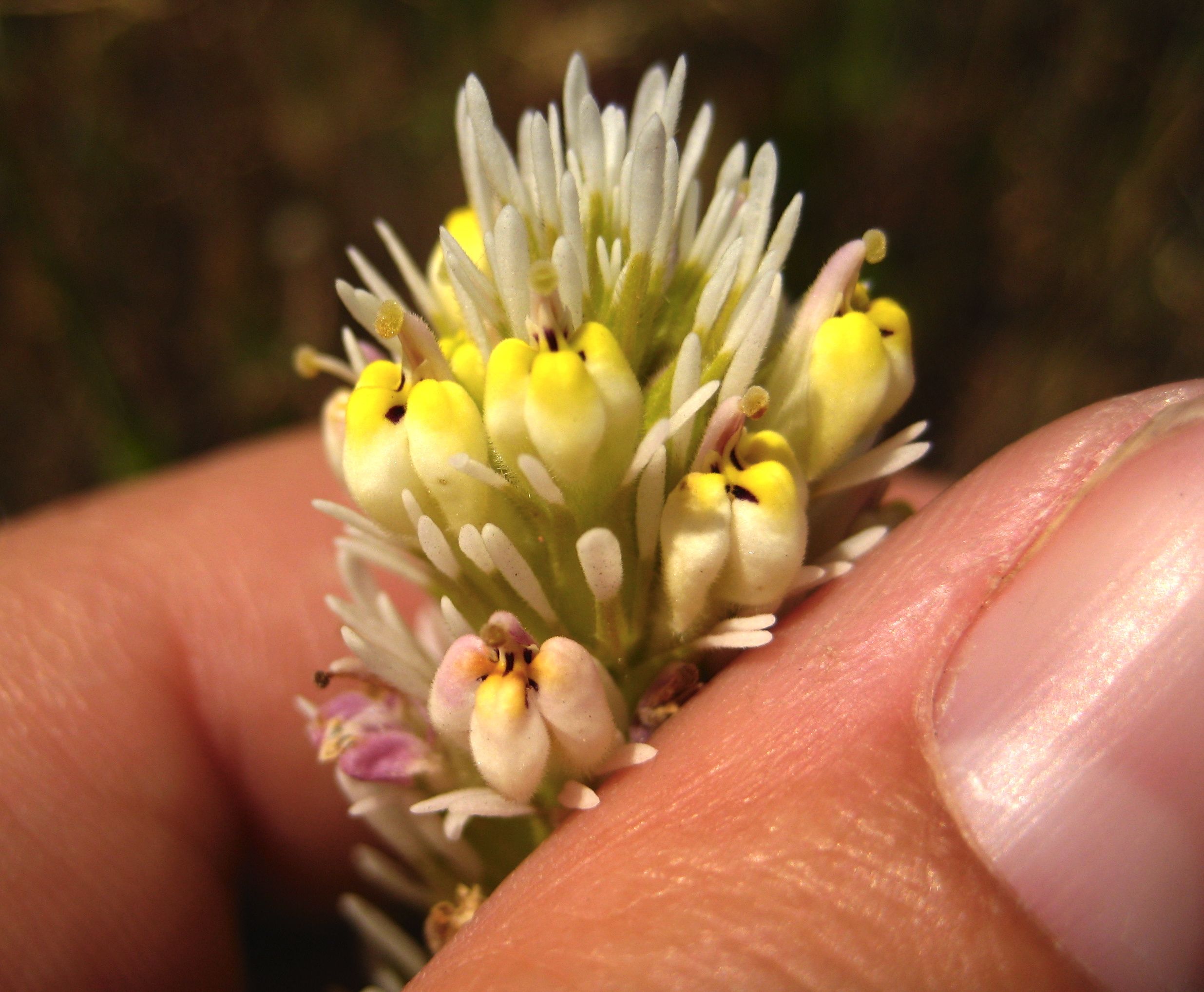
Photo by Chez Brungraber
Family: Orobanchaceae · Type: Herb · Native
Castilleja exserta (Purple owl's-clover) is a native California herb in the Orobanchaceae family, recognized by thread-like leaf lobes and annual habit.
Purple owl's-clover is a California native annual herb found in coastal, desert, and interior regions of California in grasslands, oak woodlands, and chaparral at elevations from sea level to 1,500 meters. Flowering from March to June, this plant produces spectacular white to purple-red bracts with delicate, thread-like lobes surrounding small flowers, creating eye-catching clusters up to 20 centimeters long. Growing with glandular-puberulent stems 10 to 45 centimeters tall, it has an upright and somewhat stiff appearance. Its leaves are finely divided with 5 to 9 thread-like lobes, each measuring 10 to 50 millimeters in length. The distinctive flowers feature a hooked beak and pouches 3 to 8 millimeters wide, creating an intricate and delicate botanical structure.
Identification and appearance
Key characters: 53 sympatric species; distinguished by thread-like leaf lobes and annual habit
Habitat and range
California counties: Humboldt, Contra Costa, San Bernardino, Tulare, San Luis Obispo, San Diego, Santa Barbara, Riverside, Kern, Fresno, Los Angeles, Inyo, Marin, Ventura, Orange, Colusa, Santa Clara, San Benito, Merced, Butte, Placer, Sutter, Solano, San Mateo, Shasta, Monterey, Lake, Tehama, Glenn, Tuolumne, Mendocino, Mariposa, San Joaquin, Sacramento, Stanislaus, Yolo, San Francisco, El Dorado, Santa Cruz, Kings, Calaveras, Madera, Alameda, Napa, Plumas
How to tell it apart
vs Triphysaria: Castilleja lacks the sharp fold in flower throat; Triphysaria has abrupt crease above lower lip.; vs Trifolium: Castilleja has tubular flowers with colorful bracts; Trifolium has round heads of pea-like flowers and three leaflets.; vs Pedicularis: Castilleja has open forward beak and colorful bracts; Pedicularis has closed hood and fern-like leaves.; vs Orthocarpus: Castilleja has open beak you can see into; Orthocarpus has closed hood covering stamens completely.; vs Epilobium: Castilleja has tubular two-lipped flowers and colorful bracts; Epilobium has four separate petals arranged in cross.
Frequently asked questions
Is Castilleja exserta native to California?
Yes. Castilleja exserta is native to California (recorded as native).
Where in California does Castilleja exserta grow?
Castilleja exserta occurs in Humboldt, Contra Costa, San Bernardino, Tulare, San Luis Obispo, San Diego, Santa Barbara, Riverside and other counties.
What plant family does Castilleja exserta belong to?
Castilleja exserta is in the Orobanchaceae family, genus Castilleja.
Related species
Other California species in the same genus, family, or bioregion.
Sources: Jepson eFlora · Index of California Plant Names · CalPhotos
Last updated 2026-10-08
Data from The California Species Project — 14,000+ California species with verified data from CNPS, CDFW, USFWS, Cal-IPC, and more.