Castilleja pilosa
Parrothead indian paintbrush
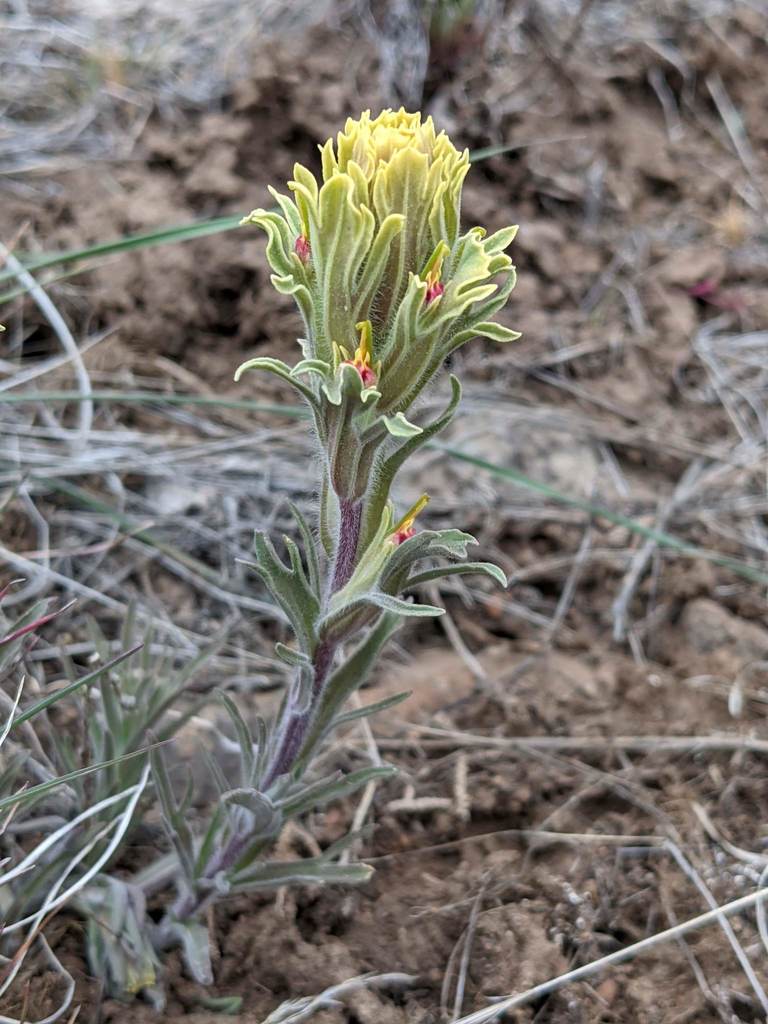
(c) Trevor Van Loon, some rights reserved (CC BY) · licence
Family: Orobanchaceae · Type: Herb · Native
Castilleja pilosa (Parrothead indian paintbrush) is a native California herb in the Orobanchaceae family, recognized by stiff spreading hairs and pale, white-margined bracts distinguish it.
Parrothead indian paintbrush is a California native perennial found in the Sierra Nevada Mountains, Great Basin, and California Range Highlands in dry sagebrush scrub and alpine barrens at elevations of 1,200 to 3,400 meters. Flowering from June to August, this plant produces pale yellow-green flowers with white-margined pale green or purple bracts, creating delicate 3 to 20 centimeter inflorescences. Growing with decumbent stems 8 to 35 centimeters tall and spreading stiff hairs, it has a distinctive growth habit that allows it to thrive in harsh alpine environments. Its leaves are lance-linear, 10 to 50 millimeters long, with zero to three subtle lobes, giving the plant a minimalist, structured appearance. The fruit is 8 to 12 millimeters long, with seeds featuring a uniquely netted coat that clings tightly to its ladder-like walls.
Identification and appearance
Key characters: 24 sympatric species; stiff spreading hairs and pale, white-margined bracts distinguish it
Habitat and range
Habitat: Dry sagebrush scrub to alpine barrens
Elevation: 1200-3400 m
California counties: Lassen, Tuolumne, Mono, Nevada, Placer, San Diego, Shasta, Sierra, Inyo, Plumas, Tulare, Modoc, Alpine, Siskiyou, Butte, El Dorado, San Francisco, Trinity, Fresno, Alameda, Los Angeles, San Bernardino, Mariposa, Madera
Outside California: to eastern Oregon, central Idaho, western Wyoming
Bloom period
Castilleja pilosa blooms Jun-Aug.
How to tell it apart
vs Triphysaria: Castilleja lacks the sharp fold in flower throat; Triphysaria has abrupt crease above lower lip.; vs Trifolium: Castilleja has tubular flowers with colorful bracts; Trifolium has round heads of pea-like flowers and three leaflets.; vs Pedicularis: Castilleja has open forward beak and colorful bracts; Pedicularis has closed hood and fern-like leaves.; vs Orthocarpus: Castilleja has open beak you can see into; Orthocarpus has closed hood covering stamens completely.; vs Epilobium: Castilleja has tubular two-lipped flowers and colorful bracts; Epilobium has four separate petals arranged in cross.
Frequently asked questions
Is Castilleja pilosa native to California?
Yes. Castilleja pilosa is native to California (recorded as native).
When does Castilleja pilosa bloom?
Castilleja pilosa blooms Jun-Aug.
Where in California does Castilleja pilosa grow?
Castilleja pilosa occurs in Lassen, Tuolumne, Mono, Nevada, Placer, San Diego, Shasta, Sierra and other counties, at elevations of 1200-3400 m.
What plant family does Castilleja pilosa belong to?
Castilleja pilosa is in the Orobanchaceae family, genus Castilleja.
What habitat does Castilleja pilosa grow in?
Castilleja pilosa grows in Dry sagebrush scrub to alpine barrens.
Related species
Other California species in the same genus, family, or bioregion.
Sources: Jepson eFlora · Index of California Plant Names · CalPhotos
Last updated 2026-10-07
Data from The California Species Project — 14,000+ California species with verified data from CNPS, CDFW, USFWS, Cal-IPC, and more.