Caulanthus flavescens
Yellow California mustard
(c) Ken-ichi Ueda, some rights reserved (CC BY), uploaded by Ken-ichi Ueda · licence
Family: Brassicaceae · Type: Herb · Native
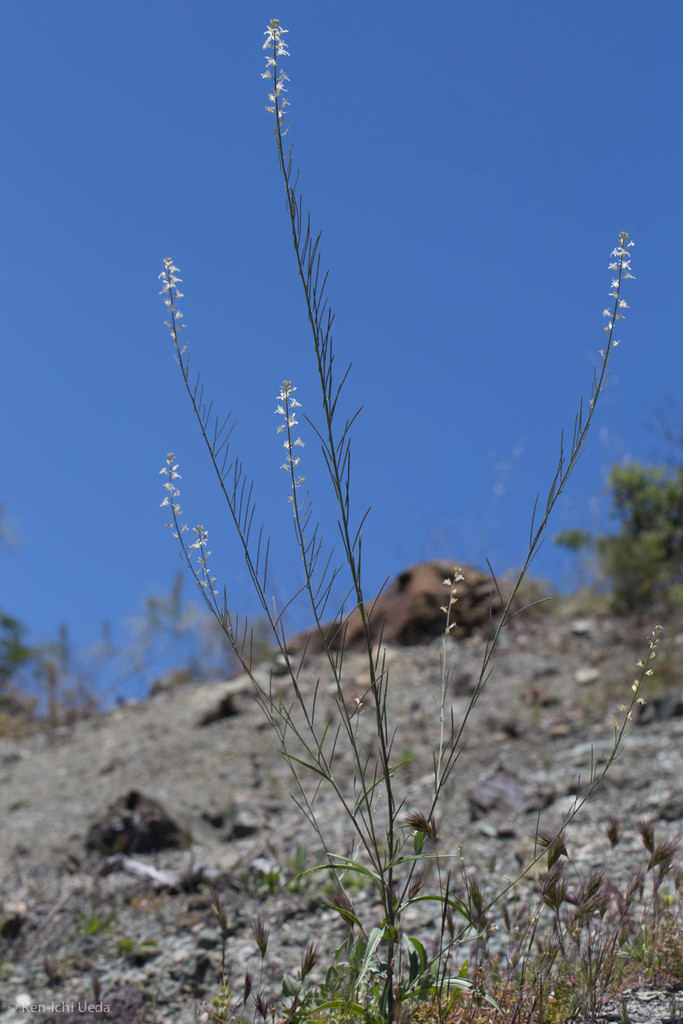
Caulanthus flavescens (Yellow California mustard) is a native California herb in the Brassicaceae family, recognized by tall stature with channeled wavy-margined cream/yellow petals diagnostic.
Yellow California mustard is a native annual found in southern North Coast Ranges Interior, Sacramento Valley (Montezuma Hills), southeastern San Francisco Bay Area, and southern Coast Ranges Interior on dry, exposed slopes and open hillsides, often on serpentine soils at elevations of 80 to 750 meters. Flowering from March to May, this plant produces delicate white or cream flowers with subtle pink tones, 7 to 13 millimeters long with wavy margins. Growing with erect stems 70 to 120 centimeters tall, it can be either glabrous or covered in stiff hairs, and may branch out in its upper portions. Its leaves vary from lyre-shaped basal leaves to lance-shaped cauline leaves, with lower leaves 2 to 13.5 centimeters long and petioled, while upper leaves are sessile. The fruit is an ascending to reflexed pod 3.8 to 7.7 centimeters long, containing 44 to 58 small oblong seeds.
Identification and appearance
Key characters: 5 sympatric species; tall stature with channeled wavy-margined cream/yellow petals diagnostic
Habitat and range
Habitat: Dry, exposed slopes, open hillsides, vertic clay, often serpentine
Elevation: 80-750 m
California counties: Colusa, Alameda, San Benito, Glenn, San Joaquin, Solano, Monterey, Contra Costa, Stanislaus, Lake, Riverside, Santa Clara, Napa, San Bernardino
Bloom period
Caulanthus flavescens blooms Mar-May.
How to tell it apart
vs Streptanthus: Seed pods are cylindrical and round versus flattened blade-like pods in Streptanthus.; vs Sisymbrium: Petals are distinctively crinkled and papery versus smooth petals in Sisymbrium.; vs Hirschfeldia: Young pods reflex sharply downward versus pointing upward or outward.; vs Boechera: Pods reflex downward and contain wingless seeds versus erect pods with winged seeds.; vs Brassica: Young seed pods bend sharply downward versus pointing upward in Brassica.
Frequently asked questions
Is Caulanthus flavescens native to California?
Yes. Caulanthus flavescens is native to California (recorded as native).
When does Caulanthus flavescens bloom?
Caulanthus flavescens blooms Mar-May.
Where in California does Caulanthus flavescens grow?
Caulanthus flavescens occurs in Colusa, Alameda, San Benito, Glenn, San Joaquin, Solano, Monterey, Contra Costa and other counties, at elevations of 80-750 m.
What plant family does Caulanthus flavescens belong to?
Caulanthus flavescens is in the Brassicaceae family, genus Caulanthus.
What habitat does Caulanthus flavescens grow in?
Caulanthus flavescens grows in Dry, exposed slopes, open hillsides, vertic clay, often serpentine.
Related species
Other California species in the same genus, family, or bioregion.
Sources: Jepson eFlora · Index of California Plant Names · CalPhotos
Last updated 2026-10-07
Data from The California Species Project — 14,000+ California species with verified data from CNPS, CDFW, USFWS, Cal-IPC, and more.