Caulanthus lasiophyllus
California mustard
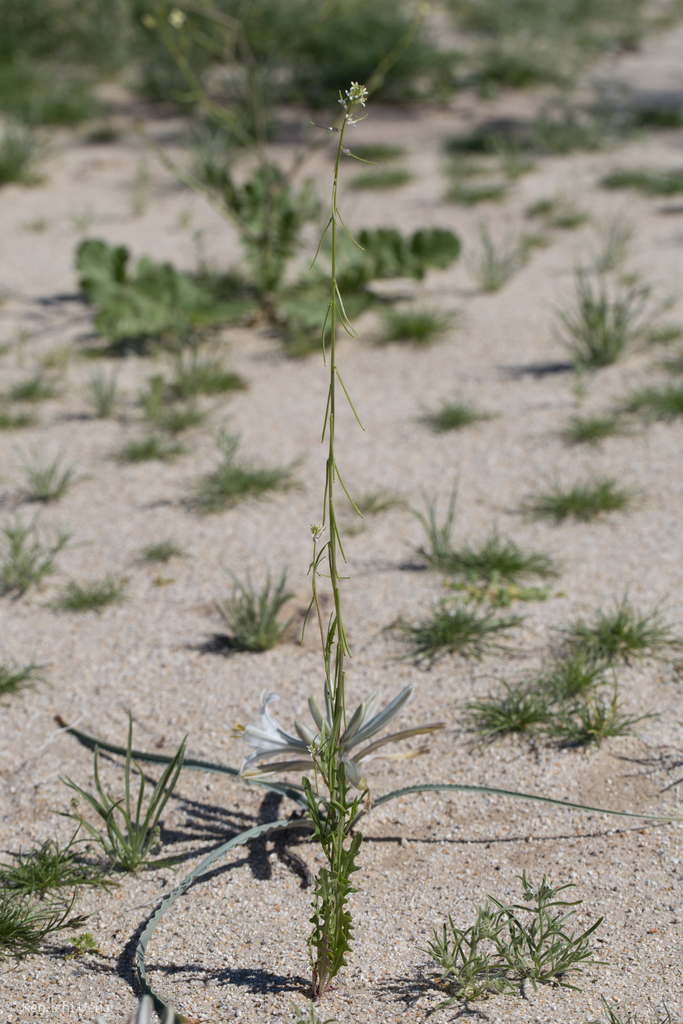
(c) Ken-ichi Ueda, some rights reserved (CC BY), uploaded by Ken-ichi Ueda · licence
Family: Brassicaceae · Type: Herb · Native
Caulanthus lasiophyllus (California mustard) is a native California herb in the Brassicaceae family, recognized by small flowers with cylindric calyx and short reflexed fruits.
California mustard is a native annual found in California (excluding the Modoc Plateau) in desert flats, sandy banks, gravelly areas, shrublands, and disturbed sites at elevations below 1,400 meters. Flowering from March to June, this plant produces white to creamy white or slightly pink flowers up to 6.5 millimeters long in elongated clusters. Growing with erect stems 20 to 100 centimeters tall, it is sparsely to densely covered in stiff hairs and can be simple or branched. Its basal leaves are lanceolate to oblanceolate, pinnately lobed or toothed, with smaller cauline leaves that are short-petioled. The plant produces elongated fruits 2 to 4.8 centimeters long, containing 14 to 60 small oblong seeds.
Identification and appearance
Key characters: 16 sympatric species; small flowers with cylindric calyx and short reflexed fruits
Habitat and range
Habitat: Common. Desert flats, sandy banks, gravelly or rocky areas, talus slopes, shrubland, grassy fields, disturbed sites
Elevation: < 1400 m
California counties: Kern, San Bernardino, Orange, Los Angeles, Ventura, Imperial, Santa Barbara, Inyo, Colusa, Riverside, San Diego, Yolo, Mendocino, Sonoma, Monterey, San Joaquin, San Francisco, Tulare, San Luis Obispo, Napa, Marin, Santa Clara, Fresno, San Benito, Alameda, Merced, Contra Costa, San Mateo, Santa Cruz, Butte, Glenn, Stanislaus, Tuolumne, Sutter, Solano, Lake, Calaveras, Mariposa, Mono, Kings, Sacramento, Shasta, Humboldt
Outside California: to British Columbia, Utah, northwestern Mexico
Bloom period
Caulanthus lasiophyllus blooms Mar-Jun.
How to tell it apart
vs Streptanthus: Seed pods are cylindrical and round versus flattened blade-like pods in Streptanthus.; vs Sisymbrium: Petals are distinctively crinkled and papery versus smooth petals in Sisymbrium.; vs Hirschfeldia: Young pods reflex sharply downward versus pointing upward or outward.; vs Boechera: Pods reflex downward and contain wingless seeds versus erect pods with winged seeds.; vs Brassica: Young seed pods bend sharply downward versus pointing upward in Brassica.
Frequently asked questions
Is Caulanthus lasiophyllus native to California?
Yes. Caulanthus lasiophyllus is native to California (recorded as native).
When does Caulanthus lasiophyllus bloom?
Caulanthus lasiophyllus blooms Mar-Jun.
Where in California does Caulanthus lasiophyllus grow?
Caulanthus lasiophyllus occurs in Kern, San Bernardino, Orange, Los Angeles, Ventura, Imperial, Santa Barbara, Inyo and other counties, at elevations of < 1400 m.
What plant family does Caulanthus lasiophyllus belong to?
Caulanthus lasiophyllus is in the Brassicaceae family, genus Caulanthus.
What habitat does Caulanthus lasiophyllus grow in?
Caulanthus lasiophyllus grows in Common. Desert flats, sandy banks, gravelly or rocky areas, talus slopes, shrubland, grassy fields, disturbed sites.
Related species
Other California species in the same genus, family, or bioregion.
Sources: Jepson eFlora · Index of California Plant Names · CalPhotos
Last updated 2026-10-07
Data from The California Species Project — 14,000+ California species with verified data from CNPS, CDFW, USFWS, Cal-IPC, and more.