Caulanthus major
Slender wild cabbage
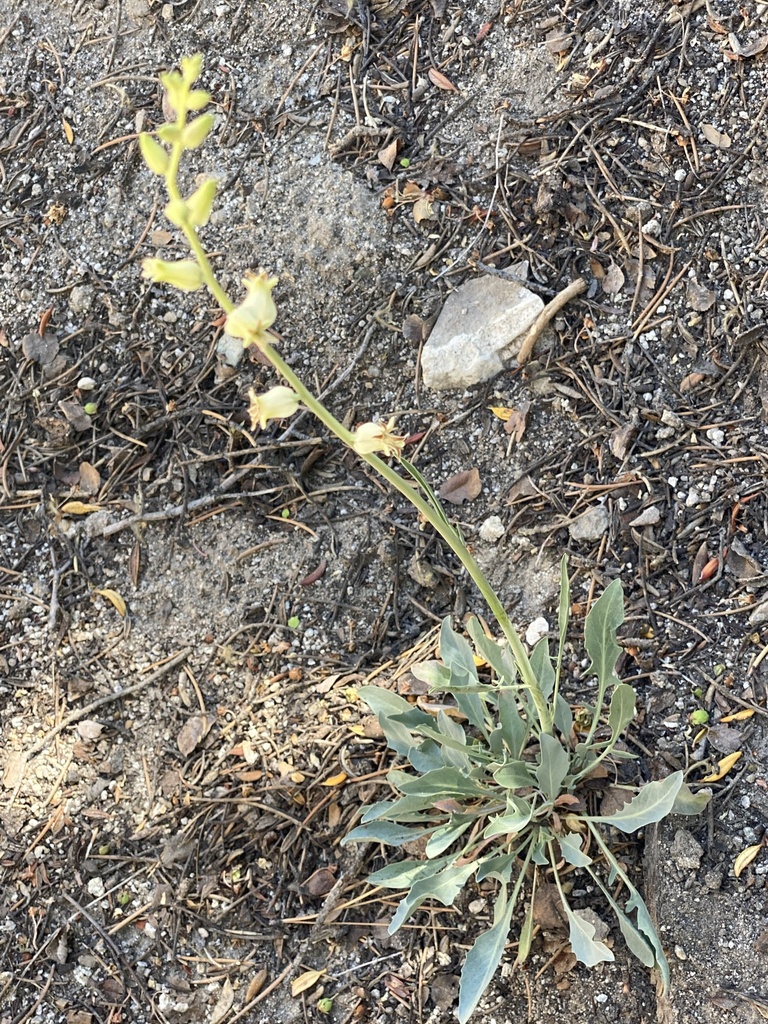
(c) nebrooks, some rights reserved (CC BY) · licence
Family: Brassicaceae · Type: Herb · Native
Conservation status: CNPS 4.3
Caulanthus major (Slender wild cabbage) is a native California herb in the Brassicaceae family, recognized by perennial with persistent basal leaves and glabrous habit.
Slender wild cabbage is a California native perennial ranked 4.3 by CNPS, found in northern Sierra Nevada Mountains in Alpine County, southern Sierra Nevada Borderlands, southern Sierra Boundary, southern Modoc Plateau, and eastern Desert Mountains including Providence and New York Mountains on dry, generally rocky slopes in sagebrush and pinyon/juniper woodland at elevations of 1,500 to 3,200 meters. Flowering from May to July, this plant produces creamy white to purple flowers with distinctive purple petals 11 to 17 millimeters long. Growing with erect stems 20 to 100 centimeters tall that are simple or branched toward the top, it has a woody base with persistent basal rosette leaves. Its leaves range from entire to dentate or pinnately lobed, with basal blades 1 to 14 centimeters long and upper leaves reduced to narrow, linear shapes. The elongated fruit is erect to ascending, 4.5 to 12 centimeters long, containing 46 to 58 oblong seeds two to 3.5 millimeters in size.
Identification and appearance
Key characters: 8 sympatric species; perennial with persistent basal leaves and glabrous habit
Habitat and range
Habitat: +- dry, generally rocky slopes, sagebrush, pinyon/juniper woodland
Elevation: 1500-3200 m
California counties: Riverside, San Bernardino, Los Angeles, Lassen, Alpine, Plumas, Mono, Inyo, Humboldt
Outside California: southeastern Oregon, northern and western Nevada, eastern Utah
Bloom period
Caulanthus major blooms May-Jul.
Conservation status
CNPS 4.3
How to tell it apart
vs Streptanthus: Seed pods are cylindrical and round versus flattened blade-like pods in Streptanthus.; vs Sisymbrium: Petals are distinctively crinkled and papery versus smooth petals in Sisymbrium.; vs Hirschfeldia: Young pods reflex sharply downward versus pointing upward or outward.; vs Boechera: Pods reflex downward and contain wingless seeds versus erect pods with winged seeds.; vs Brassica: Young seed pods bend sharply downward versus pointing upward in Brassica.
Frequently asked questions
Is Caulanthus major native to California?
Yes. Caulanthus major is native to California (recorded as native).
When does Caulanthus major bloom?
Caulanthus major blooms May-Jul.
Where in California does Caulanthus major grow?
Caulanthus major occurs in Riverside, San Bernardino, Los Angeles, Lassen, Alpine, Plumas, Mono, Inyo and other counties, at elevations of 1500-3200 m.
What plant family does Caulanthus major belong to?
Caulanthus major is in the Brassicaceae family, genus Caulanthus.
Is Caulanthus major rare or endangered?
Caulanthus major carries California Rare Plant Rank 4.3, state rank S3?.
Related species
Other California species in the same genus, family, or bioregion.
Sources: Jepson eFlora · Index of California Plant Names · CalPhotos · CDFW CNDDB
Last updated 2026-10-07
Data from The California Species Project — 14,000+ California species with verified data from CNPS, CDFW, USFWS, Cal-IPC, and more.