Caulanthus pilosus
Chocolate drops
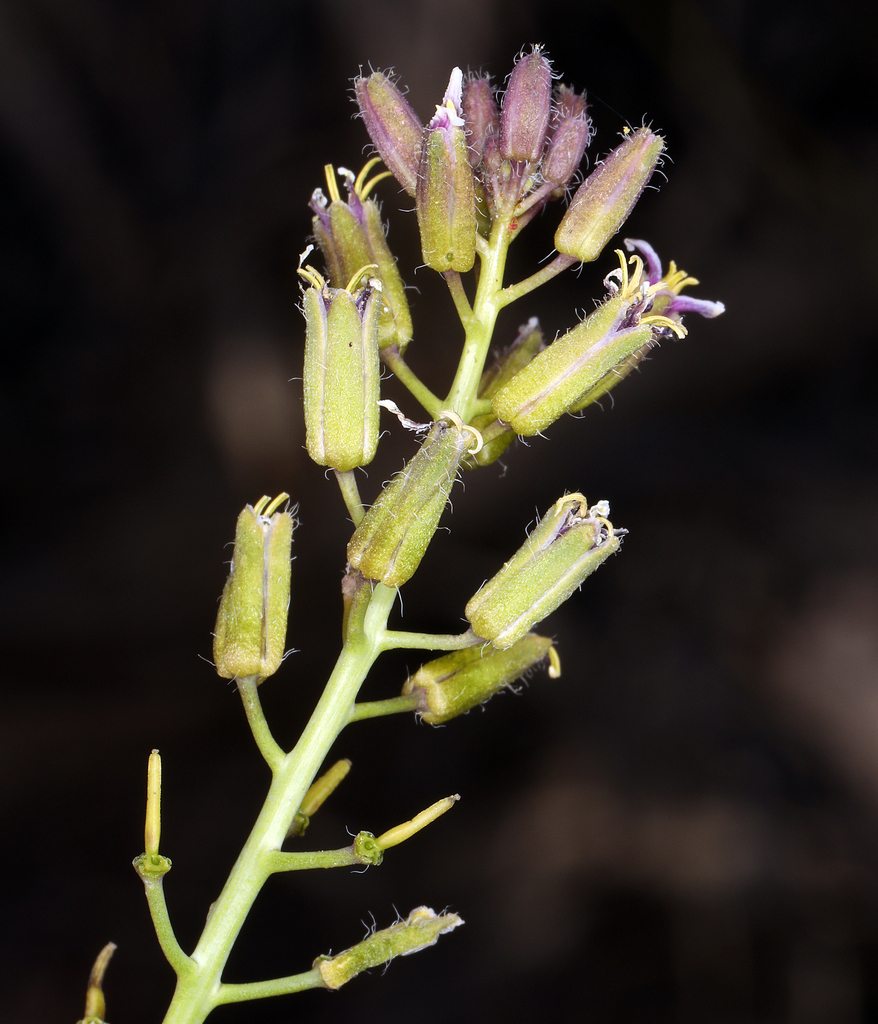
(c) Steve Matson, some rights reserved (CC BY), uploaded by Steve Matson · licence
Family: Brassicaceae · Type: Herb · Native
Caulanthus pilosus (Chocolate drops) is a native California herb in the Brassicaceae family, recognized by hairy throughout with very long curved fruits diagnostic.
Chocolate drops is a California native perennial found in central and eastern Sierra Nevada, southern Modoc Plateau near Honey Lake, eastern Sierra Nevada, and northern Desert Mountains in open, dry areas, sagebrush scrub, and pinyon/juniper woodland at elevations of 600 to 2,800 meters. Flowering from March to July, this plant produces white to purple flowers with wavy petal margins 7 to 12 millimeters long. Growing with erect or ascending hairy stems 20 to 120 centimeters tall that can be simple or branched, it has a moderately to densely hairy structure. Its lower leaves are 2 to 24 centimeters long, oblanceolate to oblong with pinnately lobed edges and dentate lobes, while upper leaves are linear to narrowly oblanceolate. The fruit is ascending to spreading, generally curved and 2 to 18 centimeters long with 152 to 198 small oblong seeds.
Identification and appearance
Key characters: 6 sympatric species; hairy throughout with very long curved fruits diagnostic
Habitat and range
Habitat: Uncommon. Open, dry areas, flats, rocky slopes, sagebrush scrub, pinyon/juniper woodland
Elevation: 600-2800 m
California counties: Inyo, Mono, Tulare, Kern, San Benito, Lassen, Madera, Santa Cruz
Outside California: to southeastern Oregon, southern Idaho, western Utah
Bloom period
Caulanthus pilosus blooms Mar-Jul.
How to tell it apart
vs Streptanthus: Seed pods are cylindrical and round versus flattened blade-like pods in Streptanthus.; vs Sisymbrium: Petals are distinctively crinkled and papery versus smooth petals in Sisymbrium.; vs Hirschfeldia: Young pods reflex sharply downward versus pointing upward or outward.; vs Boechera: Pods reflex downward and contain wingless seeds versus erect pods with winged seeds.; vs Brassica: Young seed pods bend sharply downward versus pointing upward in Brassica.
Frequently asked questions
Is Caulanthus pilosus native to California?
Yes. Caulanthus pilosus is native to California (recorded as native).
When does Caulanthus pilosus bloom?
Caulanthus pilosus blooms Mar-Jul.
Where in California does Caulanthus pilosus grow?
Caulanthus pilosus occurs in Inyo, Mono, Tulare, Kern, San Benito, Lassen, Madera, Santa Cruz, at elevations of 600-2800 m.
What plant family does Caulanthus pilosus belong to?
Caulanthus pilosus is in the Brassicaceae family, genus Caulanthus.
What habitat does Caulanthus pilosus grow in?
Caulanthus pilosus grows in Uncommon. Open, dry areas, flats, rocky slopes, sagebrush scrub, pinyon/juniper woodland.
Related species
Other California species in the same genus, family, or bioregion.
- Caulanthus simulans — Payson's jewelflower
- Caulanthus sp. — Jewelflower
- Caulanthus amplexicaulis — Clasping leaved caulanthus
- Caulanthus amplexicaulis var. barbarae — Santa Barbara Jewelflower
- Caulanthus anceps — Lemmon's mustard
- Caulanthus californicus — California jewelflower
- Chorispora sp.
- Chorispora tenella — Crossflower
Sources: Jepson eFlora · Index of California Plant Names · CalPhotos
Last updated 2026-10-07
Data from The California Species Project — 14,000+ California species with verified data from CNPS, CDFW, USFWS, Cal-IPC, and more.