Caulanthus simulans
Payson's jewelflower, Payson's Jewelflower
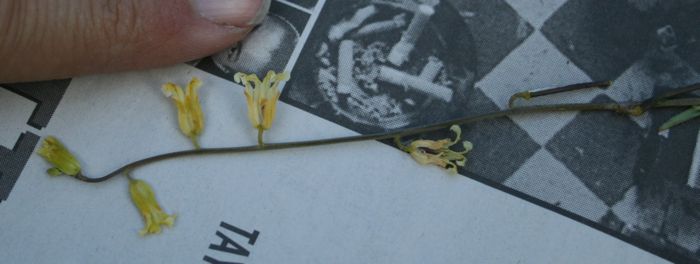
Photo by Chez Brungraber
Family: Brassicaceae · Type: Herb · Native
Conservation status: CNPS 4.2
Caulanthus simulans (Payson's jewelflower) is a native California herb in the Brassicaceae family, recognized by spreading bristly hairs with yellow sepals and pale petals diagnostic.
Payson's jewelflower is a California native annual found in eastern Santa Catalina Mountains, eastern Peninsular Ranges, and western edge of the Sonoran Desert in chaparral, scrub, and pinyon/juniper woodland at elevations of 400 to 2,200 meters. Flowering from March to June, this plant produces creamy white to pale yellow flowers with occasional purple midveins, approximately 10 to 14 millimeters long. Growing with erect stems 10 to 70 centimeters tall that are conspicuously spread with bristles, particularly near the base, and generally branched toward the top. Its leaves form a basal rosette of oblanceolate blades 1 to 8 centimeters long, coarsely dentate to pinnately lobed, with cauline leaves that are ovate to oblong and either coarsely toothed or entire. The fruit is distinctively reflexed, measuring 3 to 7.5 centimeters long and generally slightly curved.
Identification and appearance
Key characters: 3 sympatric species; spreading bristly hairs with yellow sepals and pale petals diagnostic
Habitat and range
Habitat: Chaparral, scrub, pinyon/juniper woodland
Elevation: 400-2200 m
California counties: Riverside, San Diego, Imperial
Bloom period
Caulanthus simulans blooms Mar-Jun.
Conservation status
CNPS 4.2
How to tell it apart
vs Streptanthus: Seed pods are cylindrical and round versus flattened blade-like pods in Streptanthus.; vs Sisymbrium: Petals are distinctively crinkled and papery versus smooth petals in Sisymbrium.; vs Hirschfeldia: Young pods reflex sharply downward versus pointing upward or outward.; vs Boechera: Pods reflex downward and contain wingless seeds versus erect pods with winged seeds.; vs Brassica: Young seed pods bend sharply downward versus pointing upward in Brassica.
Frequently asked questions
Is Caulanthus simulans native to California?
Yes. Caulanthus simulans is native to California (recorded as native).
When does Caulanthus simulans bloom?
Caulanthus simulans blooms Mar-Jun.
Where in California does Caulanthus simulans grow?
Caulanthus simulans occurs in Riverside, San Diego, Imperial, at elevations of 400-2200 m.
What plant family does Caulanthus simulans belong to?
Caulanthus simulans is in the Brassicaceae family, genus Caulanthus.
Is Caulanthus simulans rare or endangered?
Caulanthus simulans carries California Rare Plant Rank 4.2, state rank S4.
Related species
Other California species in the same genus, family, or bioregion.
- Caulanthus sp. — Jewelflower
- Caulanthus amplexicaulis — Clasping leaved caulanthus
- Caulanthus amplexicaulis var. barbarae — Santa Barbara Jewelflower
- Caulanthus anceps — Lemmon's mustard
- Caulanthus californicus — California jewelflower
- Caulanthus cooperi — Cooper caulanthus
- Chorispora sp.
- Chorispora tenella — Crossflower
- Cochlearia groenlandica — Greenland cochlearia
Sources: Jepson eFlora · CNPS Rare Plant Inventory · Index of California Plant Names · CalPhotos · CDFW CNDDB
Last updated 2026-10-07
Data from The California Species Project — 14,000+ California species with verified data from CNPS, CDFW, USFWS, Cal-IPC, and more.