Ceanothus gloriosus var. exaltatus
Glory brush
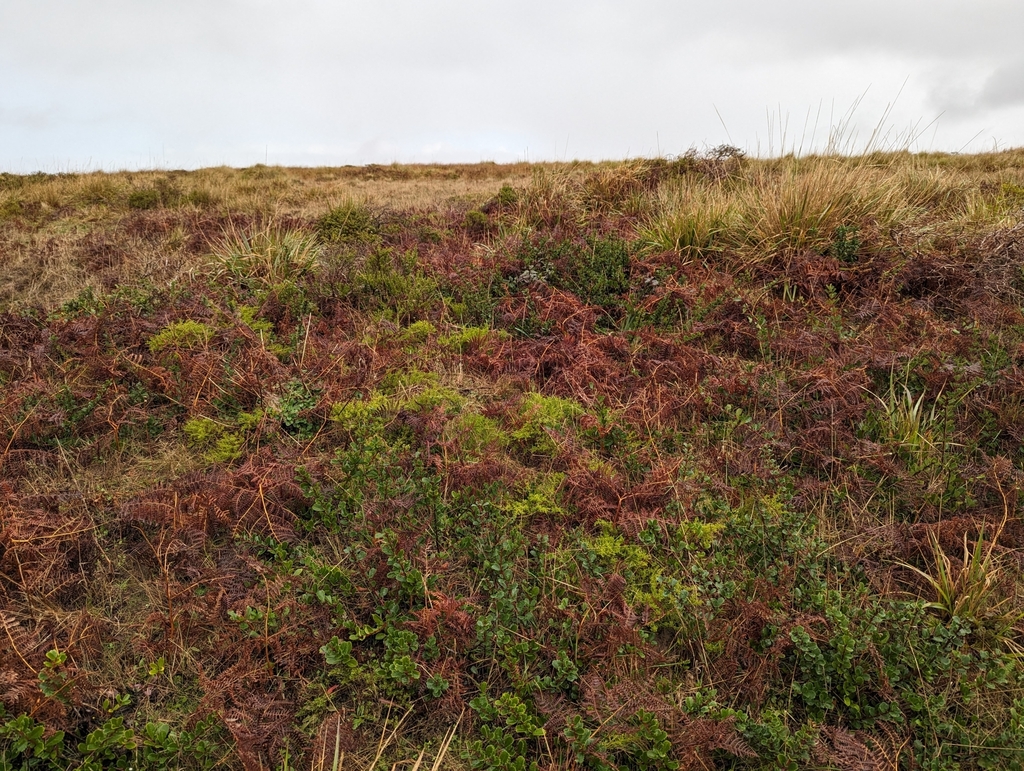
(c) Alexander Wentworth, some rights reserved (CC BY) · licence
Family: Rhamnaceae · Type: Shrub · Native
Conservation status: CNPS 4.3
Ceanothus gloriosus var. exaltatus (Glory brush) is a native California shrub in the Rhamnaceae family, recognized by . Erect growth form and large rounded leaves versus prostrate var. gloriosus.
Glory brush is a California native shrub found in northern coastal California, including the North Coast Ranges, San Francisco Bay Area, and northern coastal regions at elevations below 500 meters in sandy or rocky substrates. Flowering from March to May, this plant produces small blue to purple flowers in compact clusters. Growing to nearly 2 meters tall with spreading and arched stems that do not root at nodes, it forms an open, sculptural shape. Its leaves are widely obovate to nearly round, 13 to 45 millimeters long, with distinctive margins featuring 13 to 35 fine teeth. This shrub is a notable landscape plant with an elegant, architectural form characteristic of California's coastal chaparral zones.
Identification and appearance
Key characters: 38 sympatric species. Erect growth form and large rounded leaves versus prostrate var. gloriosus.
Habitat and range
Habitat: Sandy or rocky substrates
Elevation: < 500 m
California counties: Sonoma, Mendocino, Marin, Humboldt, Contra Costa
Bloom period
Ceanothus gloriosus var. exaltatus blooms Mar-May.
Conservation status
CNPS 4.3
How to tell it apart
vs Rhamnus: Ceanothus has showy blue/white/pink flowers in dense clusters; Rhamnus has tiny inconspicuous greenish flowers.; vs Quercus: Ceanothus has showy flower clusters and small leaves; Quercus has acorns and distinctive lobed or toothed oak leaves.; vs Baccharis: Ceanothus has individual flowers with 5 separate petals; Baccharis has composite flower heads with tiny disc flowers.; vs Cercocarpus: Ceanothus has blue/white/pink flowers in clusters; Cercocarpus has tiny flowers with no petals and feathery fruiting tails.; vs Adenostoma: Ceanothus flowers have 5 distinct colored petals; Adenostoma has tiny white flowers and needle-like clustered leaves.
Frequently asked questions
Is Ceanothus gloriosus var. exaltatus native to California?
Yes. Ceanothus gloriosus var. exaltatus is native to California (recorded as native).
When does Ceanothus gloriosus var. exaltatus bloom?
Ceanothus gloriosus var. exaltatus blooms Mar-May.
Where in California does Ceanothus gloriosus var. exaltatus grow?
Ceanothus gloriosus var. exaltatus occurs in Sonoma, Mendocino, Marin, Humboldt, Contra Costa, at elevations of < 500 m.
What plant family does Ceanothus gloriosus var. exaltatus belong to?
Ceanothus gloriosus var. exaltatus is in the Rhamnaceae family, genus Ceanothus.
Is Ceanothus gloriosus var. exaltatus rare or endangered?
Ceanothus gloriosus var. exaltatus carries California Rare Plant Rank 4.3, state rank S4.
Related species
Other California species in the same genus, family, or bioregion.
- Ceanothus gloriosus var. gloriosus — Point reyes ceanothus
- Ceanothus gloriosus var. porrectus — Mount vision ceanothus
- Ceanothus hearstiorum — Hearsts' ceanothus
- Ceanothus impressus — Santa barbara ceanothus
- Ceanothus impressus var. impressus — Santa barbara ceanothus
- Ceanothus impressus var. nipomensis — Nipomo mesa ceanothus
Sources: Jepson eFlora · CNPS Rare Plant Inventory · Index of California Plant Names · CalPhotos · CDFW CNDDB
Last updated 2026-10-07
Data from The California Species Project — 14,000+ California species with verified data from CNPS, CDFW, USFWS, Cal-IPC, and more.