Ceanothus integerrimus var. macrothyrsus
Deerbrush
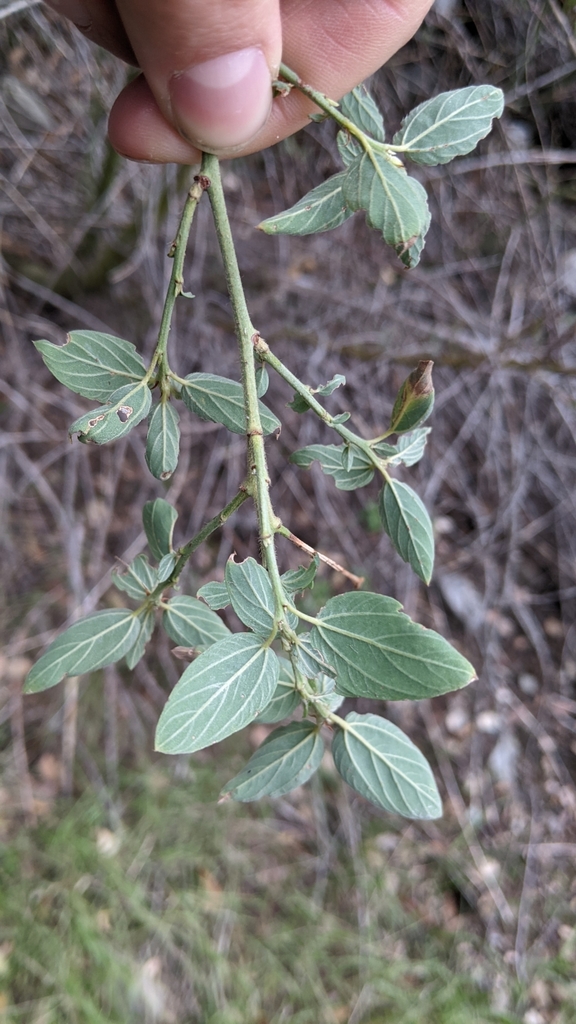
Photo: parent species Ceanothus integerrimus · (c) velodrome, some rights reserved (CC BY) · licence
Family: Rhamnaceae · Type: Tree · Native
Ceanothus integerrimus var. macrothyrsus (Deerbrush) is a native California tree in the Rhamnaceae family, recognized by deciduous nature and 3-ribbed leaves distinguish from parent species.
Deerbrush is a California native tree found in the Klamath Ranges, northern Coast Ranges, Cascade Range, Sierra Nevada, San Francisco Bay Area, southern Coast Ranges, Transverse Ranges, Peninsular Ranges, and Modoc Plateau in chaparral, oak woodland, and conifer forest at elevations of 70 to 2,600 meters. Flowering from May to July, this tree produces white to blue flowers, occasionally with pink tones, in distinctive clusters. Growing with multiple stems up to several meters tall, it develops a complex branching structure with dense foliage. Its leaves are three-ribbed from the base, ranging from lanceolate to widely ovate, creating a textured green canopy that provides important habitat and food for wildlife. The shrubby tree is particularly characteristic of California's diverse woodland and chaparral ecosystems, creating dense thickets in mixed plant communities.
Identification and appearance
Key characters: 57 sympatric species; deciduous nature and 3-ribbed leaves distinguish from parent species
Habitat and range
Habitat: Chaparral, oak woodland, conifer forest
Elevation: 70-2600 m
California counties: Fresno, Kern, Los Angeles, Trinity, Tulare, Siskiyou, Shasta, Butte, Tehama, Del Norte, San Bernardino, San Diego, El Dorado, Amador, Placer, Tuolumne, Mariposa, Plumas, Sonoma, Nevada, Yuba, Monterey, Calaveras, Mendocino, Humboldt, Glenn, Madera, Riverside, Orange, Stanislaus, Lake
Outside California: to Washington, Arizona, northern Mexico
Bloom period
Ceanothus integerrimus var. macrothyrsus blooms May-Jul.
How to tell it apart
vs Rhamnus: Ceanothus has showy blue/white/pink flowers in dense clusters; Rhamnus has tiny inconspicuous greenish flowers.; vs Quercus: Ceanothus has showy flower clusters and small leaves; Quercus has acorns and distinctive lobed or toothed oak leaves.; vs Baccharis: Ceanothus has individual flowers with 5 separate petals; Baccharis has composite flower heads with tiny disc flowers.; vs Cercocarpus: Ceanothus has blue/white/pink flowers in clusters; Cercocarpus has tiny flowers with no petals and feathery fruiting tails.; vs Adenostoma: Ceanothus flowers have 5 distinct colored petals; Adenostoma has tiny white flowers and needle-like clustered leaves.
Frequently asked questions
Is Ceanothus integerrimus var. macrothyrsus native to California?
Yes. Ceanothus integerrimus var. macrothyrsus is native to California (recorded as native).
When does Ceanothus integerrimus var. macrothyrsus bloom?
Ceanothus integerrimus var. macrothyrsus blooms May-Jul.
Where in California does Ceanothus integerrimus var. macrothyrsus grow?
Ceanothus integerrimus var. macrothyrsus occurs in Fresno, Kern, Los Angeles, Trinity, Tulare, Siskiyou, Shasta, Butte and other counties, at elevations of 70-2600 m.
What plant family does Ceanothus integerrimus var. macrothyrsus belong to?
Ceanothus integerrimus var. macrothyrsus is in the Rhamnaceae family, genus Ceanothus.
What habitat does Ceanothus integerrimus var. macrothyrsus grow in?
Ceanothus integerrimus var. macrothyrsus grows in Chaparral, oak woodland, conifer forest.
Related species
Other California species in the same genus, family, or bioregion.
Sources: Jepson eFlora · Index of California Plant Names · CalPhotos
Last updated 2026-09-30
Data from The California Species Project — 14,000+ California species with verified data from CNPS, CDFW, USFWS, Cal-IPC, and more.