Ceanothus roderickii
Pine hill ceanothus, Pine Hill Ceanothus
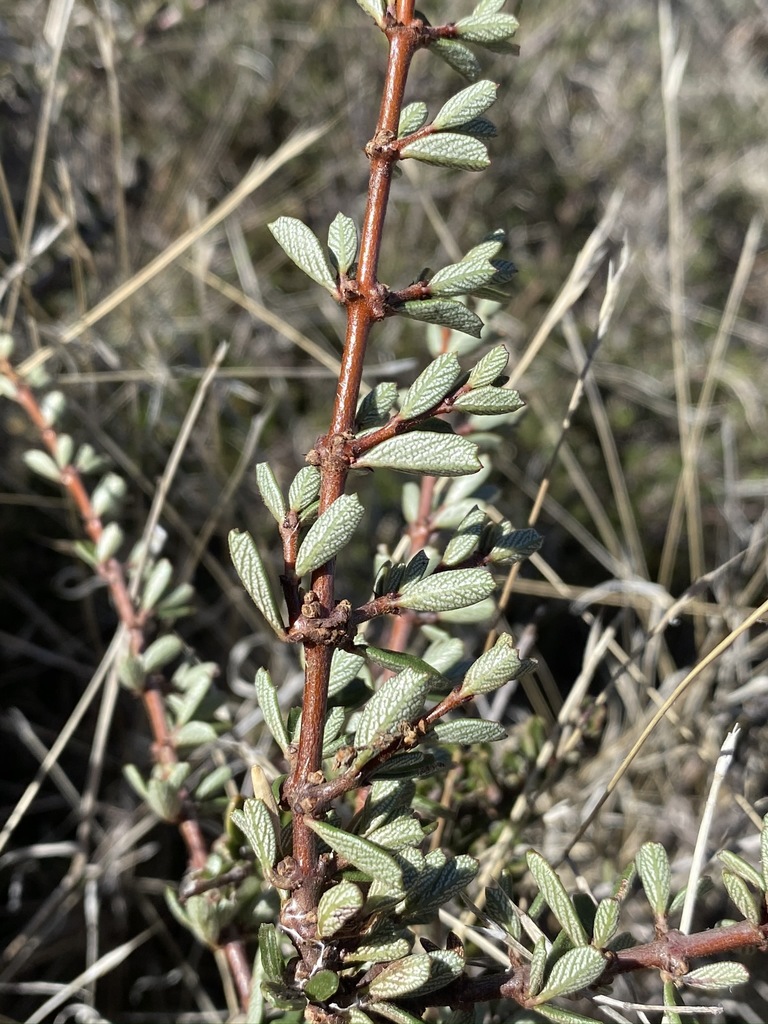
(c) Matt Berger, some rights reserved (CC BY) · licence
Family: Rhamnaceae · Type: Shrub · Native
Conservation status: CNPS 1B.1 · Endangered
Ceanothus roderickii (Pine hill ceanothus) is a native California shrub in the Rhamnaceae family, recognized by geographic isolation and specific gabbro substrate.
Pine hill ceanothus is a rare (CNPS 1B.1) California native shrub found in northern Sierra Nevada foothills in western El Dorado County, growing on rocky gabbro-derived substrates in chaparral and oak/pine woodland at elevations of 260 to 630 meters. Flowering from March to June, this plant produces white flowers tinged with blue in small umbel-like clusters less than one centimeter wide. Growing as a low, spreading mound less than half a meter tall, it features red-brown twigs and an occasionally arched, open growth habit that sometimes roots at its nodes. Its evergreen leaves are small and oblanceolate, typically 4 to 11 millimeters long, dull green on the upper surface and short-strigose between veins underneath, with entire margins and obtuse to slightly notched tips. The compact shrub forms mat- to mound-like clusters with erect leaves and distinctive knob-like stipules.
Identification and appearance
Key characters: 6 sympatric species; geographic isolation and specific gabbro substrate are diagnostic
Habitat and range
Habitat: Rocky, gabbro-derived substrates, chaparral, oak/pine woodland
Elevation: 260-630 m
California counties: El Dorado
Bloom period
Ceanothus roderickii blooms Mar-Jun.
Conservation status
CNPS 1B.1 · Endangered
How to tell it apart
vs Rhamnus: Ceanothus has showy blue/white/pink flowers in dense clusters; Rhamnus has tiny inconspicuous greenish flowers.; vs Quercus: Ceanothus has showy flower clusters and small leaves; Quercus has acorns and distinctive lobed or toothed oak leaves.; vs Baccharis: Ceanothus has individual flowers with 5 separate petals; Baccharis has composite flower heads with tiny disc flowers.; vs Cercocarpus: Ceanothus has blue/white/pink flowers in clusters; Cercocarpus has tiny flowers with no petals and feathery fruiting tails.; vs Adenostoma: Ceanothus flowers have 5 distinct colored petals; Adenostoma has tiny white flowers and needle-like clustered leaves.
Frequently asked questions
Is Ceanothus roderickii native to California?
Yes. Ceanothus roderickii is native to California (recorded as native).
When does Ceanothus roderickii bloom?
Ceanothus roderickii blooms Mar-Jun.
Where in California does Ceanothus roderickii grow?
Ceanothus roderickii occurs in El Dorado, at elevations of 260-630 m.
What plant family does Ceanothus roderickii belong to?
Ceanothus roderickii is in the Rhamnaceae family, genus Ceanothus.
Is Ceanothus roderickii rare or endangered?
Ceanothus roderickii carries California Rare Plant Rank 1B.1, state rank S1.
Related species
Other California species in the same genus, family, or bioregion.
Sources: Jepson eFlora · CNPS Rare Plant Inventory · Index of California Plant Names · CalPhotos · CDFW CNDDB
Last updated 2026-10-07
Data from The California Species Project — 14,000+ California species with verified data from CNPS, CDFW, USFWS, Cal-IPC, and more.