Ceanothus spinosus
Greenbark ceanothus
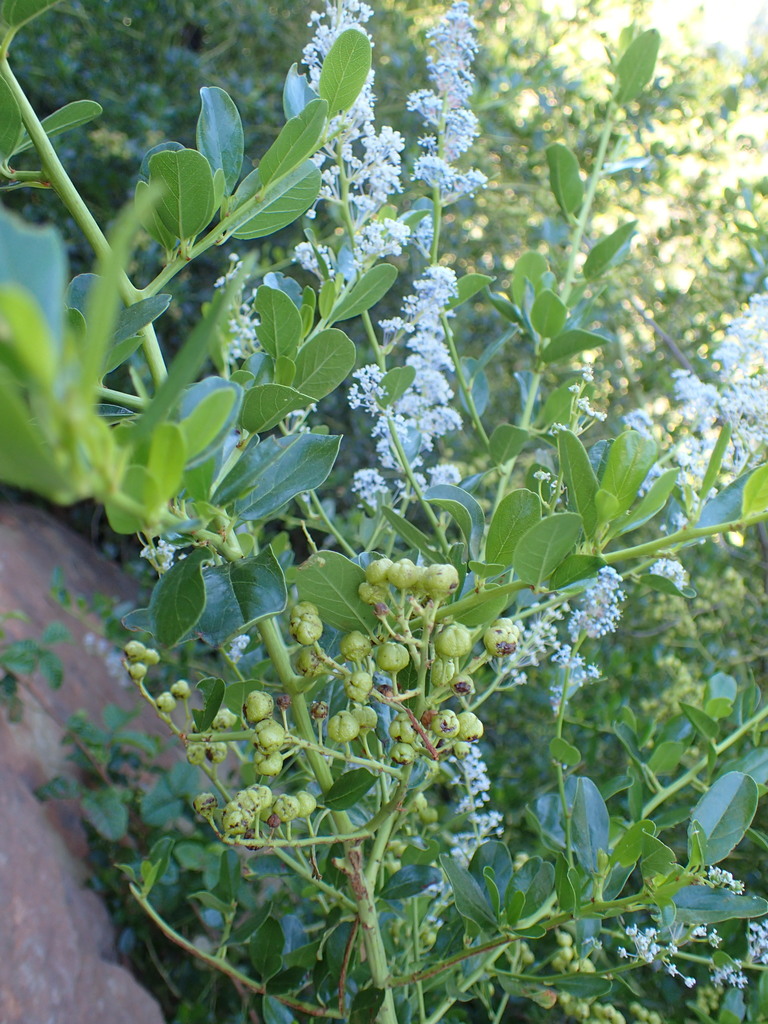
(c) George Williams, some rights reserved (CC BY) · licence
Family: Rhamnaceae · Type: Shrub / Tree · Native
Ceanothus spinosus (Greenbark ceanothus) is a native California shrub / tree in the Rhamnaceae family, recognized by tree-like size, green bark, and large flower clusters.
Greenbark ceanothus is a California native tree found in southern coastal and western transverse ranges including San Diego, Santa Barbara, and Los Angeles counties, growing on slopes and in chaparral at elevations below 1,200 meters. Flowering from January to May, this plant produces blue to pale blue flowers in raceme or panicle-like clusters 4 to 21 centimeters long. Growing up to 6 meters tall with flexible green twigs that can be thorn-like, it forms an open, occasionally tree-like structure with ascending to erect branches. Its alternate leaves are elliptic to oblong, 10 to 37 millimeters long, with a dark shiny green upper surface and a paler underside, featuring a single prominent rib from the base and an acute to obtuse tip. The fruit is compact, 4 to 7 millimeters wide, with distinctive three-ridged characteristics in its upper portion.
Identification and appearance
Key characters: 45 sympatric species; key features are tree-like size, green bark, and large flower clusters
Habitat and range
Habitat: Slopes, canyons, chaparral
Elevation: < 1200 m
California counties: San Diego, Los Angeles, Santa Barbara, San Luis Obispo, Orange, Ventura, Riverside, Alameda, San Bernardino, Solano, San Benito, Lake
Outside California: northern Baja California
Bloom period
Ceanothus spinosus blooms Jan-May.
How to tell it apart
vs Rhamnus: Ceanothus has showy blue/white/pink flowers in dense clusters; Rhamnus has tiny inconspicuous greenish flowers.; vs Quercus: Ceanothus has showy flower clusters and small leaves; Quercus has acorns and distinctive lobed or toothed oak leaves.; vs Baccharis: Ceanothus has individual flowers with 5 separate petals; Baccharis has composite flower heads with tiny disc flowers.; vs Cercocarpus: Ceanothus has blue/white/pink flowers in clusters; Cercocarpus has tiny flowers with no petals and feathery fruiting tails.; vs Adenostoma: Ceanothus flowers have 5 distinct colored petals; Adenostoma has tiny white flowers and needle-like clustered leaves.
Frequently asked questions
Is Ceanothus spinosus native to California?
Yes. Ceanothus spinosus is native to California (recorded as native).
When does Ceanothus spinosus bloom?
Ceanothus spinosus blooms Jan-May.
Where in California does Ceanothus spinosus grow?
Ceanothus spinosus occurs in San Diego, Los Angeles, Santa Barbara, San Luis Obispo, Orange, Ventura, Riverside, Alameda and other counties, at elevations of < 1200 m.
What plant family does Ceanothus spinosus belong to?
Ceanothus spinosus is in the Rhamnaceae family, genus Ceanothus.
What habitat does Ceanothus spinosus grow in?
Ceanothus spinosus grows in Slopes, canyons, chaparral.
Related species
Other California species in the same genus, family, or bioregion.
Sources: Jepson eFlora · Index of California Plant Names · CalPhotos
Last updated 2026-10-07
Data from The California Species Project — 14,000+ California species with verified data from CNPS, CDFW, USFWS, Cal-IPC, and more.