Ceanothus thyrsiflorus var. obispoensis
Hollister peak ceanothus
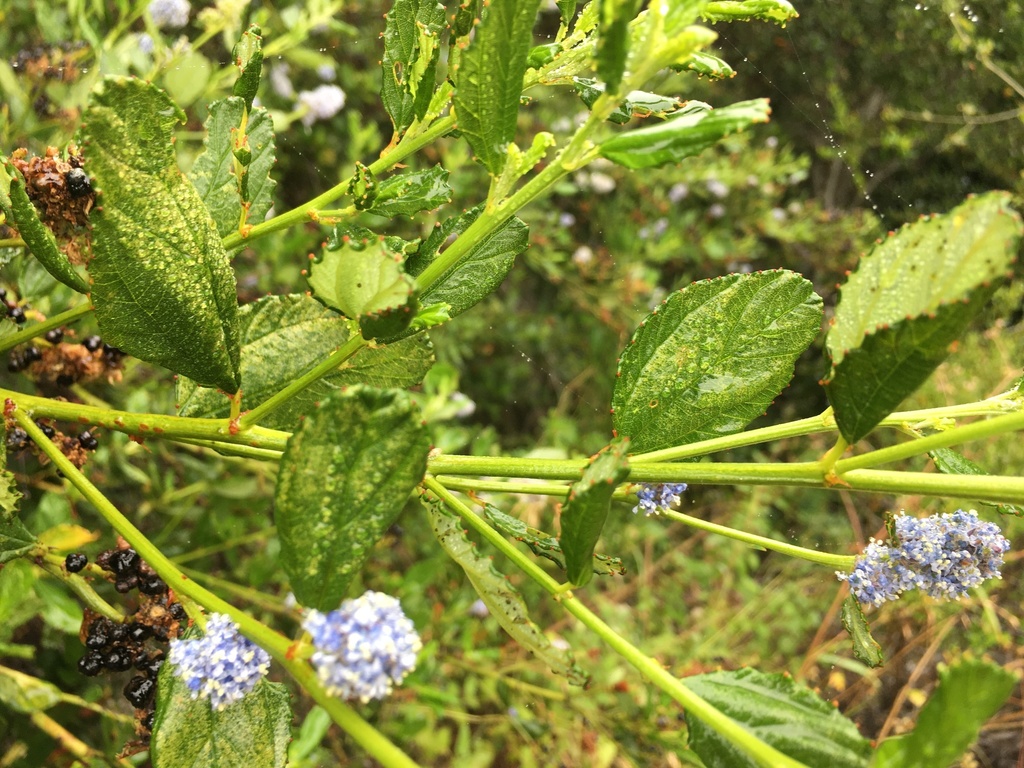
Photo: parent species Ceanothus thyrsiflorus · (c) Henrik Kibak, some rights reserved (CC BY) · licence
Family: Rhamnaceae · Type: Tree · Native
Conservation status: CNPS 1B.1
Ceanothus thyrsiflorus var. obispoensis (Hollister peak ceanothus) is a native California tree in the Rhamnaceae family, recognized by curly hairs on upper leaf surface and specific substrate.
Hollister peak ceanothus is a rare (CNPS 1B.1) California native tree found in coastal scrub, chaparral, and oak woodland on dacite-derived soils in central California at elevations of 140 to 230 meters. Flowering from January to April, this plant produces pale blue to white flowers in dense, elongated clusters. Growing as an erect, open tree up to 4 meters tall with puberulent to tomentose twigs, it develops a distinctive branching structure. Its leaves are ovate to elliptic with margins rolled under, densely covered in short, curly hairs on the upper surface, particularly when young. The tree's compact form and uniquely textured foliage make it a distinctive element of its native chaparral landscape.
Identification and appearance
Key characters: 54 sympatric species; key features are curly hairs on upper leaf surface and specific substrate
Habitat and range
Habitat: Dacite-derived soils, canyons, chaparral, coastal scrub, oak woodland
Elevation: 140-230 m
Bloom period
Ceanothus thyrsiflorus var. obispoensis blooms Jan-Apr.
Conservation status
CNPS 1B.1
How to tell it apart
vs Rhamnus: Ceanothus has showy blue/white/pink flowers in dense clusters; Rhamnus has tiny inconspicuous greenish flowers.; vs Quercus: Ceanothus has showy flower clusters and small leaves; Quercus has acorns and distinctive lobed or toothed oak leaves.; vs Baccharis: Ceanothus has individual flowers with 5 separate petals; Baccharis has composite flower heads with tiny disc flowers.; vs Cercocarpus: Ceanothus has blue/white/pink flowers in clusters; Cercocarpus has tiny flowers with no petals and feathery fruiting tails.; vs Adenostoma: Ceanothus flowers have 5 distinct colored petals; Adenostoma has tiny white flowers and needle-like clustered leaves.
Frequently asked questions
Is Ceanothus thyrsiflorus var. obispoensis native to California?
Yes. Ceanothus thyrsiflorus var. obispoensis is native to California (recorded as native).
When does Ceanothus thyrsiflorus var. obispoensis bloom?
Ceanothus thyrsiflorus var. obispoensis blooms Jan-Apr.
What plant family does Ceanothus thyrsiflorus var. obispoensis belong to?
Ceanothus thyrsiflorus var. obispoensis is in the Rhamnaceae family, genus Ceanothus.
Is Ceanothus thyrsiflorus var. obispoensis rare or endangered?
Ceanothus thyrsiflorus var. obispoensis carries California Rare Plant Rank 1B.1, state rank S1.
What habitat does Ceanothus thyrsiflorus var. obispoensis grow in?
Ceanothus thyrsiflorus var. obispoensis grows in Dacite-derived soils, canyons, chaparral, coastal scrub, oak woodland.
Related species
Other California species in the same genus, family, or bioregion.
Sources: Jepson eFlora · CalPhotos · CDFW CNDDB
Last updated 2026-09-30
Data from The California Species Project — 14,000+ California species with verified data from CNPS, CDFW, USFWS, Cal-IPC, and more.