Ceanothus velutinus
Snowbrush
(c) Aiva Noringseth, some rights reserved (CC BY) · licence
Family: Rhamnaceae · Type: Shrub / Tree · Native
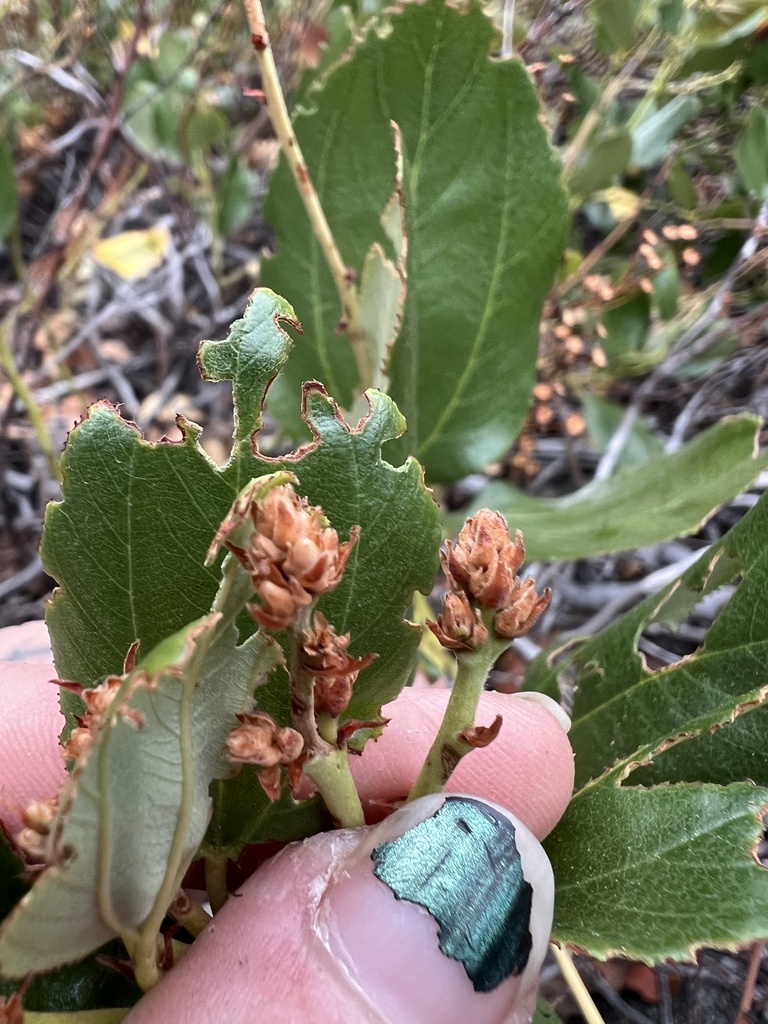
Ceanothus velutinus (Snowbrush) is a native California shrub / tree in the Rhamnaceae family, recognized by large sticky aromatic leaves with many tiny teeth.
Snowbrush is a California native shrub found in the Klamath Ranges, northern California Coast Ranges, high Cascade Range, Sierra Nevada, northern San Francisco Bay Area, Warner Mountains, and eastern Sierra Nevada in open, rocky slopes at elevations of 90 to 3,050 meters. Flowering from April to July, this plant produces white flowers in panicle-like clusters 3 to 8 centimeters long, creating delicate branching inflorescences. Growing up to 6 meters tall with erect stems and flexible green to red-brown twigs, the plant develops an open, spreading habit. Its evergreen leaves are widely elliptic to ovate, leathery and aromatic, with shiny green surfaces, measuring 33 to 75 millimeters long and 13 to 55 millimeters wide, featuring minutely gland-toothed margins with 90 to 150 tiny teeth. The fruit is brown, sticky, and 3 to 4.5 millimeters wide, often wrinkled and without distinctive horns.
Identification and appearance
Key characters: 43 sympatric species; key features are large sticky aromatic leaves with many tiny teeth
Habitat and range
Habitat: Open, rocky slopes
Elevation: 90-3050 m
California counties: Humboldt, Mendocino, Modoc, Sierra, Mono, Siskiyou, Lassen, Plumas, Shasta, Inyo, Trinity, Alpine, Nevada, El Dorado, Butte, Placer, Sonoma, Tulare, San Bernardino, Del Norte, Napa, Marin, Santa Cruz, Tehama, Tuolumne, Fresno, San Diego, Riverside, Monterey, Lake
Outside California: to British Columbia, South Dakota
Bloom period
Ceanothus velutinus blooms Apr-Jul.
How to tell it apart
vs Rhamnus: Ceanothus has showy blue/white/pink flowers in dense clusters; Rhamnus has tiny inconspicuous greenish flowers.; vs Quercus: Ceanothus has showy flower clusters and small leaves; Quercus has acorns and distinctive lobed or toothed oak leaves.; vs Baccharis: Ceanothus has individual flowers with 5 separate petals; Baccharis has composite flower heads with tiny disc flowers.; vs Cercocarpus: Ceanothus has blue/white/pink flowers in clusters; Cercocarpus has tiny flowers with no petals and feathery fruiting tails.; vs Adenostoma: Ceanothus flowers have 5 distinct colored petals; Adenostoma has tiny white flowers and needle-like clustered leaves.
Frequently asked questions
Is Ceanothus velutinus native to California?
Yes. Ceanothus velutinus is native to California (recorded as native).
When does Ceanothus velutinus bloom?
Ceanothus velutinus blooms Apr-Jul.
Where in California does Ceanothus velutinus grow?
Ceanothus velutinus occurs in Humboldt, Mendocino, Modoc, Sierra, Mono, Siskiyou, Lassen, Plumas and other counties, at elevations of 90-3050 m.
What plant family does Ceanothus velutinus belong to?
Ceanothus velutinus is in the Rhamnaceae family, genus Ceanothus.
What habitat does Ceanothus velutinus grow in?
Ceanothus velutinus grows in Open, rocky slopes.
Related species
Other California species in the same genus, family, or bioregion.
- Ceanothus verrucosus — Wart-stemmed ceanothus
- Ceanothus arboreus — Feltleaf ceanothus
- Ceanothus arcuatus — Arching ceanothus
- Ceanothus confusus — Rincon ridge ceanothus
- Ceanothus cordulatus — Mountain whitethorn
- Ceanothus crassifolius — Hoaryleaf ceanothus
- Colubrina californica — Las animas colubrina
- Colubrina sp.
- Condalia globosa var. pubescens — Spiny abrojo
Sources: Jepson eFlora · Index of California Plant Names · CalPhotos
Last updated 2026-10-07
Data from The California Species Project — 14,000+ California species with verified data from CNPS, CDFW, USFWS, Cal-IPC, and more.