Cenchrus echinatus
Southern sandbur
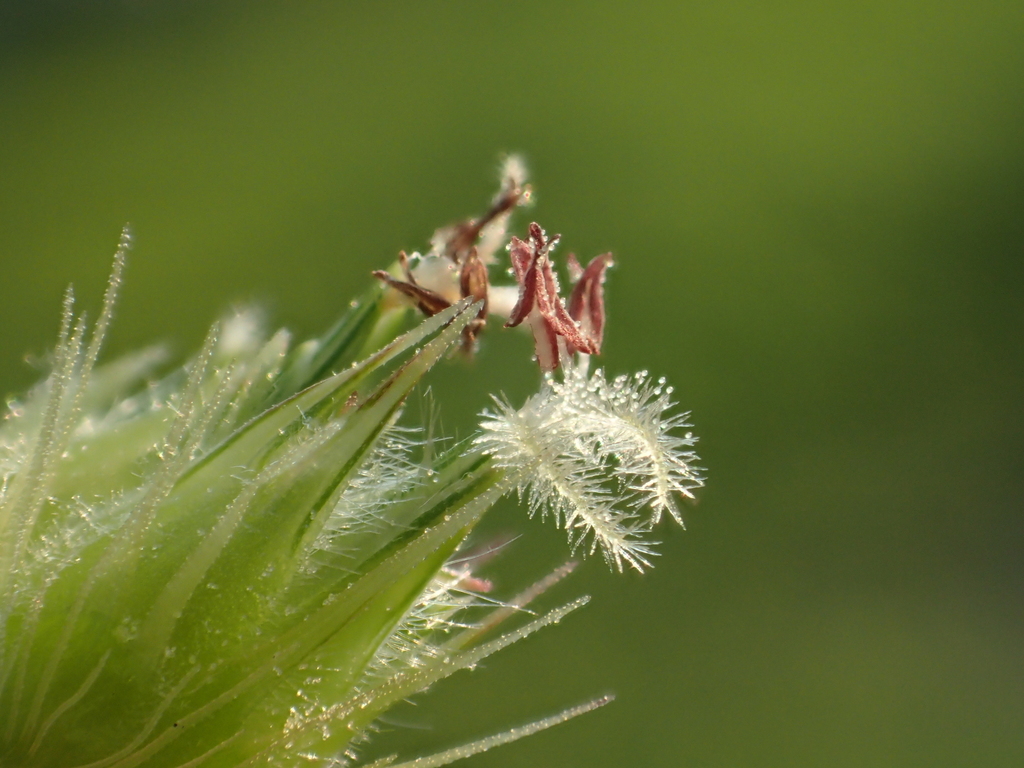
no rights reserved, uploaded by 葉子 · CC0
Family: Poaceae · Type: Grass · Not Native
Conservation status: Cal-IPC Yes
Cenchrus echinatus (Southern sandbur) is a non-native California grass in the Poaceae family, recognized by (C. longispinus); distinguished by bur bristle arrangement and spikelet characteristics.
Southern sandbur is a naturalized annual grass found in southern California regions including Solano County, San Diego County, Peninsular Ranges, and desert areas at elevations generally below 700 meters. Flowering in October, this plant produces green spikelets in dense, spherical burs with sharp bristles. Growing with stems 10 to 50 centimeters tall, it spreads across disturbed places and fields with grass blades 6 to 20 centimeters long and 2 to 10 millimeters wide. Its distinctive burs contain 2 to 3 spikelets, with inner bracts forming a cup-like structure that traps and disperses seeds. The plant's cylindrical outer bracts and pubescent inner bracts create a unique, spiky seed cluster that helps distinguish it from other grasses.
Identification and appearance
Key characters: 1 sympatric species (C. longispinus); distinguished by bur bristle arrangement and spikelet characteristics
Habitat and range
Habitat: Disturbed places, fields
Elevation: generally < 700 m
California counties: Imperial, Los Angeles, Riverside, San Diego, Solano, Santa Barbara, San Bernardino, Ventura
Outside California: native to southern United States, Mexico, Central America, South America
Bloom period
Cenchrus echinatus blooms Oct.
Conservation status
Cal-IPC Yes
How to tell it apart
vs Setaria: Cenchrus spikelets are enclosed in a hard spiny bur; Setaria (foxtail) has free bristles beneath the spikelets and forms no bur.; vs Pennisetum: Cenchrus bristles fuse into a clinging spiny burr; Pennisetum (fountain grass) has free, plumose bristles forming a soft brush.; vs Hordeum: Cenchrus disperses as spherical spiny burs; Hordeum (foxtail barley) disperses as barbed awns breaking from a spike.; vs Bromus: Cenchrus has globular spiny burs; Bromus has awned florets in open nodding panicles, with no burs.; vs Tragus: Cenchrus burs are large (5-10 mm) with stout flattened spines fused into a cup; Tragus burs are tiny (2-4 mm) with rows of small hooked bristles.
Frequently asked questions
Is Cenchrus echinatus native to California?
No. Cenchrus echinatus is not native to California (recorded as not native).
When does Cenchrus echinatus bloom?
Cenchrus echinatus blooms Oct.
Where in California does Cenchrus echinatus grow?
Cenchrus echinatus occurs in Imperial, Los Angeles, Riverside, San Diego, Solano, Santa Barbara, San Bernardino, Ventura, at elevations of generally < 700 m.
What plant family does Cenchrus echinatus belong to?
Cenchrus echinatus is in the Poaceae family, genus Cenchrus.
Is Cenchrus echinatus invasive in California?
Cenchrus echinatus is listed by Cal-IPC with an invasiveness rating of Yes.
Related species
Other California species in the same genus, family, or bioregion.
Sources: Jepson eFlora · Index of California Plant Names · CalPhotos
Last updated 2026-10-07
Data from The California Species Project — 14,000+ California species with verified data from CNPS, CDFW, USFWS, Cal-IPC, and more.