Cenchrus longispinus
Mat sandbur
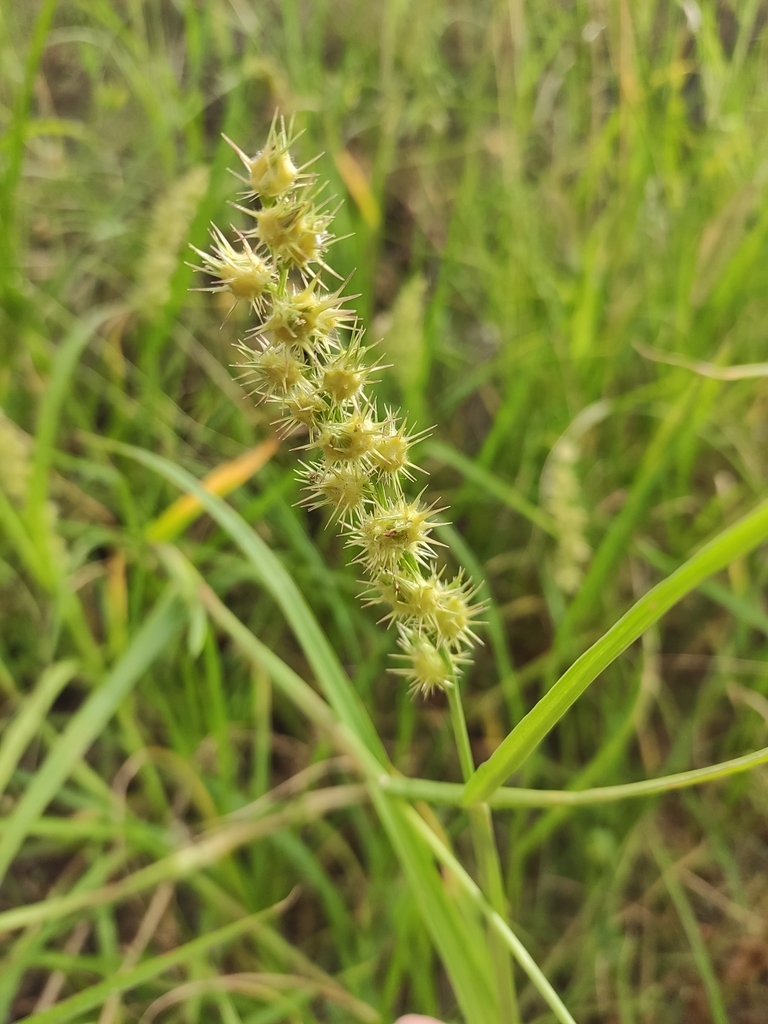
(c) KAnatoliy, some rights reserved (CC BY) · licence
Family: Poaceae · Type: Grass · Not Native
Conservation status: Cal-IPC Yes
Cenchrus longispinus (Mat sandbur) is a non-native California grass in the Poaceae family, recognized by (C. echinatus); distinguished by numerous reflexed outer bur bristles and cup formation.
Mat sandbur is a naturalized annual grass found in southern San Joaquin Valley, southern coastal ranges, Peninsular Ranges, Mojave Desert, and Modoc Plateau at elevations below 1,500 meters in disturbed areas. Flowering from July to September, this plant produces green spikelets with distinctive burrlike seed heads that attach easily to clothing and animal fur. Growing with decumbent stems 10 to 90 centimeters long, it spreads across the ground in sprawling patches. Its leaves are narrow, 4 to 28 centimeters long and 1.5 to 5 millimeters wide, with strongly keeled sheaths and short ligules about 1 millimeter long. The seed heads are particularly notable, with 45 to 75 bracts forming a cylindric, reflexed cup that efficiently traps and disperses seeds.
Identification and appearance
Key characters: 1 sympatric species (C. echinatus); distinguished by numerous reflexed outer bur bristles and cup formation
Habitat and range
Habitat: Disturbed areas
Elevation: < 1500 m
California counties: Kern, Fresno, Imperial, Los Angeles, San Bernardino, Merced, Orange, Riverside, San Diego, Ventura, El Dorado, Lassen, Yolo, Stanislaus, Solano, Santa Barbara, Tuolumne, San Joaquin, Glenn, Contra Costa
Outside California: widespread in United States, Canada, native to central and eastern US
Bloom period
Cenchrus longispinus blooms Jul-Sep.
Conservation status
Cal-IPC Yes
How to tell it apart
vs Setaria: Cenchrus spikelets are enclosed in a hard spiny bur; Setaria (foxtail) has free bristles beneath the spikelets and forms no bur.; vs Pennisetum: Cenchrus bristles fuse into a clinging spiny burr; Pennisetum (fountain grass) has free, plumose bristles forming a soft brush.; vs Hordeum: Cenchrus disperses as spherical spiny burs; Hordeum (foxtail barley) disperses as barbed awns breaking from a spike.; vs Bromus: Cenchrus has globular spiny burs; Bromus has awned florets in open nodding panicles, with no burs.; vs Tragus: Cenchrus burs are large (5-10 mm) with stout flattened spines fused into a cup; Tragus burs are tiny (2-4 mm) with rows of small hooked bristles.
Frequently asked questions
Is Cenchrus longispinus native to California?
No. Cenchrus longispinus is not native to California (recorded as not native).
When does Cenchrus longispinus bloom?
Cenchrus longispinus blooms Jul-Sep.
Where in California does Cenchrus longispinus grow?
Cenchrus longispinus occurs in Kern, Fresno, Imperial, Los Angeles, San Bernardino, Merced, Orange, Riverside and other counties, at elevations of < 1500 m.
What plant family does Cenchrus longispinus belong to?
Cenchrus longispinus is in the Poaceae family, genus Cenchrus.
Is Cenchrus longispinus invasive in California?
Cenchrus longispinus is listed by Cal-IPC with an invasiveness rating of Yes.
Related species
Other California species in the same genus, family, or bioregion.
Sources: Jepson eFlora · Index of California Plant Names · CalPhotos
Last updated 2026-10-07
Data from The California Species Project — 14,000+ California species with verified data from CNPS, CDFW, USFWS, Cal-IPC, and more.