Centaurea benedicta
Blessed thistle
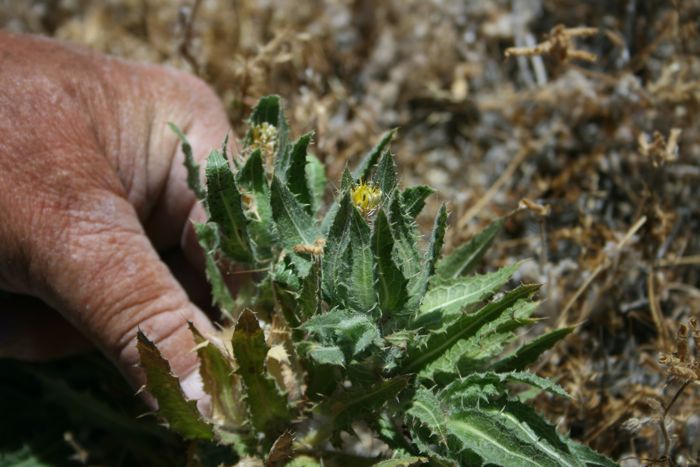
Photo by Chez Brungraber
Family: Asteraceae · Type: Herb · Not Native
Centaurea benedicta (Blessed thistle) is a non-native California herb in the Asteraceae family, recognized by yellow flowers and involucre-like bracts.
Blessed thistle is a naturalized annual found in northwestern California, southern Sierra Nevada, Great Valley, coastal western California, southwestern California, and western Mojave Desert in roadsides and disturbed places at elevations below 1,700 meters. Flowering from April to June, this plant produces yellow flowers in disciform heads with distinctive green or straw-colored involucres surrounded by wide, leaf-like bracts. Growing up to one meter tall with erect to wide-spreading stems that are loosely to densely covered in long, crinkled hairs and finer cobwebby hairs, it spreads widely in disturbed landscapes. Its leaves range from oblanceolate to elliptic, with basal and lower stem leaves 10 to 20 centimeters long, coarsely lobed and dentate with weakly spine-tipped edges. The fruit is straw-colored, 8 to 11 millimeters long with 20 ribs and a 10-toothed rim.
Identification and appearance
Key characters: 15 sympatric species; yellow flowers and involucre-like bracts are diagnostic
Habitat and range
Habitat: Roadsides, disturbed places
Elevation: < 1700 m
Outside California: to eastern United States, native to Europe
Bloom period
Centaurea benedicta blooms Apr-Jun.
How to tell it apart
vs Cirsium: Cirsium bracts taper to simple spines; Centaurea bract tips expanded with fringed/toothed edges; vs Carduus: Carduus bracts spine-tipped but not fringed; Centaurea bract appendages distinctly fringed or toothed; vs Jacobaea: Jacobaea has obvious yellow ray flowers; Centaurea lacks true rays (all tubular flowers); vs Silybum: Silybum has white-veined leaves and simple spine-tipped bracts; Centaurea bracts ornately fringed; vs Eriophorum: Eriophorum is a sedge with grass-like leaves and cottony heads; Centaurea is a branched herb
Frequently asked questions
Is Centaurea benedicta native to California?
No. Centaurea benedicta is not native to California (recorded as not native).
When does Centaurea benedicta bloom?
Centaurea benedicta blooms Apr-Jun.
What plant family does Centaurea benedicta belong to?
Centaurea benedicta is in the Asteraceae family, genus Centaurea.
What habitat does Centaurea benedicta grow in?
Centaurea benedicta grows in Roadsides, disturbed places.
Related species
Other California species in the same genus, family, or bioregion.
Sources: Jepson eFlora · Index of California Plant Names · CalPhotos
Last updated 2026-10-07
Data from The California Species Project — 14,000+ California species with verified data from CNPS, CDFW, USFWS, Cal-IPC, and more.