Centaurea calcitrapa
Purple star-thistle
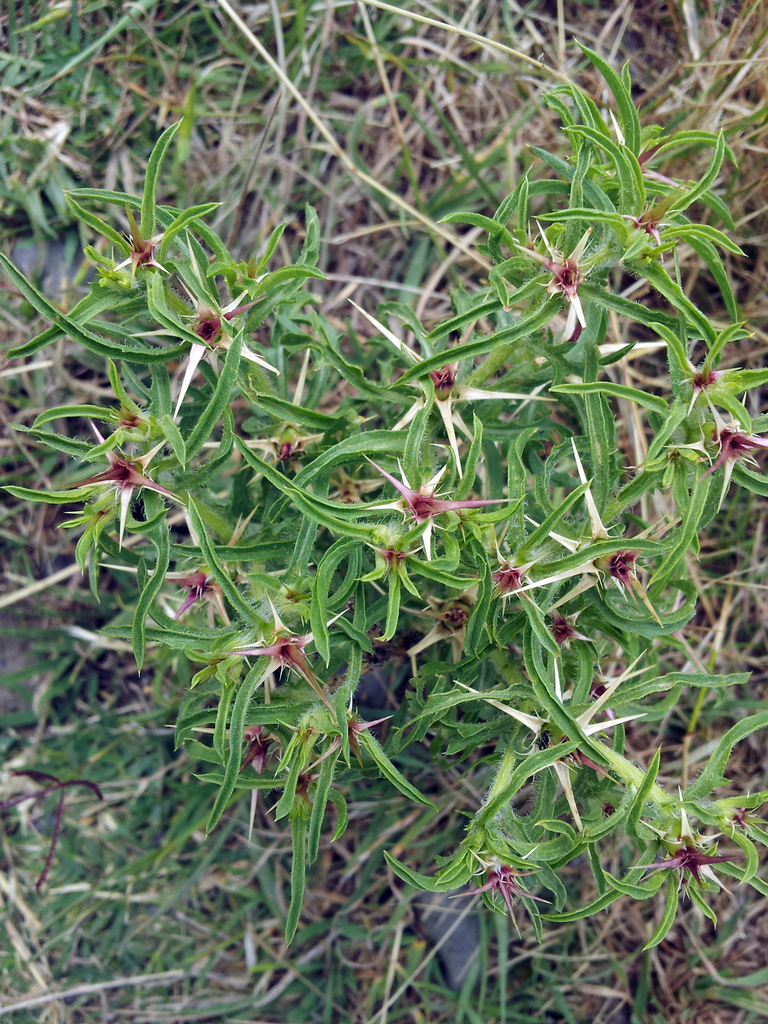
no rights reserved, uploaded by Peter de Lange · CC0
Family: Asteraceae · Type: Herb · Not Native
Conservation status: Cal-IPC Yes
Centaurea calcitrapa (Purple star-thistle) is a non-native California herb in the Asteraceae family, recognized by long stout spines (10-25mm) and sessile heads.
Purple star-thistle is a naturalized perennial herb found in northwestern California, southern California Ranges, Sierra Nevada Foothills, northern Sierra Nevada, Central Valley, central western, and southwestern California in pastures and disturbed places at elevations generally below 1,000 meters. Flowering from April to November, this plant produces distinctive purple flowers with spiny-fringed involucre bracts and sharp tip-spines 10 to 25 millimeters long. Growing 2 to 10 meters tall with a bushy, often mounded appearance, the plant has wide-spreading stems that branch throughout. Its leaves range from deeply divided basal leaves 10 to 20 centimeters long to narrow, sessile cauline leaves that can be entire, toothed, or divided into slender lobes. The plant forms dense, prickly clusters with lance-linear bracts surrounding each flower head, creating a distinctive and formidable appearance in disturbed landscapes.
Identification and appearance
Key characters: 15 sympatric species; long stout spines (10-25mm) and sessile heads are diagnostic
Habitat and range
Habitat: Pastures, disturbed places
Elevation: generally < 1000 m
Outside California: native to southern Europe
Bloom period
Centaurea calcitrapa blooms Apr-Nov.
Conservation status
Cal-IPC Yes
How to tell it apart
vs Cirsium: Cirsium bracts taper to simple spines; Centaurea bract tips expanded with fringed/toothed edges; vs Carduus: Carduus bracts spine-tipped but not fringed; Centaurea bract appendages distinctly fringed or toothed; vs Jacobaea: Jacobaea has obvious yellow ray flowers; Centaurea lacks true rays (all tubular flowers); vs Silybum: Silybum has white-veined leaves and simple spine-tipped bracts; Centaurea bracts ornately fringed; vs Eriophorum: Eriophorum is a sedge with grass-like leaves and cottony heads; Centaurea is a branched herb
Frequently asked questions
Is Centaurea calcitrapa native to California?
No. Centaurea calcitrapa is not native to California (recorded as not native).
When does Centaurea calcitrapa bloom?
Centaurea calcitrapa blooms Apr-Nov.
What plant family does Centaurea calcitrapa belong to?
Centaurea calcitrapa is in the Asteraceae family, genus Centaurea.
Is Centaurea calcitrapa invasive in California?
Centaurea calcitrapa is listed by Cal-IPC with an invasiveness rating of Yes.
What habitat does Centaurea calcitrapa grow in?
Centaurea calcitrapa grows in Pastures, disturbed places.
Related species
Other California species in the same genus, family, or bioregion.
Sources: Jepson eFlora · Index of California Plant Names · CalPhotos
Last updated 2026-10-07
Data from The California Species Project — 14,000+ California species with verified data from CNPS, CDFW, USFWS, Cal-IPC, and more.