Centaurea iberica
Iberian star-thistle, Iberian Star-Thistle
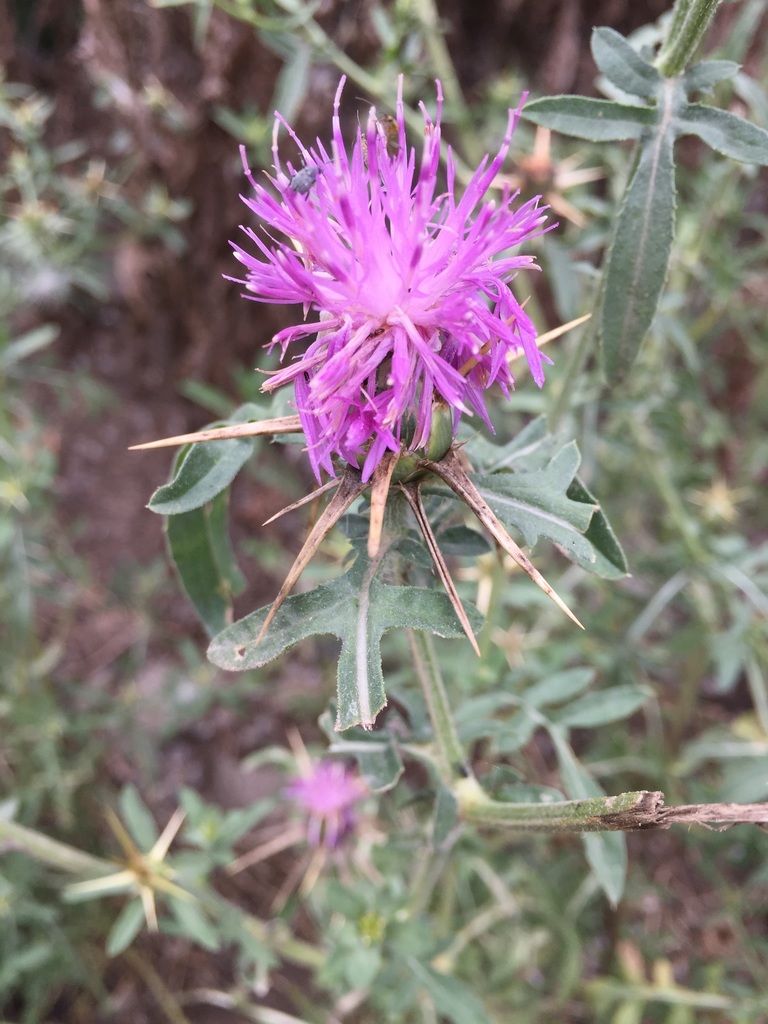
(c) Andre Hosper, some rights reserved (CC BY) · licence
Family: Asteraceae · Type: Herb · Not Native
Centaurea iberica (Iberian star-thistle) is a non-native California herb in the Asteraceae family, recognized by shorter spines (10-25mm), peduncled heads, and rose-pink flowers distinguish from C. calcitrapa.
Iberian star-thistle is a naturalized perennial herb found in southern North Coast Ranges Interior, northern and central Sierra Nevada Foothills, central Great Valley, Central Western California, southern Southern California, and Peninsular Ranges at elevations below 1,000 meters in disturbed places. Flowering from June to August, this plant produces rose-pink to white flowers in disciform heads with distinctive spiny involucres 15 to 18 millimeters long. Growing 50 to 100 centimeters tall with openly branched stems that are loosely tomentose and becoming somewhat glabrous, it has a resinous appearance. Its leaves range from deeply lobed proximal leaves 10 to 20 centimeters long to more oblong distal leaves that are entire or slightly toothed, with short rough hairs when young. The fruit is approximately 3 millimeters long, white or straw-colored, with sparse pappus bristles 1 to 2.5 millimeters in length.
Identification and appearance
Key characters: 11 sympatric species; shorter spines (10-25mm), peduncled heads, and rose-pink flowers distinguish from C. calcitrapa
Habitat and range
Habitat: Disturbed places
Elevation: < 1000 m
Outside California: native to southeastern Europe
Bloom period
Centaurea iberica blooms Jun-Aug.
How to tell it apart
vs Cirsium: Cirsium bracts taper to simple spines; Centaurea bract tips expanded with fringed/toothed edges; vs Carduus: Carduus bracts spine-tipped but not fringed; Centaurea bract appendages distinctly fringed or toothed; vs Jacobaea: Jacobaea has obvious yellow ray flowers; Centaurea lacks true rays (all tubular flowers); vs Silybum: Silybum has white-veined leaves and simple spine-tipped bracts; Centaurea bracts ornately fringed; vs Eriophorum: Eriophorum is a sedge with grass-like leaves and cottony heads; Centaurea is a branched herb
Frequently asked questions
Is Centaurea iberica native to California?
No. Centaurea iberica is not native to California (recorded as not native).
When does Centaurea iberica bloom?
Centaurea iberica blooms Jun-Aug.
What plant family does Centaurea iberica belong to?
Centaurea iberica is in the Asteraceae family, genus Centaurea.
What habitat does Centaurea iberica grow in?
Centaurea iberica grows in Disturbed places.
Related species
Other California species in the same genus, family, or bioregion.
Sources: Jepson eFlora · CalPhotos
Last updated 2026-10-07
Data from The California Species Project — 14,000+ California species with verified data from CNPS, CDFW, USFWS, Cal-IPC, and more.