Centaurea stoebe subsp. australis
Spotted knapweed, Spotted Knapweed
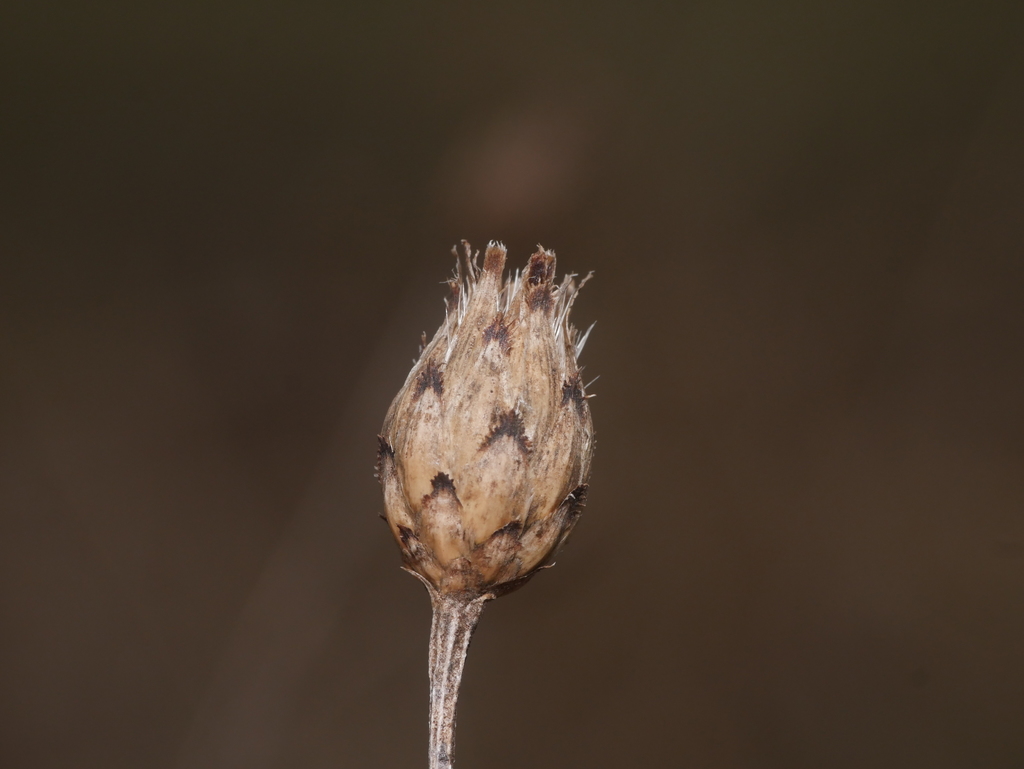
(c) Alexis Tinker-Tsavalas, some rights reserved (CC BY), uploaded by Alexis Tinker-Tsavalas · licence
Family: Asteraceae · Type: Herb · Not Native
Conservation status: Cal-IPC Yes
Centaurea stoebe subsp. australis (Spotted knapweed) is a non-native California herb in the Asteraceae family, recognized by dark brown-purple spotted phyllary appendages and radiant heads.
Spotted knapweed is a naturalized perennial herb found in northwestern California, the Cascade Range, Sierra Nevada, northern Sacramento Valley, northern Coast Ranges, Transverse Ranges, southern Peninsular Ranges, Modoc Plateau, and northern eastern Sierra Nevada in disturbed areas at elevations below 2,600 meters. Flowering from July to September, this plant produces pink or purple flowers (occasionally white) with distinctive dark brown-purple to black-tipped involucre bracts in radiant heads. Growing 30 to 100 centimeters tall with multiple stems that branch distally and are thinly covered in soft hairs, it has a complex branching structure. Its leaves are short-stiff hairy and resin-dotted, with lower leaves 10 to 15 centimeters long and deeply 1 to 2 times lobed, while upper leaves tend to be entire or minimally lobed. The fruit is 3 to 3.5 millimeters long, pale brown, and finely hairy with white pappus bristles.
Identification and appearance
Key characters: 15 sympatric species; dark brown-purple spotted phyllary appendages and radiant heads are diagnostic
Habitat and range
Habitat: Disturbed areas
Elevation: < 2600 m
California counties: San Bernardino, Modoc, Lassen, Siskiyou, Monterey, Butte, Mono, San Mateo, Shasta, Plumas, Mariposa, Placer, Fresno, Sonoma, Mendocino, Trinity, Los Angeles, Santa Barbara, Ventura, San Diego, Nevada, Alpine, Madera
Outside California: native to Europe
Bloom period
Centaurea stoebe subsp. australis blooms Jul-Sep.
Conservation status
Cal-IPC Yes
How to tell it apart
vs Cirsium: Cirsium bracts taper to simple spines; Centaurea bract tips expanded with fringed/toothed edges; vs Carduus: Carduus bracts spine-tipped but not fringed; Centaurea bract appendages distinctly fringed or toothed; vs Jacobaea: Jacobaea has obvious yellow ray flowers; Centaurea lacks true rays (all tubular flowers); vs Silybum: Silybum has white-veined leaves and simple spine-tipped bracts; Centaurea bracts ornately fringed; vs Eriophorum: Eriophorum is a sedge with grass-like leaves and cottony heads; Centaurea is a branched herb
Frequently asked questions
Is Centaurea stoebe subsp. australis native to California?
No. Centaurea stoebe subsp. australis is not native to California (recorded as not native).
When does Centaurea stoebe subsp. australis bloom?
Centaurea stoebe subsp. australis blooms Jul-Sep.
Where in California does Centaurea stoebe subsp. australis grow?
Centaurea stoebe subsp. australis occurs in San Bernardino, Modoc, Lassen, Siskiyou, Monterey, Butte, Mono, San Mateo and other counties, at elevations of < 2600 m.
What plant family does Centaurea stoebe subsp. australis belong to?
Centaurea stoebe subsp. australis is in the Asteraceae family, genus Centaurea.
Is Centaurea stoebe subsp. australis invasive in California?
Centaurea stoebe subsp. australis is listed by Cal-IPC with an invasiveness rating of Yes.
Related species
Other California species in the same genus, family, or bioregion.
Sources: Jepson eFlora · Index of California Plant Names · CalPhotos
Last updated 2026-10-07
Data from The California Species Project — 14,000+ California species with verified data from CNPS, CDFW, USFWS, Cal-IPC, and more.