Centaurea sulphurea
Sicilian star-thistle
no rights reserved · CC0
Family: Asteraceae · Type: Herb · Not Native
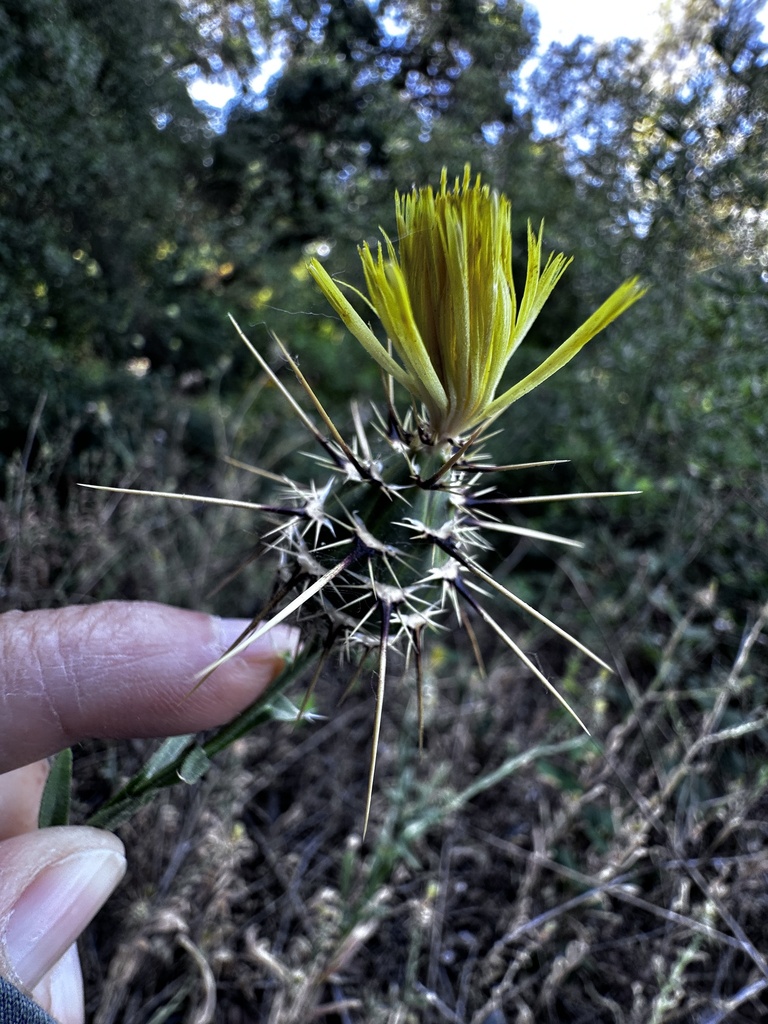
Centaurea sulphurea (Sicilian star-thistle) is a non-native California herb in the Asteraceae family, recognized by larger involucre (2-3cm), larger flowers (25-30mm), and limited Central Valley range distinguish from C. solstitialis.
Sicilian star-thistle is a naturalized annual found in central Sierra Nevada Foothills, central Great Valley, and southern San Francisco Bay Area in disturbed places at elevations below 300 meters. Flowering from May to June, this plant produces yellow flowers with distinctive spiny involucre bracts up to 3 centimeters long, featuring straw-colored or purple-black appendages with sharp tip-spines 10 to 25 millimeters long. Growing 1 to 10 decimeters tall with simple or openly branched stems that are soft-crinkly hairy and winged, it has a distinctive branching structure. Its leaves range from deeply lobed proximal leaves up to 15 centimeters long to entire or spiny-serrate distal leaves that are long-decurrent and puberulent with resin dots. The fruit is approximately 5 millimeters long with dark pappus bristles 6 to 7 millimeters in length.
Identification and appearance
Key characters: 9 sympatric species; larger involucre (2-3cm), larger flowers (25-30mm), and limited Central Valley range distinguish from C. solstitialis
Habitat and range
Habitat: Disturbed places
Elevation: < 300 m
Outside California: native to southwestern Europe
Bloom period
Centaurea sulphurea blooms May-Jun.
How to tell it apart
vs Cirsium: Cirsium bracts taper to simple spines; Centaurea bract tips expanded with fringed/toothed edges; vs Carduus: Carduus bracts spine-tipped but not fringed; Centaurea bract appendages distinctly fringed or toothed; vs Jacobaea: Jacobaea has obvious yellow ray flowers; Centaurea lacks true rays (all tubular flowers); vs Silybum: Silybum has white-veined leaves and simple spine-tipped bracts; Centaurea bracts ornately fringed; vs Eriophorum: Eriophorum is a sedge with grass-like leaves and cottony heads; Centaurea is a branched herb
Frequently asked questions
Is Centaurea sulphurea native to California?
No. Centaurea sulphurea is not native to California (recorded as not native).
When does Centaurea sulphurea bloom?
Centaurea sulphurea blooms May-Jun.
What plant family does Centaurea sulphurea belong to?
Centaurea sulphurea is in the Asteraceae family, genus Centaurea.
What habitat does Centaurea sulphurea grow in?
Centaurea sulphurea grows in Disturbed places.
Related species
Other California species in the same genus, family, or bioregion.
- Centaurea virgata subsp. squarrosa
- Centaurea benedicta — Blessed thistle
- Centaurea calcitrapa — Purple star-thistle
- Centaurea cineraria — Dusty miller
- Centaurea cyanus — Bachelor's button
- Centaurea diffusa — Diffuse knapweed
- Centromadia fitchii — Spikeweed
- Centromadia parryi — Pappose tarweed
- Centromadia parryi subsp. australis — Southern tarplant
Sources: Jepson eFlora · CalPhotos
Last updated 2026-10-07
Data from The California Species Project — 14,000+ California species with verified data from CNPS, CDFW, USFWS, Cal-IPC, and more.