Centaurium erythraea
European centaury, European Centaury
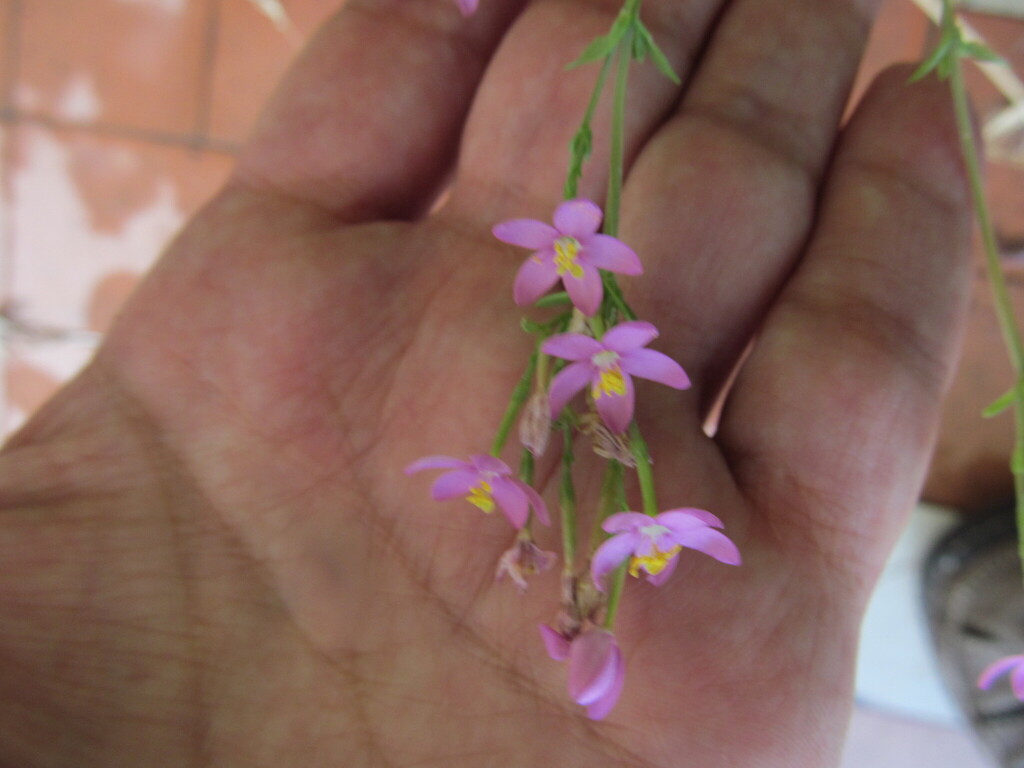
(c) zebedeugalinha, some rights reserved (CC BY) · licence
Family: Gentianaceae · Type: Herb · Not Native
Centaurium erythraea (European centaury) is a non-native California herb in the Gentianaceae family, recognized by larger stature, larger corolla lobes, and rosetted basal leaves.
European centaury is a naturalized annual found in northern coastal California, particularly near Crescent City, Eureka, and Fort Bragg, occurring in fields and roadsides at elevations below 200 meters. Flowering from July to September, this plant produces delicate pink to white flowers with lobes 4.5 to 8 millimeters long in dense, nearly flat-topped clusters. Growing 20 to 60 centimeters tall with upright stems, it develops a distinctive rosette of basal leaves at its base. Its leaves are notable for their varied shapes, with basal leaves 15 to 70 millimeters long, obovate to widely elliptic and rounded, while cauline leaves are 8 to 50 millimeters long, elliptic to lanceolate and pointed. Each flower cluster is characterized by sessile blooms immediately surrounded by two distinctive bracts.
Identification and appearance
Key characters: 1 sympatric species; distinguished by larger stature, larger corolla lobes, and rosetted basal leaves
Habitat and range
Habitat: Fields, roadsides
Elevation: < 200 m
California counties: Del Norte, Mendocino, Calaveras, Fresno, Humboldt, Sonoma, Merced, Santa Cruz
Outside California: to British Columbia, eastern North America, native to Eurasia
Bloom period
Centaurium erythraea blooms Jul-Sep.
How to tell it apart
vs Zeltnera: Centaurium has oval stigmas; Zeltnera has wedge-shaped stigmas (need hand lens).; vs Dianthus: Centaurium has tubular flowers; pinks have notched separate petals.; vs Coleonema: Centaurium is herbaceous; breath-of-heaven is a woody shrub.; vs Eustoma: Centaurium has narrow-tubed flowers; Eustoma has wide bells.; vs Gentianopsis: Centaurium has tiny pink flowers; Gentianopsis has larger fringed petals.
Frequently asked questions
Is Centaurium erythraea native to California?
No. Centaurium erythraea is not native to California (recorded as not native).
When does Centaurium erythraea bloom?
Centaurium erythraea blooms Jul-Sep.
Where in California does Centaurium erythraea grow?
Centaurium erythraea occurs in Del Norte, Mendocino, Calaveras, Fresno, Humboldt, Sonoma, Merced, Santa Cruz, at elevations of < 200 m.
What plant family does Centaurium erythraea belong to?
Centaurium erythraea is in the Gentianaceae family, genus Centaurium.
What habitat does Centaurium erythraea grow in?
Centaurium erythraea grows in Fields, roadsides.
Related species
Other California species in the same genus, family, or bioregion.
Sources: Jepson eFlora · Index of California Plant Names · CalPhotos
Last updated 2026-10-07
Data from The California Species Project — 14,000+ California species with verified data from CNPS, CDFW, USFWS, Cal-IPC, and more.