Centranthus ruber
Red valerian, Red Valerian
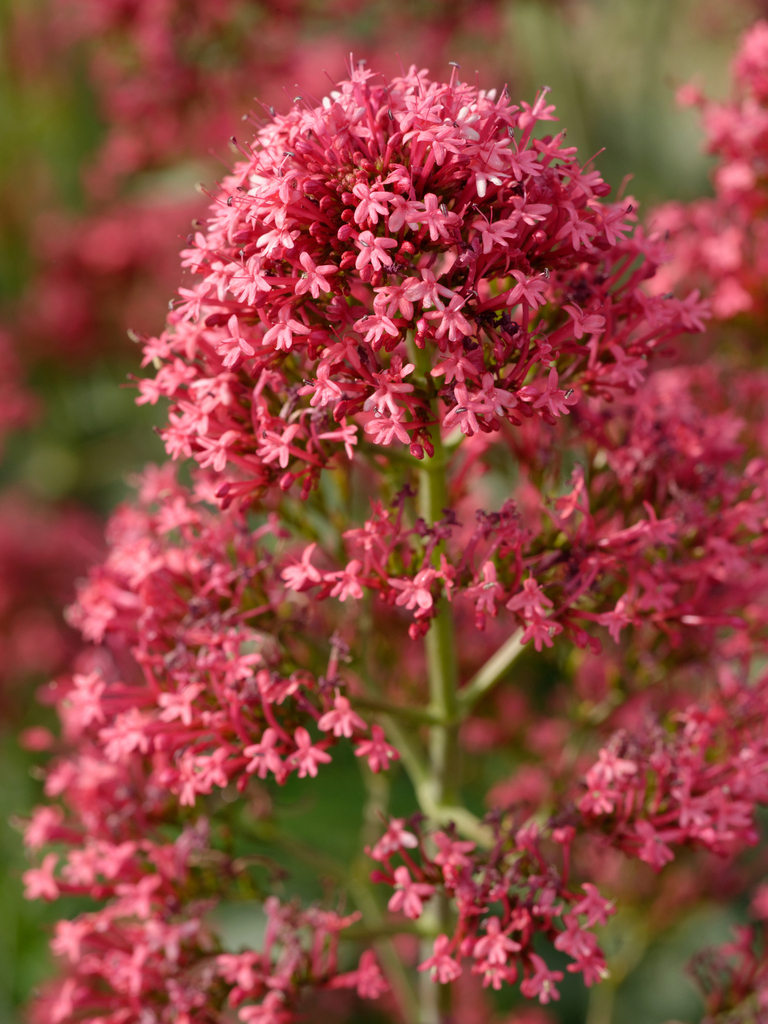
(c) Marie-Lan Nguyen, some rights reserved (CC BY) · licence
Family: Valerianaceae · Type: Subshrub · Not Native
Centranthus ruber (Red valerian) is a non-native California subshrub in the Valerianaceae family, recognized by Mediterranean introduction naturalized in disturbed habitats, differs from native Valeriana by spurred flowers.
Red valerian is a naturalized perennial found in southern coastal, Klamath, North Coast, Sierra Nevada foothill, Central Valley, central coastal, San Francisco Bay, and southwestern California regions in disturbed places, rock or wall crevices, and roadsides at elevations below 1,500 meters. Flowering from April to July, this plant produces purple-red, occasionally lavender or white flowers with a distinctive 3 to 6 millimeter spur. Growing with decumbent to erect stems 30 to 90 centimeters tall that are hollow and often branched, it has a woody base and a glaucous appearance. Its leaves range from 5 to 8 centimeters long, with widely oblong to lance-elliptic blades that are entire and occasionally lobed at the base, with lower leaves petioled and upper leaves sessile. The glabrous fruit is 3 to 4 millimeters long.
Identification and appearance
Key characters: Mediterranean introduction naturalized in disturbed habitats, differs from native Valeriana by spurred flowers
Habitat and range
Habitat: Disturbed places, rock or wall crevices, roadsides
Elevation: < 1500 m
California counties: Orange, Los Angeles, Monterey, San Mateo, Santa Cruz, Riverside, Yolo, Alameda, San Francisco, San Bernardino, Ventura, Santa Barbara, Santa Clara, Contra Costa, Marin, San Diego, Trinity, Amador, Butte, Sacramento, Humboldt, Mendocino, San Luis Obispo, Napa, Solano
Outside California: native to Mediterranean Europe
Bloom period
Centranthus ruber blooms Apr-Jul.
How to tell it apart
vs Valeriana: Centranthus has simple, undivided leaves; Valeriana has fern-like compound leaves.; vs Lagerstroemia: Centranthus has small spurred flowers with 1 stamen; Lagerstroemia has large crinkled petals with many stamens.; vs Achillea: Centranthus has individual spurred flowers; Achillea has tiny flowers packed into flat-topped clusters.; vs Asclepias: Centranthus flowers have a backward spur; Asclepias flowers have a complex crown in the center.; vs Hylotelephium: Centranthus has spurred tubular flowers; Hylotelephium has star-shaped flowers with thick succulent leaves.
Frequently asked questions
Is Centranthus ruber native to California?
No. Centranthus ruber is not native to California (recorded as not native).
When does Centranthus ruber bloom?
Centranthus ruber blooms Apr-Jul.
Where in California does Centranthus ruber grow?
Centranthus ruber occurs in Orange, Los Angeles, Monterey, San Mateo, Santa Cruz, Riverside, Yolo, Alameda and other counties, at elevations of < 1500 m.
What plant family does Centranthus ruber belong to?
Centranthus ruber is in the Valerianaceae family, genus Centranthus.
What habitat does Centranthus ruber grow in?
Centranthus ruber grows in Disturbed places, rock or wall crevices, roadsides.
Related species
Other California species in the same genus, family, or bioregion.
Sources: Jepson eFlora · Index of California Plant Names · CalPhotos
Last updated 2026-10-07
Data from The California Species Project — 14,000+ California species with verified data from CNPS, CDFW, USFWS, Cal-IPC, and more.