Cephalanthera austiniae
Phantom orchid
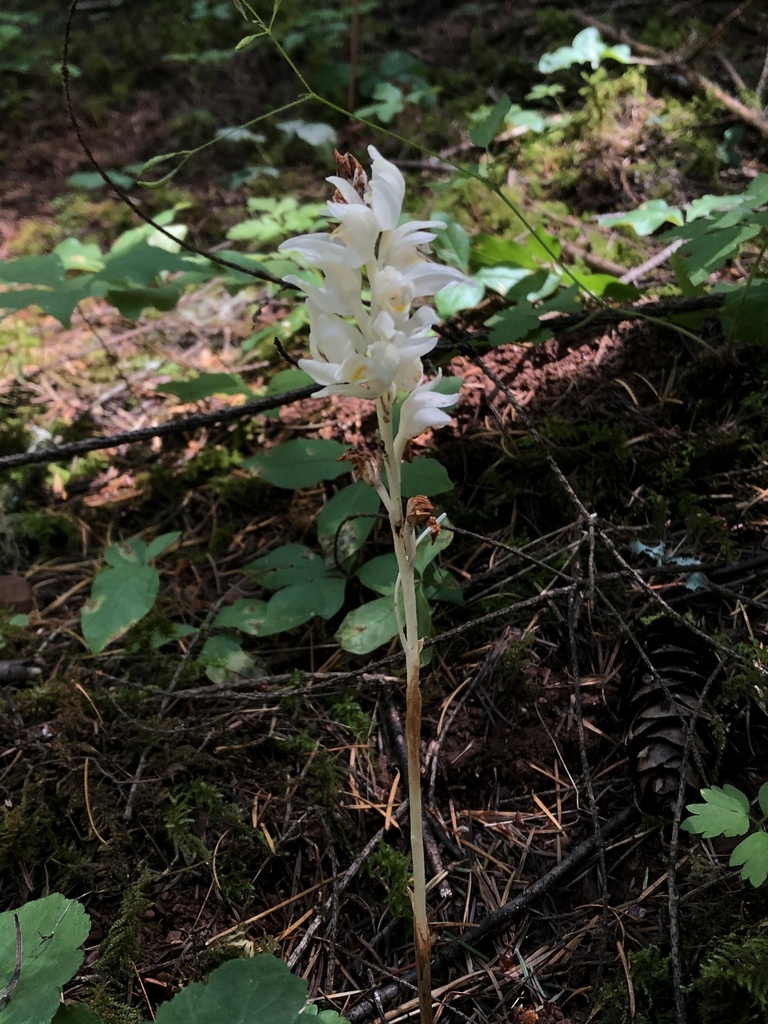
(c) Jared Shorma, some rights reserved (CC BY) · licence
Family: Orchidaceae · Type: Herb · Native
Cephalanthera austiniae (Phantom orchid) is a native California herb in the Orchidaceae family, recognized by Only non-photosynthetic orchid genus in California, mycoheterotrophic forest species.
The phantom orchid is a California native perennial found in northwestern California, the Cascade Range, Sierra Nevada, San Francisco Bay Area, northern southern Coast Ranges, San Bernardino Mountains, and Peninsular Ranges in decomposed litter of rich soil within mixed-evergreen and conifer forests at elevations below 2,200 meters. Flowering from March to July, this plant produces distinctive pure white flowers with delicate, elliptic sepals 12 to 20 millimeters long and a unique lip with a yellow, papillate spot. Growing 20 to 55 centimeters tall, the plant emerges pale white and gradually transitions to yellowish or brownish tones with an elegant, slender profile. Its flowers feature a complex lip that folds lengthwise, with a lower section that is lobed and an upper section that is reflexed, creating an intricate and sculptural appearance. The orchid's column measures 6 to 9 millimeters long, with an anther stalk that is characteristically hinge-like.
Identification and appearance
Key characters: Only non-photosynthetic orchid genus in California, mycoheterotrophic forest species
Habitat and range
Habitat: Decomposed litter of rich soil in mixed-evergreen or conifer forest
Elevation: < 2200 m
California counties: Humboldt, Butte, Siskiyou, Trinity, Mendocino, Mariposa, Del Norte, Tehama, Sierra, Tulare, Tuolumne, El Dorado, Plumas, Yuba, Glenn, Lake, Fresno, Calaveras, Shasta, Monterey, Colusa, Placer, Santa Barbara, San Diego, Sonoma
Outside California: to British Columbia, Idaho
Bloom period
Cephalanthera austiniae blooms Mar-Jul.
How to tell it apart
vs Spiranthes: Cephalanthera starts pure white aging yellow/brown; Spiranthes has green stem with white flowers in spiral.; vs Corallorhiza: Cephalanthera is brilliant white aging yellow; Corallorhiza shows brown/pink/purple/red tones from start.; vs Piperia: Cephalanthera is entirely white/pale throughout; Piperia has green stems when leafless and flowering.
Frequently asked questions
Is Cephalanthera austiniae native to California?
Yes. Cephalanthera austiniae is native to California (recorded as native).
When does Cephalanthera austiniae bloom?
Cephalanthera austiniae blooms Mar-Jul.
Where in California does Cephalanthera austiniae grow?
Cephalanthera austiniae occurs in Humboldt, Butte, Siskiyou, Trinity, Mendocino, Mariposa, Del Norte, Tehama and other counties, at elevations of < 2200 m.
What plant family does Cephalanthera austiniae belong to?
Cephalanthera austiniae is in the Orchidaceae family, genus Cephalanthera.
What habitat does Cephalanthera austiniae grow in?
Cephalanthera austiniae grows in Decomposed litter of rich soil in mixed-evergreen or conifer forest.
Related species
Other California species in the same genus, family, or bioregion.
Sources: Jepson eFlora · Index of California Plant Names · CalPhotos
Last updated 2026-10-07
Data from The California Species Project — 14,000+ California species with verified data from CNPS, CDFW, USFWS, Cal-IPC, and more.