Cephalanthus occidentalis
California button willow, California Button Willow
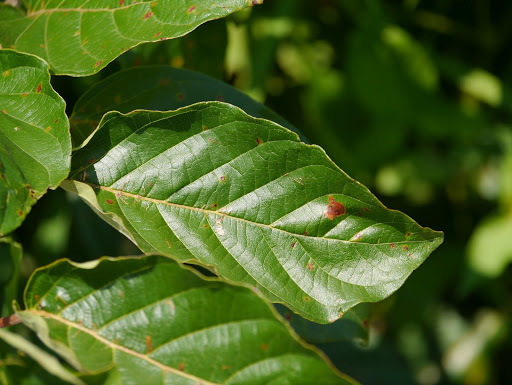
(c) 116916927065934112165, some rights reserved (CC BY), uploaded by 116916927065934112165 · licence
Family: Rubiaceae · Type: Shrub / Tree · Native
Cephalanthus occidentalis (California button willow) is a native California shrub / tree in the Rubiaceae family, recognized by Only native member of coffee family with spherical flower heads in California's wetland habitats.
California button willow is a native shrub found in the southeastern Klamath Ranges, northern Coast Ranges, Sierra Nevada Foothills, central Sierra Nevada, and Central Valley in lake and stream edge habitats at elevations below 1,000 meters. Flowering from May to September, this plant produces white to nearly yellow flowers in dense, spherical heads about 3 to 3.5 centimeters wide. Growing 2 to 10 meters tall with young stems that are round and slightly reddish, it develops a striking architectural form with smooth branches. Its leaves are large and elegant, measuring 7 to 20 centimeters long, elliptical to ovate, with smooth surfaces that become glabrous as they mature. The long, slender flower tubes and exserted stigmas give this shrub a distinctive appearance in wet, riparian environments.
Identification and appearance
Key characters: Only native member of coffee family with spherical flower heads in California's wetland habitats
Habitat and range
Habitat: Lake, stream edges
Elevation: < 1000 m
California counties: Butte, Tulare, Kern, Shasta, Tuolumne, Mariposa, El Dorado, Nevada, Merced, Lake, Sutter, Solano, San Joaquin, Tehama, Amador, Calaveras, Kings, Madera, Sacramento, Stanislaus, Trinity, Contra Costa, Fresno, Monterey, Napa, Placer, Colusa, Yolo, Humboldt
Outside California: Arizona, eastern North America, Mexico, Central America
Bloom period
Cephalanthus occidentalis blooms May-Sep.
How to tell it apart
vs Lonicera: Cephalanthus has perfectly spherical flower heads; honeysuckle has tubular flowers in pairs or whorls along the stem.; vs Calycanthus: Cephalanthus has tiny flowers in dense spherical heads; Calycanthus has large solitary flowers with many petals.; vs Cornus: Cephalanthus has perfectly round white flower balls; dogwood has flat-topped or head-like clusters, often with large white bracts.; vs Diodia: Cephalanthus is a woody shrub with spherical flower heads; Diodia is an herb with flowers in leaf axils.; vs Kelloggia: Cephalanthus forms dense spherical heads of 50+ flowers; Kelloggia has small loose clusters of a few flowers.
Frequently asked questions
Is Cephalanthus occidentalis native to California?
Yes. Cephalanthus occidentalis is native to California (recorded as native).
When does Cephalanthus occidentalis bloom?
Cephalanthus occidentalis blooms May-Sep.
Where in California does Cephalanthus occidentalis grow?
Cephalanthus occidentalis occurs in Butte, Tulare, Kern, Shasta, Tuolumne, Mariposa, El Dorado, Nevada and other counties, at elevations of < 1000 m.
What plant family does Cephalanthus occidentalis belong to?
Cephalanthus occidentalis is in the Rubiaceae family, genus Cephalanthus.
What habitat does Cephalanthus occidentalis grow in?
Cephalanthus occidentalis grows in Lake, stream edges.
Related species
Other California species in the same genus, family, or bioregion.
Sources: Jepson eFlora · Index of California Plant Names · CalPhotos
Last updated 2026-10-07
Data from The California Species Project — 14,000+ California species with verified data from CNPS, CDFW, USFWS, Cal-IPC, and more.