Cerastium glomeratum
Sticky mouse-ear chickweed, Sticky Mouse-Ear Chickweed
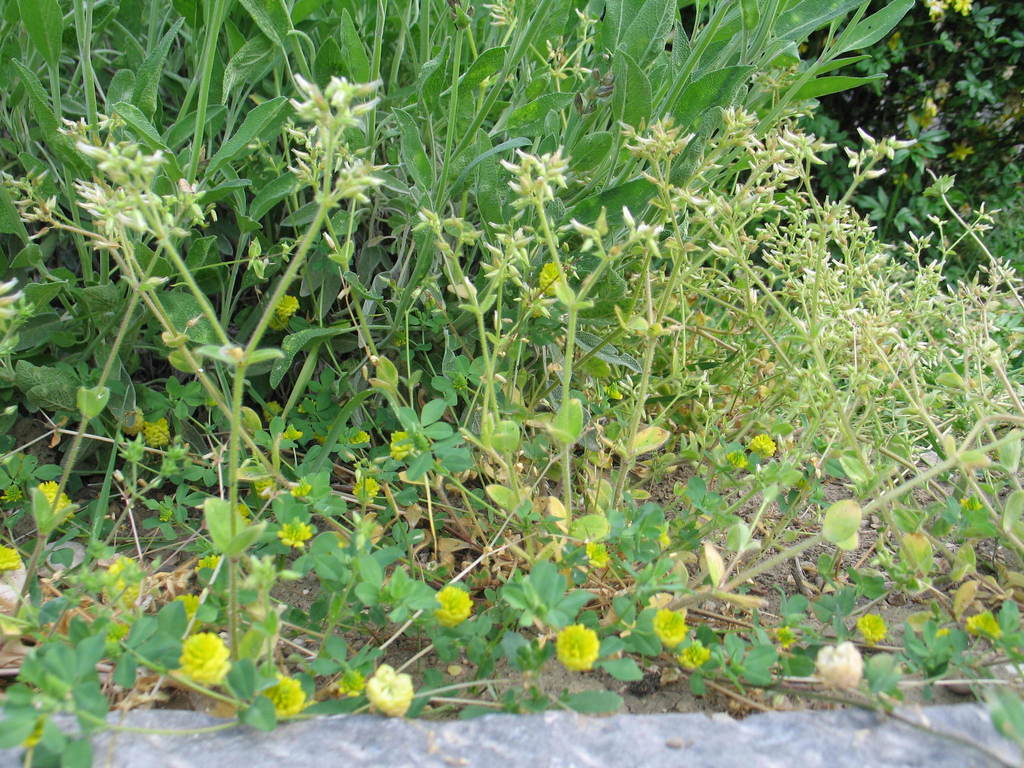
(c) Flora_DUMO, some rights reserved (CC BY), uploaded by Flora_DUMO · licence
Family: Caryophyllaceae · Type: Herb · Not Native
Cerastium glomeratum (Sticky mouse-ear chickweed) is a non-native California herb in the Caryophyllaceae family, recognized by glandular hairs and short pedicels.
Sticky mouse-ear chickweed is a naturalized annual found in California Floristic Province (excluding southern Sierra Nevada), Modoc Plateau, and Desert regions in dry hillsides, grasslands, chaparral, and disturbed areas at elevations below 1,600 meters. Flowering in spring, this plant produces small white flowers in compact clusters, with delicate petals 3 to 5 millimeters long. Growing 3 to 40 centimeters tall with ascending to erect stems that are notably hairy and somewhat glandular, it spreads easily in disturbed landscapes. Its leaves are lanceolate to ovate, measuring 5 to 35 millimeters long, with a soft, hairy texture that covers both stem and foliage. The fruit develops 3.5 to 8 millimeters long, allowing the plant to readily propagate in open, dry environments.
Identification and appearance
Key characters: 5 sympatric species; distinguished by glandular hairs and short pedicels
Habitat and range
Habitat: dry hillsides, grassland, chaparral, disturbed areas
Elevation: < 1600 m
California counties: Los Angeles, San Luis Obispo, Kern, Contra Costa, San Bernardino, Madera, Napa, Mendocino, Butte, El Dorado, Fresno, Humboldt, Lake, Lassen, Mariposa, Monterey, Orange, Riverside, San Diego, San Francisco, San Mateo, Santa Barbara, Santa Clara, Santa Cruz, Solano, Sonoma, Tulare, Ventura, Yuba, Del Norte, Yolo, Mono, Calaveras, Placer, Amador, San Joaquin, Nevada, Marin, Colusa, Glenn, Merced, Modoc, San Benito, Shasta, Siskiyou, Stanislaus, Alameda, Plumas, Sutter, Tuolumne, Sacramento, Tehama, Trinity, Alpine
Outside California: to Alaska, eastern North America (except +- north-central), native to Europe
Bloom period
Cerastium glomeratum blooms Spring.
How to tell it apart
vs Stellaria: Cerastium capsules are cylindrical and curved; Stellaria capsules are round and straight.; vs Limnanthes: Cerastium has tiny white flowers with cylindrical capsules; Limnanthes has showy bowl-shaped flowers with separate nutlets.; vs Pseudostellaria: Cerastium has fuzzy leaves and curved capsules; Pseudostellaria has smooth leaves and straight capsules.
Frequently asked questions
Is Cerastium glomeratum native to California?
No. Cerastium glomeratum is not native to California (recorded as not native).
When does Cerastium glomeratum bloom?
Cerastium glomeratum blooms Spring.
Where in California does Cerastium glomeratum grow?
Cerastium glomeratum occurs in Los Angeles, San Luis Obispo, Kern, Contra Costa, San Bernardino, Madera, Napa, Mendocino and other counties, at elevations of < 1600 m.
What plant family does Cerastium glomeratum belong to?
Cerastium glomeratum is in the Caryophyllaceae family, genus Cerastium.
What habitat does Cerastium glomeratum grow in?
Cerastium glomeratum grows in dry hillsides, grassland, chaparral, disturbed areas.
Related species
Other California species in the same genus, family, or bioregion.
- Cerastium sp.
- Cerastium viride — Western field mouse-ear chickweed
- Cerastium arvense subsp. strictum — Field mouse-ear chickweed
- Cerastium beeringianum — Bering mouse-ear chickweed
- Cerastium dichotomum — Forked mouse-ear chickweed
- Cerastium diffusum — Dark green mouse-ear chickweed
- Cherleria biflora — Mountain sandwort
- Cherleria sp.
Sources: Jepson eFlora · Index of California Plant Names · CalPhotos
Last updated 2026-10-07
Data from The California Species Project — 14,000+ California species with verified data from CNPS, CDFW, USFWS, Cal-IPC, and more.