Ceratophyllum demersum
Coon's tail
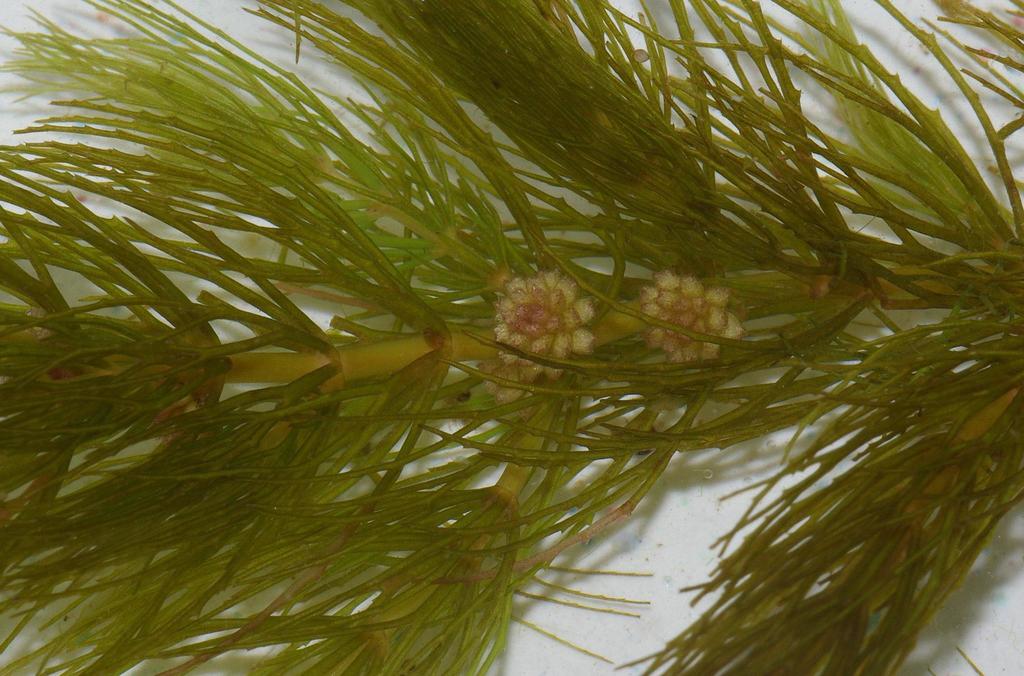
(c) Christian Fischer, some rights reserved (CC BY-SA) · licence
Family: Ceratophyllaceae · Type: Herb · Native
Ceratophyllum demersum (Coon's tail) is a native California herb in the Ceratophyllaceae family, recognized by Ancient aquatic family with unique rootless, free-floating growth form and forked underwater leaves.
Coon's tail is a native perennial found throughout California (except Cascade Range foothills, Tehama, Channel Islands, White and Inyo Mountains, and Desert Mountains) in ditches, lakes, ponds, and slow watercourses at elevations generally below 1,700 meters. Flowering from June to August, this aquatic plant produces tiny pink to red staminate flowers and small yellow to red-tinged pistillate flowers. Growing as a suspended, limp water plant 1 to 3 meters long with brittle branching stems, it forms dense underwater clusters. Its leaves are arranged in whorls of 3 to 11 per node, with delicate, finely toothed segments and small multicellular appendages at the tips. The fruit is dark green to red-brown, 3.5 to 6 millimeters long, with distinctive tubercles and occasionally small spines at the base.
Identification and appearance
Key characters: Ancient aquatic family with unique rootless, free-floating growth form and forked underwater leaves
Habitat and range
Habitat: Common. Ditches, lakes, ponds, pools, slow watercourses; water 0.1--4 m deep, fresh to +- brackish, medium to high nutrient levels, acidic to alkaline (pH 5.9--9.4) but generally alkaline (pH > 7)
Elevation: generally < 1700 m
California counties: Los Angeles, Lake, Monterey, Kern, San Bernardino, Santa Clara, Siskiyou, Riverside, Sonoma, Plumas, Santa Cruz, San Mateo, Contra Costa, Mono, Santa Barbara, San Luis Obispo, Inyo, Imperial, Modoc, San Francisco, Orange, San Joaquin, Mendocino, San Diego, Marin, Butte, Humboldt, Mariposa, Merced, Sierra, Yuba, Lassen, Shasta, Ventura, El Dorado, Sutter, Alameda, Stanislaus, Napa, Sacramento, Colusa, Solano
Outside California: common worldwide
Bloom period
Ceratophyllum demersum blooms Jun-Aug.
How to tell it apart
vs Myriophyllum: Ceratophyllum leaves are forked (repeatedly dichotomous) and stiff-brittle; Myriophyllum (milfoil) leaves are pinnately feather-divided and limp.; vs Cabomba: Ceratophyllum leaves are whorled and forked with tiny marginal teeth; Cabomba (fanwort) submersed leaves are dissected into a flat, fan-shaped array.; vs Elodea: Ceratophyllum leaves fork into thread-like segments; Elodea and Egeria have flat, strap-shaped, undivided leaves in whorls of 3-4.; vs Utricularia: Ceratophyllum bears no bladders and has no roots; Utricularia (bladderwort) has small pea-like bladder traps on its dissected leaves.; vs Chara: Ceratophyllum is a flowering plant with soft forked leaves; Chara (a stonewort alga) is gritty and calcified with a musky smell and whorled branchlets.
Frequently asked questions
Is Ceratophyllum demersum native to California?
Yes. Ceratophyllum demersum is native to California (recorded as native).
When does Ceratophyllum demersum bloom?
Ceratophyllum demersum blooms Jun-Aug.
Where in California does Ceratophyllum demersum grow?
Ceratophyllum demersum occurs in Los Angeles, Lake, Monterey, Kern, San Bernardino, Santa Clara, Siskiyou, Riverside and other counties, at elevations of generally < 1700 m.
What plant family does Ceratophyllum demersum belong to?
Ceratophyllum demersum is in the Ceratophyllaceae family, genus Ceratophyllum.
What habitat does Ceratophyllum demersum grow in?
Ceratophyllum demersum grows in Common. Ditches, lakes, ponds, pools, slow watercourses; water 0.1--4 m deep, fresh to +- brackish, medium to high nutrient levels, acidic to alkaline (pH 5.9--9.4) but generally alkaline (pH > 7).
Related species
Other California species in the same genus, family, or bioregion.
Sources: Jepson eFlora · Index of California Plant Names · CalPhotos
Last updated 2026-10-07
Data from The California Species Project — 14,000+ California species with verified data from CNPS, CDFW, USFWS, Cal-IPC, and more.