Chaenactis carphoclinia
Pebble pincushion
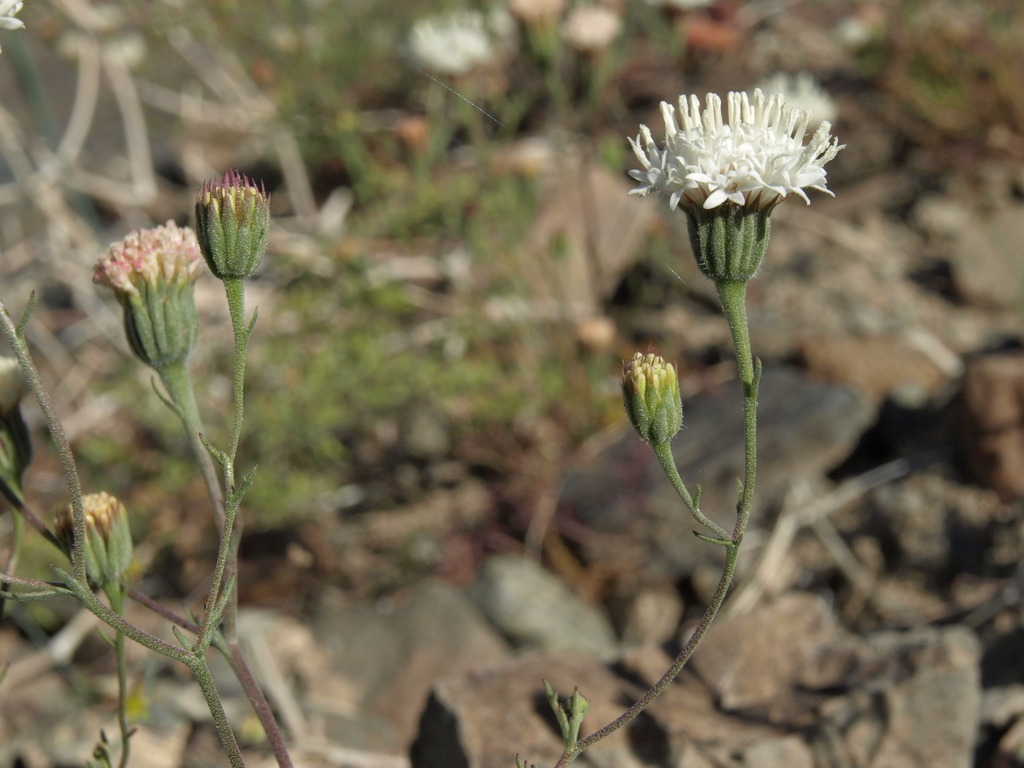
(c) Jim Morefield, some rights reserved (CC BY) · licence
Family: Asteraceae · Type: Herb · Native
Chaenactis carphoclinia (Pebble pincushion) is a native California herb in the Asteraceae family.
Pebble pincushion is a California native annual found in desert regions in rocky or gravelly habitats. Flowering from March to May, this plant produces white to pale pink flowers in small heads with distinctive needle-like phyllary tips. Growing with a single stem branching distally, it reaches 10 to 30 centimeters tall with delicate, finely divided leaves. Its leaf blades are intricately lobed with 2 to 7 pairs of curved, cylindrical leaf segments that give the plant a distinctive feathery appearance. The plant's white powdery hairs and slender, stiff phyllary tips create a unique textural quality in desert landscapes.
How to tell it apart
vs Eriophyllum: Eriophyllum has obvious yellow ray flowers; Chaenactis completely lacks rays; vs Lasthenia: Lasthenia has bright yellow rays; Chaenactis rayless with white/purple tubular flowers only; vs Malacothrix: Malacothrix has all strap-shaped flowers and milky sap; Chaenactis all tubular, clear sap; vs Eriogonum: Eriogonum flowers have 6 segments in ball-like clusters; Chaenactis typical composite heads; vs Uropappus: Uropappus has all strap-shaped yellow flowers; Chaenactis all tubular white/purple flowers
Frequently asked questions
Is Chaenactis carphoclinia native to California?
Yes. Chaenactis carphoclinia is native to California (recorded as native).
What plant family does Chaenactis carphoclinia belong to?
Chaenactis carphoclinia is in the Asteraceae family, genus Chaenactis.
Related species
Other California species in the same genus, family, or bioregion.
- Chaenactis carphoclinia var. carphoclinia — Pebble pincushion
- Chaenactis carphoclinia var. peirsonii — Peirson's pincushion
- Chaenactis douglasii — Chaenactis
- Chaenactis douglasii var. alpina — Alpine dusty-maidens
- Chaenactis douglasii var. douglasii — Dusty-maidens; false yarrow
- Chaenactis fremontii — Fremont pincushion
Sources: Jepson eFlora · Index of California Plant Names · CalPhotos
Last updated 2026-10-07
Data from The California Species Project — 14,000+ California species with verified data from CNPS, CDFW, USFWS, Cal-IPC, and more.