Chaetadelpha wheeleri
Wheeler's dune-broom, Wheeler's Dune-Broom
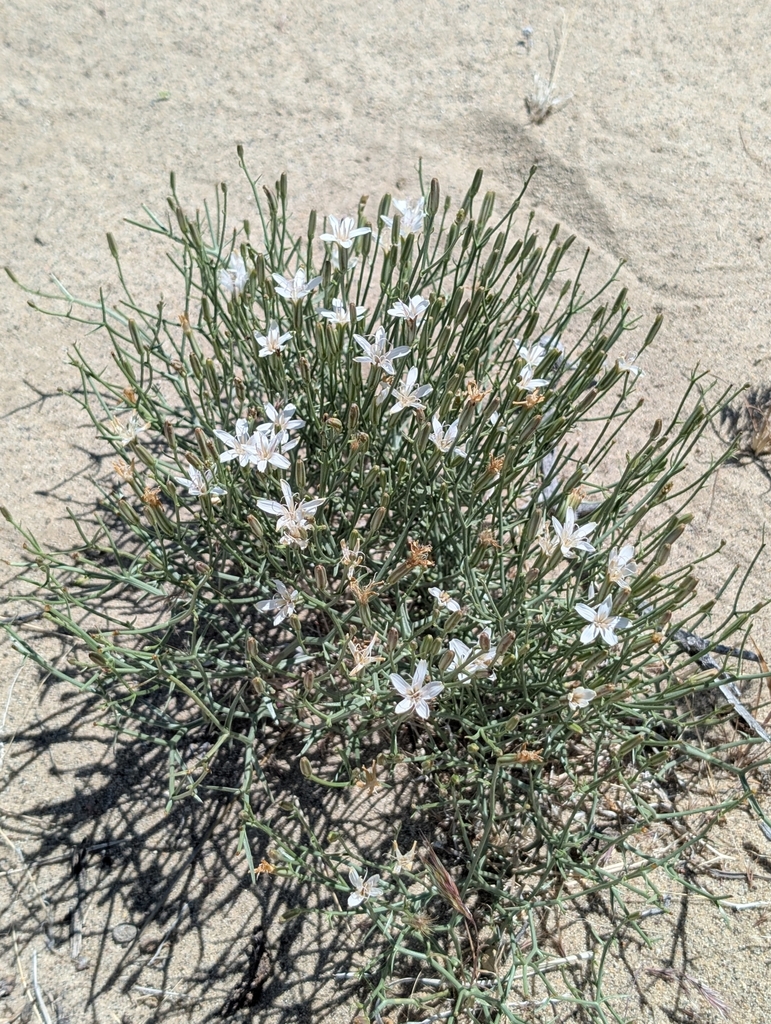
(c) sdash, some rights reserved (CC BY) · licence
Family: Asteraceae · Type: Herb · Native
Conservation status: CNPS 2B.2
Chaetadelpha wheeleri (Wheeler's dune-broom) is a native California herb in the Asteraceae family, recognized by Relict Great Basin genus reaching California at southern range edge in alkaline desert habitats.
Wheeler's dune-broom is a rare (CNPS 2B.2) California native perennial found in the northern Mojave Desert and southern eastern California deserts in sand dunes, alkali flats, and creosote-bush scrub at elevations of 800 to 1,800 meters. Flowering from May to September, this plant produces pale lavender to white flowers in narrow heads approximately 11 to 14 millimeters long. Growing with multiple ascending to erect stems 15 to 40 centimeters tall that are much-branched and originating from a stout rhizome, it forms a distinctive clumping habit. Its leaves are linear to lance-linear, with basal leaves 1 to 5 centimeters long and often withering during flowering, creating a sparse, open architectural form. The fruit is a light tan cylindric structure 8 to 12 millimeters long, topped with a distinctive pappus of 5 stiff awns and numerous shorter bristles.
Identification and appearance
Key characters: Relict Great Basin genus reaching California at southern range edge in alkaline desert habitats
Habitat and range
Habitat: Sand dunes, alkali flats, creosote-bush and sagebrush scrub
Elevation: 800-1800 m
Outside California: southeastern Oregon, western Nevada
Bloom period
Chaetadelpha wheeleri blooms May-Sep.
Conservation status
CNPS 2B.2
How to tell it apart
vs Tolpis: Chaetadelpha has pink to white flowers; Tolpis has yellow flowers.; vs Microseris: Chaetadelpha has branched stems with small linear leaves; Microseris has basal leaves and leafless flower stalks.; vs Stebbinsoseris: Chaetadelpha has branched leafy stems and pink flowers; Stebbinsoseris has basal leaves and yellow flowers.; vs Uropappus: Chaetadelpha has much-branched stems and pink flowers; Uropappus has single stems and yellow flowers.; vs Leontodon: Chaetadelpha has branched stems and linear leaves; Leontodon has unbranched stems and lobed basal leaves.
Frequently asked questions
Is Chaetadelpha wheeleri native to California?
Yes. Chaetadelpha wheeleri is native to California (recorded as native).
When does Chaetadelpha wheeleri bloom?
Chaetadelpha wheeleri blooms May-Sep.
What plant family does Chaetadelpha wheeleri belong to?
Chaetadelpha wheeleri is in the Asteraceae family, genus Chaetadelpha.
Is Chaetadelpha wheeleri rare or endangered?
Chaetadelpha wheeleri carries California Rare Plant Rank 2B.2, state rank S2.
What habitat does Chaetadelpha wheeleri grow in?
Chaetadelpha wheeleri grows in Sand dunes, alkali flats, creosote-bush and sagebrush scrub.
Related species
Other California species in the same genus, family, or bioregion.
Sources: Jepson eFlora · CNPS Rare Plant Inventory · Index of California Plant Names · CalPhotos · CDFW CNDDB
Last updated 2026-10-07
Data from The California Species Project — 14,000+ California species with verified data from CNPS, CDFW, USFWS, Cal-IPC, and more.