Chamaebatiaria millefolium
Desertsweet
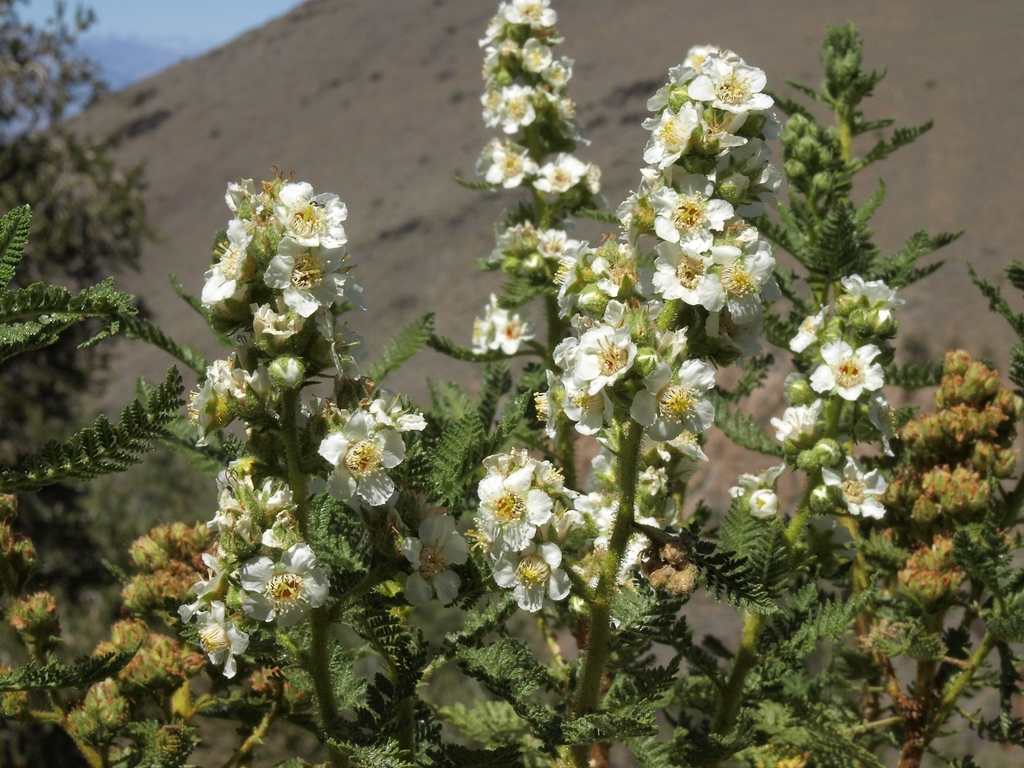
(c) Jim Morefield, some rights reserved (CC BY) · licence
Family: Rosaceae · Type: Shrub · Native
Chamaebatiaria millefolium (Desertsweet) is a native California shrub in the Rosaceae family, recognized by Great Basin endemic rose family member with unique fern-like compound leaves and adaptation to arid conditions.
Desertsweet is a native shrub found in the Klamath Ranges, Cascades, eastern Sierra Nevada, Great Basin, and northeastern desert mountains in dry, rocky sagebrush scrub, pinyon and juniper woodland, and pine forest at elevations of 900 to 3,400 meters. Flowering from June to August, this strongly aromatic shrub produces white flowers approximately 5 millimeters wide in dense panicles or racemes with 20 to 400 individual blossoms. Growing 1.2 to 2 meters tall with a densely branched, evergreen structure covered in stellate hairs, it forms a robust and textured silhouette in its arid habitats. Its distinctive leaves are complex, with odd-pinnately compound arrangement featuring 13 to 25 primary leaflets and 6 to 10 secondary leaflets that are tiny, sessile, and variably entire or toothed. The fruit develops as reddish-brown follicles 3 to 5 millimeters long, containing a few narrow, yellowish seeds.
Identification and appearance
Key characters: Great Basin endemic rose family member with unique fern-like compound leaves and adaptation to arid conditions
Habitat and range
Habitat: Dry, rocky sagebrush scrub, pinyon/juniper woodland, pine forest
Elevation: 900-3400 m
California counties: Mono, Inyo, Siskiyou, Shasta, Modoc, Lassen, Kern, Tulare, Tuolumne, Amador, El Dorado, Butte, San Bernardino
Outside California: to Oregon, southern Idaho, Utah, Arizona
Bloom period
Chamaebatiaria millefolium blooms Jun-Aug.
How to tell it apart
vs Chamaebatia: Chamaebatiaria has less finely divided leaves and pod-like follicles; mountain misery has more segments and single-seeded achenes.; vs Purshia: Chamaebatiaria has pinnately divided fern-like leaves; Purshia has wedge-shaped leaves lobed only at the tip.; vs Luetkea: Chamaebatiaria is an upright shrub; partridge foot forms low mats under 8 inches.; vs Lyonothamnus: Chamaebatiaria is a small shrub with fern-like foliage; Catalina ironwood is a tree with peeling bark.
Frequently asked questions
Is Chamaebatiaria millefolium native to California?
Yes. Chamaebatiaria millefolium is native to California (recorded as native).
When does Chamaebatiaria millefolium bloom?
Chamaebatiaria millefolium blooms Jun-Aug.
Where in California does Chamaebatiaria millefolium grow?
Chamaebatiaria millefolium occurs in Mono, Inyo, Siskiyou, Shasta, Modoc, Lassen, Kern, Tulare and other counties, at elevations of 900-3400 m.
What plant family does Chamaebatiaria millefolium belong to?
Chamaebatiaria millefolium is in the Rosaceae family, genus Chamaebatiaria.
What habitat does Chamaebatiaria millefolium grow in?
Chamaebatiaria millefolium grows in Dry, rocky sagebrush scrub, pinyon/juniper woodland, pine forest.
Related species
Other California species in the same genus, family, or bioregion.
Sources: Jepson eFlora · Index of California Plant Names · CalPhotos
Last updated 2026-10-07
Data from The California Species Project — 14,000+ California species with verified data from CNPS, CDFW, USFWS, Cal-IPC, and more.