Chamaecyparis lawsoniana
Port orford cedar, lawson cypress, Lawson Cypress
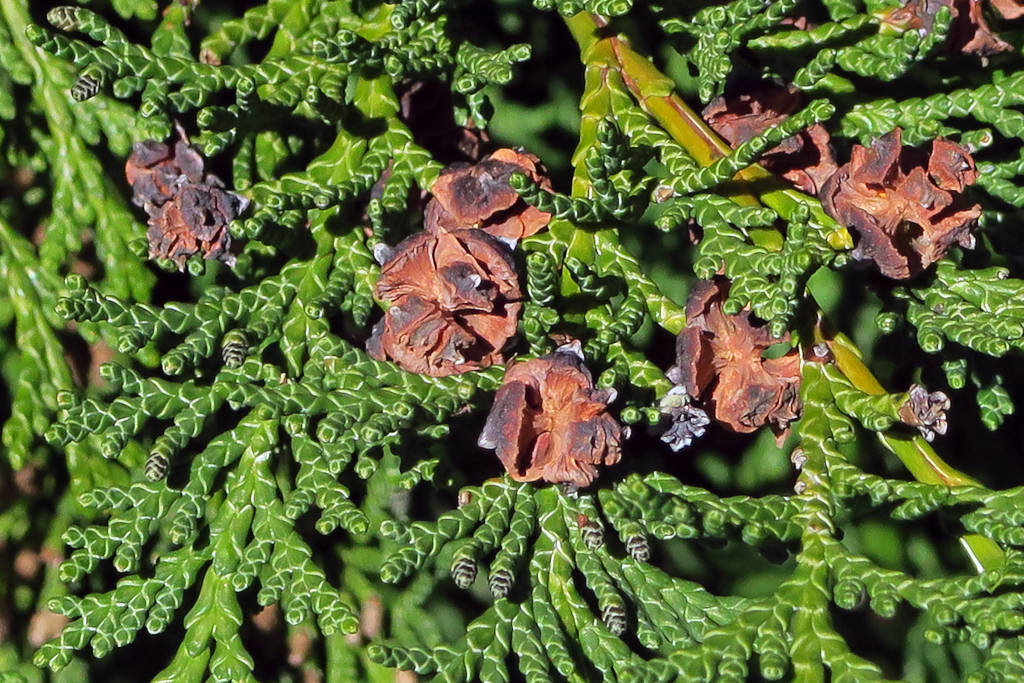
(c) John Rusk, some rights reserved (CC BY) · licence
Family: Cupressaceae · Type: Tree · Native
Chamaecyparis lawsoniana (Port orford cedar) is a native California tree in the Cupressaceae family, recognized by Narrow endemic false cypress of Pacific Northwest coast, restricted to fog belt of far northwestern California.
Port orford cedar is a native tree found in the Klamath Ranges in coastal conifer, mixed-evergreen, and yellow-pine forests, often on serpentine at elevations below 1,700 meters. Producing yellow-green pollen cones that mature to dark red or purple-black, this impressive conifer has distinctive flat shoots held horizontally with lower surfaces often appearing paler. Growing to an immense height of 20 to 65 meters with a trunk potentially 6 meters in diameter, it features a fire-resistant red-brown to tan bark that is 15 to 25 centimeters thick. Its green leaves, often with a glaucous appearance, have lateral tips curved toward the stem axis and generally visible glands. The seed cones are small and spherical, measuring 6 to 11 millimeters across, with 7 to 10 scales containing 2 to 5 light chestnut-brown seeds that typically have distinctive wart-like pitch pockets.
Identification and appearance
Key characters: Narrow endemic false cypress of Pacific Northwest coast, restricted to fog belt of far northwestern California
Habitat and range
Habitat: Coastal conifer, mixed-evergreen, yellow-pine forests, often on serpentine
Elevation: < 1700 m
California counties: Humboldt, Del Norte, El Dorado, Sacramento, Trinity, Shasta, Siskiyou, Marin, Butte, Mendocino, Alameda, San Luis Obispo, Santa Barbara, Santa Clara, Monterey
Outside California: southwestern Oregon
How to tell it apart
vs Thuja: Chamaecyparis has round cones with shield-shaped scales; Thuja has oblong upright cones with overlapping shingle-like scales.; vs Calocedrus: Chamaecyparis has flattened sprays and round cones; Calocedrus has leaves appearing whorled in fours and hanging oblong cones.; vs Sequoia: Chamaecyparis has only scale leaves in flat sprays; Sequoia has flat needles in two rows on most branches.; vs Sequoiadendron: Chamaecyparis has flattened fern-like sprays; Sequoiadendron has rope-like twigs with awl leaves in four rows.; vs Callitropsis: Chamaecyparis has upright or spreading flat sprays; Callitropsis has distinctive drooping, weeping branch tips.
Frequently asked questions
Is Chamaecyparis lawsoniana native to California?
Yes. Chamaecyparis lawsoniana is native to California (recorded as native).
Where in California does Chamaecyparis lawsoniana grow?
Chamaecyparis lawsoniana occurs in Humboldt, Del Norte, El Dorado, Sacramento, Trinity, Shasta, Siskiyou, Marin and other counties, at elevations of < 1700 m.
What plant family does Chamaecyparis lawsoniana belong to?
Chamaecyparis lawsoniana is in the Cupressaceae family, genus Chamaecyparis.
What habitat does Chamaecyparis lawsoniana grow in?
Chamaecyparis lawsoniana grows in Coastal conifer, mixed-evergreen, yellow-pine forests, often on serpentine.
Related species
Other California species in the same genus, family, or bioregion.
Sources: Jepson eFlora · Index of California Plant Names · CalPhotos
Last updated 2026-10-07
Data from The California Species Project — 14,000+ California species with verified data from CNPS, CDFW, USFWS, Cal-IPC, and more.